Trails-less Traveled 3

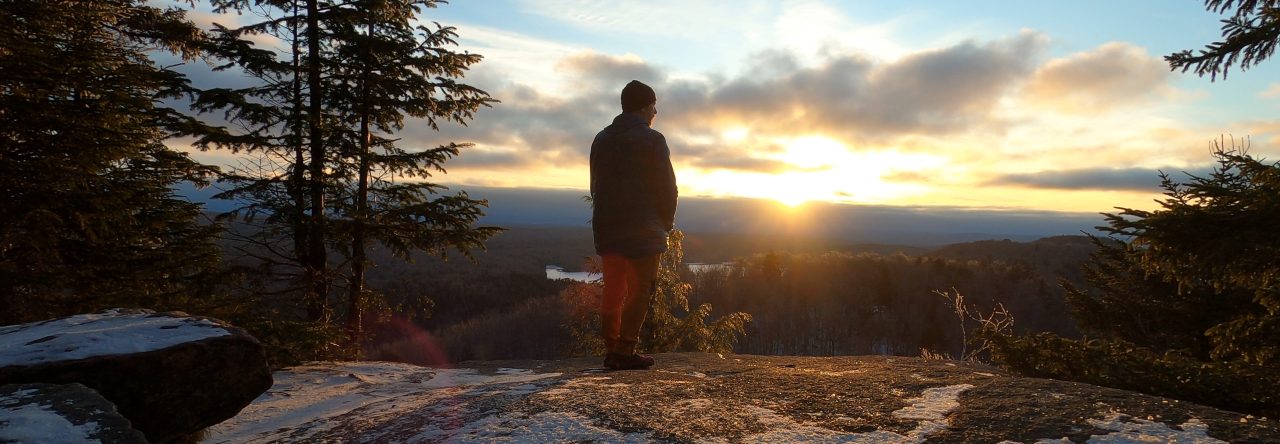
Sunset from Good Luck Cliffs, Arietta NY.

Hike Date: November 12, 2020

Destinations: Sherman Mt, and Good Luck Cliffs
ADK Location: Ferris Lake Wild Forest
Roundtrip Mileage: 8 +/-
Elevation: Sherman (2,641ft), Good Luck (2,151ft.) 
Elevation gain: 1,100 ft. combined.

This was my third trip back to the Chub Lake area. In my previous hikes here I had visited Chub Lake Mt. and North Branch Mt. My plan on this day was to do a bushwhack to Sherman Mt., which sits between Chub Lake Mt. and North Branch Mt, and then, if time allowed, to drive over to do a quick climb up to Good Luck Cliffs, my third visit there this year, and then do a short bushwhack down the north side of the mountain to the Dexter Lake trail.

Some of the amazing rock walls at the base of Chub Lake Mt.

I parked once again at the trailhead for Chub Lake on Rt. 10 in Arietta NY. My plan was to follow the herd path over to the base of Chub Lake Mt. used by hikers and rock climbers, and drop down into the drainage once the herd path turned up the mountain. The drainage was an easy landmark to use with my bearing to Sherman Mt. From the drainage I would drop down a short hill, and then cross a tributary for Chub Lake, see below, another natural feature to help guide the way.
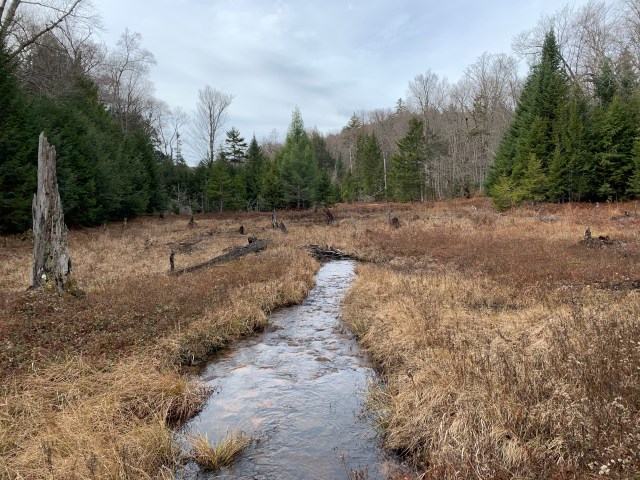
Standing on a beaver dam as I cross the flow between Chub Lake Mt. and Sherman Mt.

As I was nearing my exit from the drainage along the base of Chub Lake Mt., Sherman Mt. came into view. As I checked my bearing, and looked off in the distance, I located a stand of hemlock trees in the area that I had planned to climb to, before turning north to reach the summit.
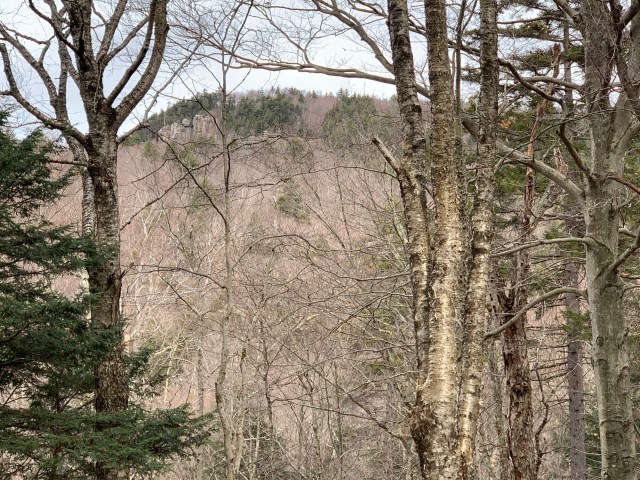
Looking toward the summit of Sherman Mt., Arietta NY.

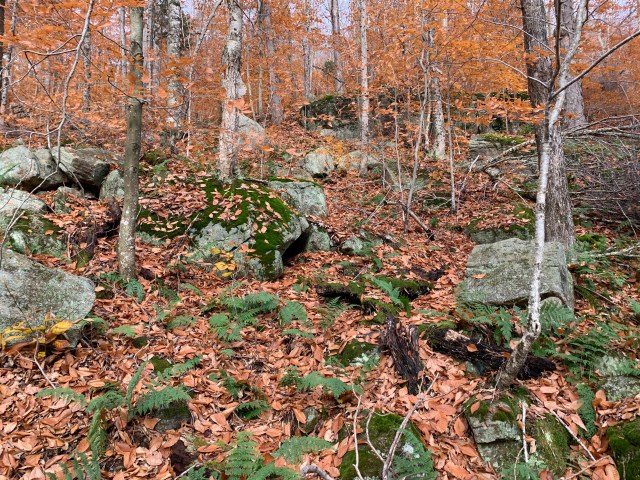
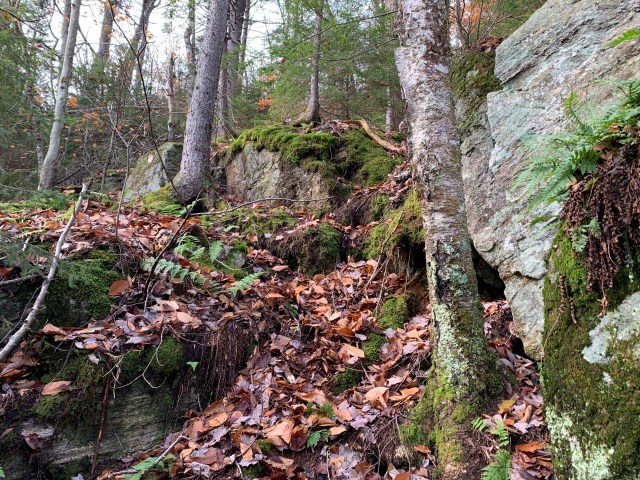
Crossing the tributary between Chub Lake Mt. and Sherman Mt. was quick, and without wet feet! I took note of my exit and entry into the woods, and began to climb Sherman Mt. For the first two or three tenths the climb is gentle, and then the grade increases rapidly. The rock features of this mountain come into view quickly, and provide some nice climbing, or an obstacle to get around, if you do not feel like climbing at the moment.
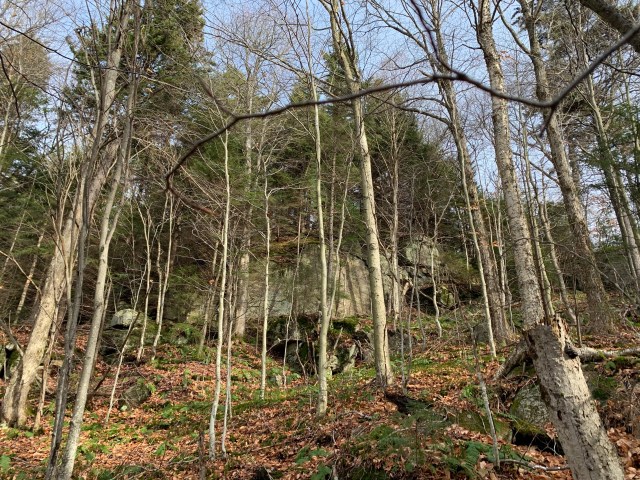
Heading up Sherman Mt.

I arrived at the southern side, the lower side, of the summit exactly where I had planned. I then turned due north and made steady progress to the high point of the mountain. I explored around, descended on the north side to explore some rock formations, and then began to make my way back to my south side exit. While there is no lookout on the summit, there are plenty of breaks in the trees as you wander about to look at the surrounding wilderness.
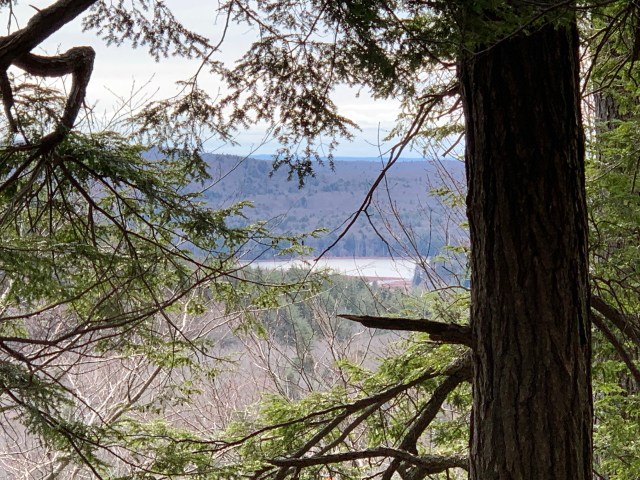
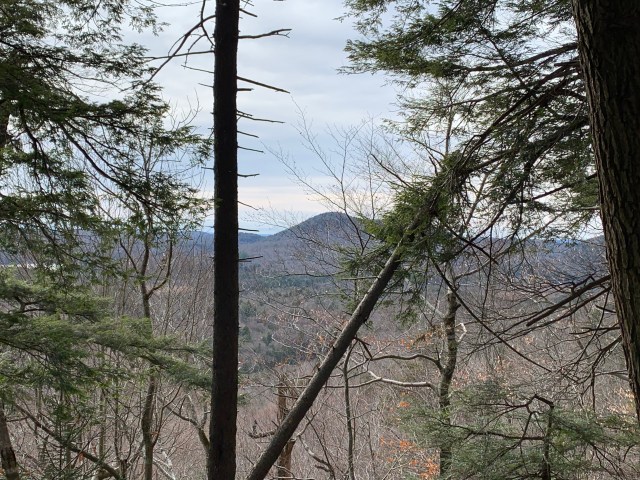
Good Luck Lake across Rt. 10. I would be walking on its shoreline about an hour later.
Good Luck Mt. from Sherman Mt.
Chub Lake Mt. through the trees.

The hike down and back to the trailhead was uneventful. I stopped and had a quick snack as I crossed the tributary once again, see below, up a short hill to the Chub Lake Mt. drainage, and then reconnected with the herd path back to my vehicle.

Another nice spot.

Now to Good Luck Cliffs.

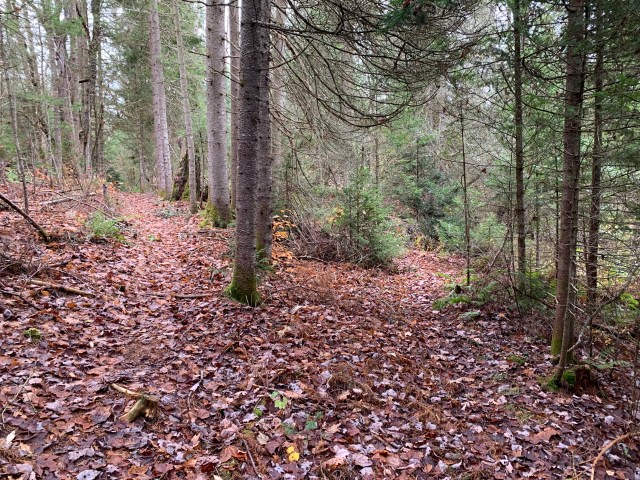
Heading up the trail to Good Luck Cliffs

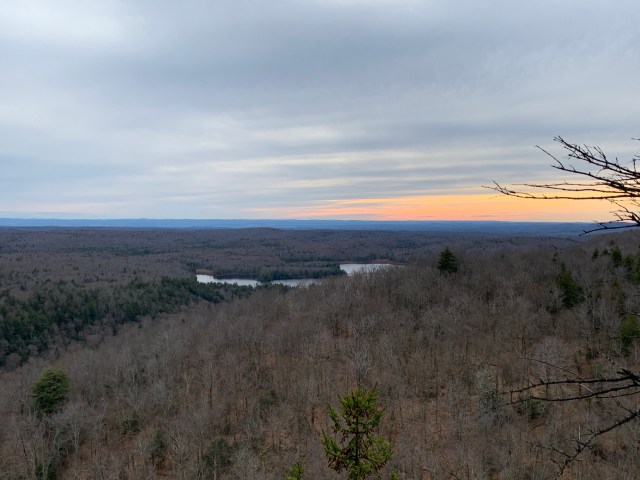
I have hiked the area around Good Luck Cliffs and Lake many times. Because it is so close to my house I will often drive over to trail run, just for something different to do. I had planned earlier in the day to climb up Good Luck Cliffs, descend down the north side, and then hike out to Dry Lake and Dexter Lake. It had been overcast and chilly all day so when I hit the summit I sat down for another snack and decided that I would descend and head home, saving the lakes for another adventure up a neighboring mountain I have yet to climb. As always, the view from the cliffs is excellent. An extra blessing is that I can see our home mountain off in the distance. Snack over. Now to the bushwhack.

The beginning of the bushwhack down Good Luck Cliffs. The trail is before me, just hidden in the trees and only visible on the compass.

Earlier in the day I had taken the bearing to descend from a spot on the trail, just before the summit, that I knew well. This spot would provide a direct route down the mountain, and connect me to the Dexter Lake trail approximately .4 of a mile away. When I hit the trail, by the snowmobile bridge, I would turn right and hike .3 to the trail register before heading the .6 to the vehicle parking.

It was a quick descent. It is here, however, that I will remind you, and me, to always trust your compass – provided that you have used it properly with a map! As I am beginning my descent I look over to a mountain across the way – State Brook Mountain – and I’m thinking to myself, “I don’t think I have to go over that.” Being that I was still at elevation, more or less, the landscape was playing with my eyes. I looked at my compass again, and said, “I know I took the correct bearing, trust the compass.” Of course, as I dropped down, I could now see – and be reminded of what I had observed on the map – I was descending into the valley between the two mountains, just above State Brook. I landed on the Dexter Lake trail exactly where I had planned, even in spite of my earlier momentary hesitation.
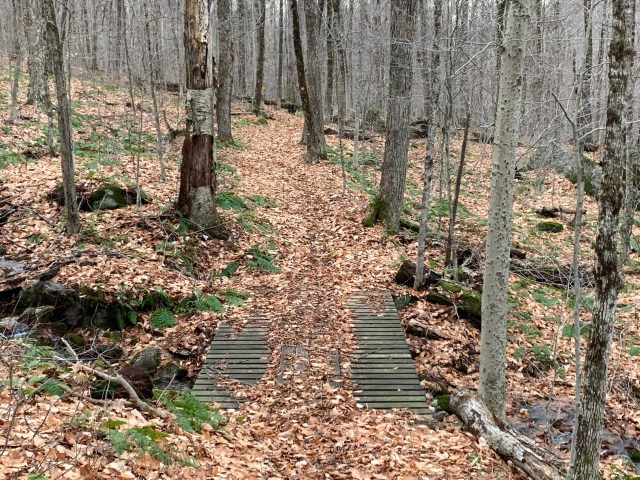
Stepping onto the Dexter Lake Trail, looking toward Dexter Lake.

While this was a much shorter bushwhack than Sherman Mt., it reinforced the importance of proper map and compass use, and application in the field. I walked back to civilization contemplating my trek that day. In my eight mile adventure I only saw one other person, and I was able to have some time of prayer and communion with the Lord. There is also something deeply satisfying about taking a map, finding a landmark or feature, noting that there is no trail, taking a bearing, and traveling there and back again safely with only a compass and map to lead the way. Hard to put into words, but deeply satisfying.

There is a need, on the level of the soul, for a person to go out into the wild places, and reconnect with something pure and natural. The trail, even when there appeared to be no trail, was right there before me. The compass told me where it was, even while I could not see it. It’s a lot like walking by faith, and not by sight.

Be well, Shalom, and happy hiking.

A Lasting Investment

The Song of the Mountains – Verse 42

Teach them well. 

All of us are familiar with the stresses and difficulties of adulthood, not the least of which is financial stress. As a father I have tried to teach financial conservatism by example. Making sure that we save enough, that we consider options before making purchases, and that we measure future considerations appropriately. Most of us desire to ensure that our children can take care of themselves as they leave the nest, and when needed, of course, we help them. Obviously none of us can see the future and adequately prepare for every twist and turn that life has to offer; but you pray that you prepare your children to be as responsible, and equipped as possible for the life that is before them.

The lesson. 

In Matthew 6:19-21 Messiah teaches, “Do not store up for yourselves treasures on earth, where moth and rust destroy and where thieves break in and steal. But store up for yourselves treasures in heaven, where neither moth nor rust destroys and where thieves do not break in or steal. For where your treasure is, there will your heart be also.” 

An important component that must be included in raising children, and the teaching of financial responsibility, is faith. We should teach them to work hard with honesty and integrity in order to support themselves and their families; but that there is a greater treasure to be found in life.

In what do we trust? 

In this lesson, Yeshua/Jesus is teaching us a valuable lesson regarding what we are placing our trust in. Now, He knows that we need financial means to live, and He is not telling us to ignore such concerns. Rather, He is speaking to us regarding treasure that does not tarnish, and cannot be stolen: heavenly treasure.

His disciples. 

One of the first things that we note in our text is this: Yeshua is speaking to us as His disciples, and that we are going to heaven, Amen! Yet, what of the earthly? In our text we find four descriptions of “earthly treasures.”

  1. Possessions: How many of us still own our first television or computer? Many things that we treasured or greatly enjoyed got old, or fell out of fashion with time. The apostle Paul wrote, “Some people, eager for money, have wandered from the faith and pierced themselves with many griefs.” The story is told of a wealthy old man on his death bed, who asked that all of his gold be brought to his bed: jewelry, coins and gold nuggets. He lay on his bed, holding the things that he treasured most, but when he died it slipped from his hands and fell to the ground. 
  2. Earthly Power: Some people have great wealth that brings with it influence over other people, as examples: Jeff Bezos, Bill Gates, Rupert Murdoch or Warren Buffett. Our society highly respects such people, and in many cases, stand in awe of them – but they too will die.
  3. Pleasure: There are many pleasurable things in this life, but some things are taken to excess; yet, pleasures too will end.
  4. Praise: We must be careful not to live for the praise of men, but the praise of God to one day hear, “well done, thy good and faithful servant.” 

Wealth is a blessing, but not the only blessing. 

Scripture has a favorable attitude regarding wealth; as wealth, blessing, and prosperity are an outworking of covenant blessing. Abraham, Isaac, and Jacob were wealthy by the Lord’s design. Job, after being tried, was blessed by the Lord with great wealth once again. Joseph of Arimathea was a wealthy and faithful man, who tended to Yeshua’s body – an act of a disciple. The apostle Paul tells us that there were “not many” wealthy people in the congregation, implying that there were some (I Cor. 1:26). 

However, wealth, and yearning for it, can become a snare. It can lead to a vain attempt to serve both God and money. After a wealthy man refuses to give up his wealth in order to follow Yeshua, He says, “It is easier for a camel to go through the eye of a needle than for a rich man to enter the kingdom of God.” The lingering nature of the old man, with its preoccupation with wealth, can easily influence us to pursue such things under the guise of faith. Paul rightly warns that the “love of money is the root of all kinds of evil” (I Tim. 6:9-10), so it is not money itself that is evil, but the love of it; our treasure leading our hearts in this instance. 

U-Haul?

The bottom line is that earthly treasures and wealth, although not inherently bad, do not last and we cannot take them with us – have you ever seen a U-Haul behind a hearse? Having officiated at many funerals, I have yet to witness such a sight. I recall watching an interview of the chairman of Lehman Brothers back in 2008, the morning after the company collapsed, he was a billionaire the night before and bankrupt the next morning – all while he was sleeping.

Getting to the point. 

So what point am I leading us to? As followers of Messiah, we are not only living for today and the care and concerns of daily life, we must have a mindset of eternity before us as well. There is a poetic verse by Charles Studd that brings this point forward: “Only one life, t’will soon be past; only what’s done for Christ will last.”

Dear reader, where your treasure is, your heart will also be there. Unfortunately, our hearts often follow our currency. The Lord, then, asks us to invest in people, in His Kingdom, both near and far, so that our hearts are always with them, and ultimately, with Him.

The deeds we do in faith, for Messiah, showing care, concern, and love to those around us, both family, friend and stranger, is deposited in our heavenly account from which no one can steal and upon which, no corruption will come. Yeshua asked, “For what will it profit a man if he gains the whole world, and loses his own soul?”

It’s a matter of faith.  

Shalom. Be well.

Trails-less Traveled 2

Along the West Branch Sacandaga River, outside of Arietta, New York, about 2.5 miles in.

Hike Date: October 23, 2020

Destination: North Branch Mountain
ADK Location: Silver Lake Wilderness
Roundtrip Mileage: 10 +/-
Elevation: 2738 ft.
Elevation gain: 888 ft.

As in my previous Trails-less Traveled post, this trailhead is one that I have passed frequently. After my visit to Chub Mountain, I decided to investigate other mountains nearby. As I examined my map I noted Sherman Mt., and North Branch Mountain. While there is a trail that leads in their general direction, neither of these mountains have trails to their summits. A perfect place to fine tune some bushwhacking skills. For those who don’t know, a bushwhack is a means of travel that uses map, compass, GPS, and natural landmarks to navigate to a destination where either there are no trails, or you desire to approach from a different direction.

My original plan was to head directly out to North Branch Mountain, which would require about 1.5 mile bushwhack from the end of the trail at the wetland to reach the summit.

I arrived at the trailhead a little later than expected, around 8:45am. I intended to make up the time delay, and move a bit faster while on trail. The first mile or so of the trail has numerous junctions and offshoots that are not indicated on the map, which shows only one junction. With my compass and map, and using my compass and landmarks, I was able to resolve directional issues rather quickly. Yet, I realized that I would probably only get North Branch Mountain on this day, and would have to leave Sherman for another time, as I had an afternoon appointment at my office before Friday evening Shabbat service. So, North Branch it was.

Two vital tools for any trek, trail or no.

I made steady progress to the terminus of the trail indicated on the map, just on the edge of a wetland area; this wetland area would be my baseline landmark for navigating out and back. When you reach the end of the trail, you can see the beginning of North Branch Mountain off in the distance. With the water level low I was able to keep to one side, and then turn into the woods and begin the bushwhack. With the bearing set on my compass, and seeing the faint tracks of another hiker from the day before, I was heading in the right direction. In about .4 of a mile I began my ascent up the steep side of the mountain.

Beginning the ascent up North Branch Mountain.

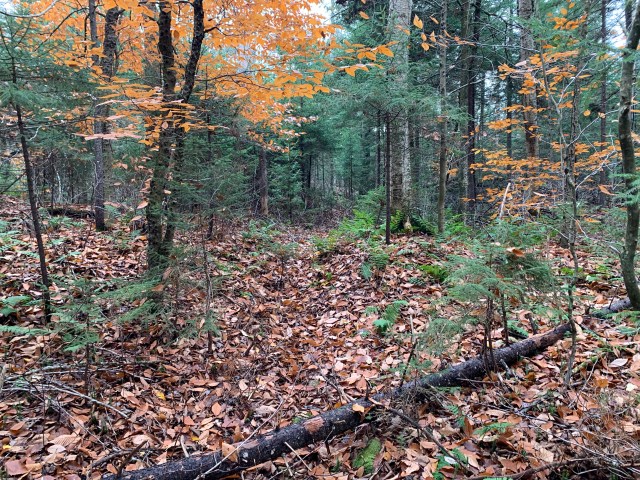
Fallen leaves, on top of wet rocks and mud, can be almost as bad as ice. It had been a rainy week, so the ground was wet. Steady progress up. The summit is wooded, as expected. This trek, however, was not about the views from a summit, but the bushwhack itself. Plotting a course, taking a bearing, identifying landmarks from the map in the field, and safely completing the bushwhack portion of the trek.

An interesting section of North Branch Mountain.

As I descended from the summit I decided to bend toward the draw and follow the drainage down. I knew that this would deliver me about 100 yards from where I began my ascent. Knowing that at the base I would turn right, now following a reverse azimuth, I would begin to listen for the sound of the river that would deliver me back to the wetland where I began my bushwhack.

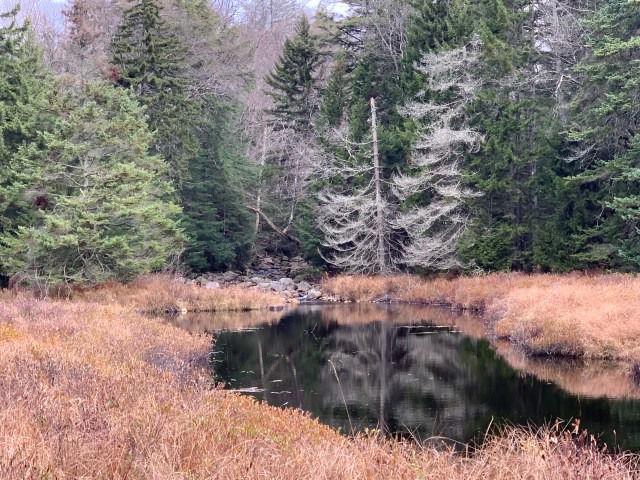
This is the end of the trail on the map. It is the edge of a wetland, which is just ahead.
This is the view about 100 yards from the beginning of the wetland, you can see a shoulder of North Branch Mountain in the distance.

Dialing in map and compass skills, and identifying geographic features and sounds, noting positions, etc., is key to returning safely from a bushwhack. At one point on my way back, having forgotten that the drainage took me further east than I anticipated, I stopped, had a drink and said, “I think I’m lost.” No. Checking my compass, I was right on track. In fact, I was about 50 ft. from the break in the trees that would allow me to walk along the side of the wetland, the exact spot I passed through earlier. Trusting your tools, once you know how to use them, is vital.

A view along the semi-maintained trail.

The way out was relatively uneventful, but enjoyable nonetheless. This was the longest intended bushwhack I had done, about 3 miles total. I took my time heading out, stopping to admire the river, the beaver huts and dams, and have a snack or two.

Overall, an excellent, short hike in an area not heavily trafficked. I plan to visit again to snowshoe, and explore a little further into the wild.

State marker indicated a wilderness area at the trailhead parking area on Rt. 10 just over the bridge out of Arietta NY. You can enter here, and take the trail on the right to the river, but see below.
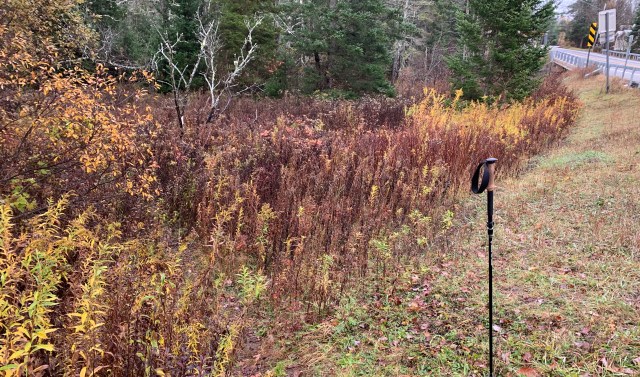
An easier trail to take is at the end of the trailhead parking area toward the bridge. My trekking pole is next to the break in the weeds that begins the footpath.
This is first break in the trail that I was not expecting. Here, you bear left.

Next time, Sherman Mountain.