Many years ago, when I purchased a new iPhone, I seem to recall it being the iPhone X in 2017, I was surprised to discover that it would not sync with my Mac. The new operating system was not backwards compatible. It struck me that, in the faith life, we can face a similar tension. We must be “backwards compatible.” We honor what the Lord has done, remembering His faithfulness, and recognizing the growth rings of our formation (Ps. 77:11), but we must never become “backwards controllable” (Isa. 43:18-19).
This tension is vividly on display in Numbers 11. Israel, though physically free from Egypt, was not yet spiritually or psychologically free. They were no longer following Pharaoh, but neither were they truly following Moses. Instead, they were following their memories. “We remember the fish we ate in Egypt that cost nothing, the cucumbers, the melons, the leeks, the onions, and the garlic” (Num. 11:5) they said, longing not for the Lord’s promise, but for their past comforts. Their desires had rooted them in memory, anchoring them to what the Lord had already called them out of. But they were not being shaped by His presence or the leadership of Moses; they were being hardened by what they refused to release. They had left Egypt, but Egypt had not yet left them.
This reveals something essential about the life of faith, or life in general: we are always being formed by something. The question is not whether we are being shaped, but by what, and by whom.
When Messiah says, “Come, follow Me,” He is not offering a casual invitation to observe Him, but a call to imitate Him. Discipleship is not just the transfer of information; it is the transformation of life. This is why Paul can say, “Imitate me,” (Phil. 3:17) and again, “Imitate me as I imitate Christ,” (1 Cor. 11:1). The disciple does not simply learn the teachings of the rabbi; he adopts his way of life. He walks as his teacher walks. He becomes, in time, a living expression of what he has received: a “living epistle,” read by all (2 Cor. 3:2-3).
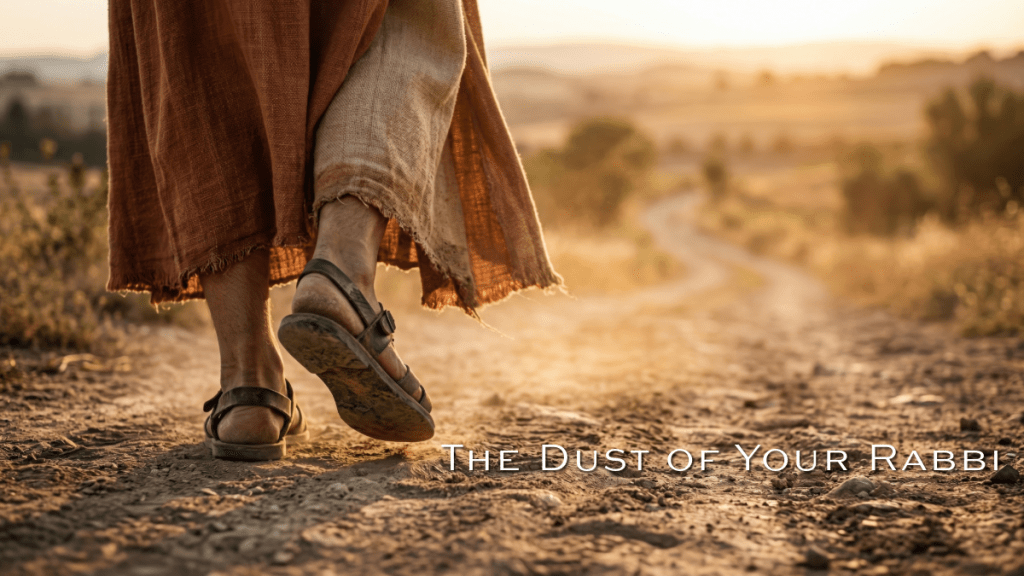
In the ancient Jewish world, this idea was captured in a powerful image: to be a disciple was to be “covered in the dust of your rabbi.” This was no small concept. The sages taught, “cover yourself in the dust of their feet,” a call to walk so closely with your teacher that his life settles upon you (Pirkei Avot 1:4; cf. Lk. 10:39; Acts 4:35; 22:3). In a land of dry, unpaved roads, this was not metaphor alone; it was lived reality. As the rabbi walked, his disciples followed close behind, the dust rising from his steps settled upon them. To be covered in that dust was a sign of proximity, devotion, and formation. You were not simply near your teacher; you were being shaped by him.
This image brings clarity to the warning found in Matthew 10:14, where Yeshua instructs His disciples to shake the dust off their feet when leaving a place that rejects them and their message. In Jewish practice, devout Israelites would sometimes shake the dust from their feet when leaving Gentile lands, a symbolic act of separation from what was considered unclean. Yeshua draws on this imagery, not to cultivate pride, but to teach discernment – not everyone we walk with, nor everything we walk through, should be permitted to have formational influence on us. Influence is never neutral. One must not carry the “dust” of every place into the life of discipleship. The issue is not withdrawal from the world, but awareness of what is shaping us as we move through it.
So the questions must be asked: What dust is covering you? And whose voice is still directing your steps?
For Israel, it was the dust of Egypt: the residue of a life they had physically left but inwardly preserved. For us, it may be the dust of our past, the weight of former identities, the pull of cultural expectations, social convention, or even the subtle influence of misdirected orthodoxy. It is possible to walk with the Lord outwardly while still being inwardly shaped by something or someone else entirely.
This is why discipleship must be intentional. In Hebraic thought, learning is never an end in itself. The root ל-מ-ד (lamad) connects learning and teaching. One learns in order to live, and lives in order to teach. Likewise, the concept of avodah (ע-ב-ד), encompassing both work and worship, reminds us that what we do is inseparable from how we serve the Lord. This is not passive discipleship, but intentional, lived obedience before Him. It is a life lived in response to the One we follow.
This balance is beautifully illustrated in the account of Mary and Martha (Lk. 10:38-42). Too often, they are set against one another: Mary as the spiritual ideal, Martha as a cautionary example of distraction. But this is an unnecessary dichotomy. Martha’s service was an expression of devotion, offered within the cultural framework she understood. Mary, however, stepped beyond those expectations, sitting at the feet of Yeshua, taking the posture of a disciple. Remarkably, Yeshua affirmed her.
The lesson is not that one must choose between being Mary or Martha, but that discipleship requires both. But first we are called to sit at His feet, to be formed, instructed, and covered in His dust, Mary’s “good portion,” and then to rise and serve with lives shaped by that formation. Service without formation becomes hollow; formation without service becomes stagnant: “Martha, Martha, you are anxious and troubled about many things.” But when the two are joined, the result is a life that truly reflects our Rabbi, “You will drink my cup…” (Matt. 20:23).
Israel’s failure in the wilderness was not simply disobedience; it was misdirected formation. They did not walk closely enough with their shepherd to be shaped by him. Instead, they clung to the dust they already carried—they remained “backward controllable.” And so they longed for what the Lord had delivered them from. The voice – and dust – of Pharaoh still directed their steps. We must not make the same mistake.
To follow Messiah is to walk so closely with Him that His life shapes ours as we are covered in His dust (Ro. 8:28-29). It is to allow His words, His ways, and His character to permeate our thinking, our desires, and our actions. It is to be transformed, not by the residue of where we have been, but by the presence of the One we now follow.
The winds of life will always carry dust. Influence is unavoidable. Formation is inevitable. The only question is whether we will be shaped by the dust of our past, or by the dust of our Rabbi.
So walk with Him. Stay near. And let His dust, not the dust of your past, be what forms you.
Maranatha. Shalom.


 the mountain mensch