
Marked by Redemption

Having led and walked with many through the season of Passover, I have often reflected on how redemption is not only something we recall, it is something that leaves its mark upon us. 
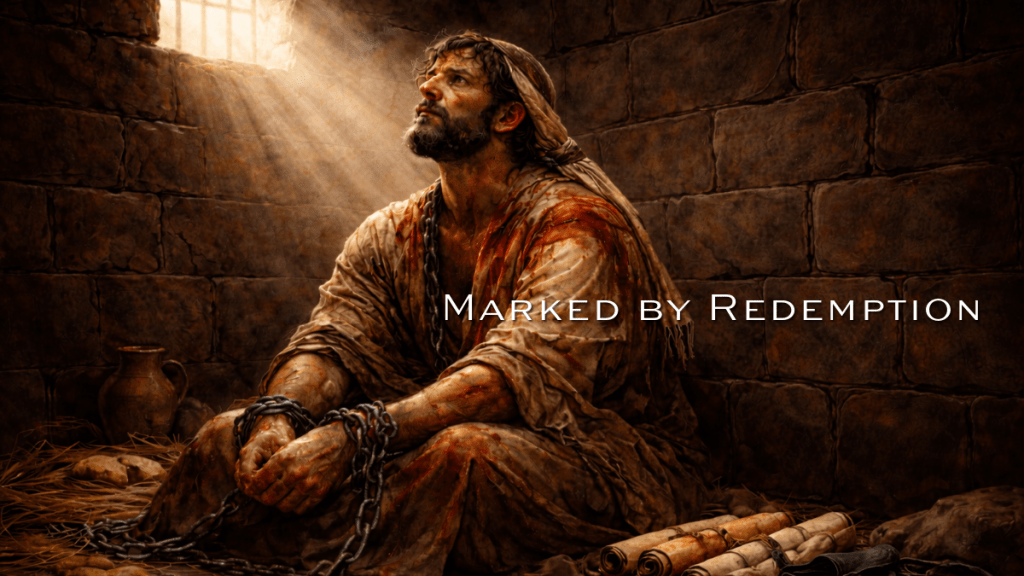
In Exodus 13:9, the Lord commands that the remembrance of deliverance from Egypt shall be “as a sign on your hand and as a memorial between your eyes.” This is no casual metaphor. Redemption is to be bound to the body, to shape thought, action, and speech. It is to be carried.

Over time, this command found tangible expression in the practice of tefillin, or phylacteries, the binding of small leather boxes upon the arm and forehead by religious Jews during prayer. Within them are the very words of Torah, including the account of redemption (Ex. 13:1-10; 13:11-16; Deut. 6:4-9; 11:13-21). The people of Israel quite literally bind the memory of the exodus upon themselves.

And yet, later rabbinic reflection adds a striking layer to this image. Some sages taught that the leather straps of the tefillin, wrapped around the arm and hand, had undergone a symbolic transformation: what once symbolized the whips of Egyptian slavery is now reshaped into the cords of covenantal devotion. The instruments of oppression become the instruments of remembrance and dedication. This is a profound reversal.

What once bound Israel in suffering now binds them in obedience. What once marked them as slaves now marks them as redeemed. Redemption does not erase the past; it redeems it.

The straps that encircle the bicep and arm, traditionally wound down toward the hand and fingers, mirror both memory and mission. The arm: strength, action. The hand: deed, obedience. The head: thought, intention. The whole person is claimed. The whole person is marked. But the story does not end there.

When we turn to Galatians 6:17, we encounter a man who also speaks of being marked. The Apostle Paul writes, “I bear in my body the marks of Jesus.” These are not ritual bindings. These are scars. The risen Messiah still bears His wounds, and those who belong to Him should not be surprised if redemption leaves its mark upon them as well. Beatings. Stonings. Imprisonments. The cost of following and proclaiming Messiah Yeshua. 

Paul does not bind straps upon himself as a remembrance of redemption; his very body has become the testimony.  If Israel bore the sign of deliverance through commanded symbols, Paul bears the sign of redemption through suffering. And yet, both speak the same truth: redemption leaves a mark. It is here that the imagery converges in a powerful way.

The rabbis saw in the leather straps of tefillin a transformation of the whips of Egypt. Paul, too, knew the lash. He knew the rod. He knew the weight of affliction laid upon his body. But in Messiah, even these marks are transformed. What was intended for harm becomes a testimony of belonging, for a man who once rejected the very Messiah he now clings to. What once would have silenced him instead proclaims that he is not his own. The straps and the scars tell the same story.

Both declare: I belong to the One who redeemed me.

In Exodus, the marking is commanded, an act of faithful remembrance. In Galatians, the marking is endured, an act of faithful witness. One is taken up willingly in obedience; the other received through the cost of discipleship. Yet both are bound together by covenant. This invites a searching question. What marks us?

Not just what do we profess, but what do we carry? What has redemption done in us that can be seen, felt, known? For some, the mark may indeed be visible suffering, the cost of faithfulness in a world that resists the claims of Messiah. For others, it may be the quiet but no less real transformation of life: habits reshaped, desires reordered, words redeemed, actions aligned with the will of God. But make no mistake, redemption is never without imprint.

At Passover, we remember that Israel did not leave Egypt unchanged. The blood of the lamb marked their doorposts. The journey marked their identity. The covenant marked their lives. And in Messiah, we, who have been redeemed by a greater deliverance, are likewise marked, not by the absence of hardship, but by the presence of belonging. The question is not whether we are marked. The question is whose mark we bear.

Israel bound the remembrance of redemption upon their minds and arms Paul bore the cost of redemption in his very flesh. And we, too, are called to live as those upon whom the mark of God rests, not superficially, not symbolically alone, but truly and wholly. For those redeemed by the Lamb are never left untouched.

We are marked.

Maranatha. Shalom. 


Losing to Gain

In Philippians 3:4–9, Paul unveils the heart of a disciple. Once proud of his pedigree, his many achievements, and religious fervor, he now counts them as loss, not because they were worthless in themselves, but because they could never measure up to the surpassing worth of knowing Messiah Yeshua/Jesus.

Paul writes, “For His sake I have suffered the loss of all things and count them as rubbish, in order that I may gain Messiah.”

This is no small exchange. Paul relinquishes his identity, his status, and his self-righteousness, not in despair, but in joyful surrender to something greater. He stops striving to be found righteous by religious observance or human credentials, and instead rests in the righteousness that comes by faith.

The challenge for us today is to examine the things we hold as gain — our titles, traditions, successes — and ask whether they draw us closer to Messiah or distract us from Him.

When our worth is rooted in our achievements, we miss the liberating grace found in what Jesus has already done. But when we let go of what had defined us, when we lose to gain, we find the richness of a relationship not earned but freely given (Eph. 2:8-10).

May we, like Paul, be found in Yeshua, pressing on, not because we are perfect, but because we are loved by the One who is, as the Apostle John wrote, “We love because he first loved us” (1 Jn. 4:19). 

Maranatha. Shalom. 

The Deep Valleys of Good

אֲנִי יוֹסֵף, הַעוֹד אָבִי חָי

“I am Joseph! Is my father still alive?” 

In those quiet times of reflection, has the Lord ever shown you a glimpse of a moment in your past that was worked together for good in the present (Ro. 8:28)? When the expected did not happen, or when the unexpected disrupted the course of life? 

 Joseph knew he was to be a ruler, a grand leader that his brothers, mother, and father would bow before. Yet, the Joseph who dreamed the dreams that enraged his brothers, could not discern the deep valleys before him that would lead him to that moment. Still, even then, the young and pompous Joseph could not have imagined that it was not the reverence he wanted, but the reconciliation; it was not honor but an embrace that his heart would desire. 

 Joseph revealed himself by proclaiming: “I am Joseph!” Here is the revelation of a name, but the inquiry about Jacob confirmed Joseph’s identity: “Is my father still alive?” The Torah tells us that the brothers were troubled, more likely nervous, before his face (Gen. 45:3). Joseph knowing his brothers, ceases to be the exalted leader, becomes the caring brother, “And now do not be distressed or angry with yourselves because you sold me here, for God sent me before you to preserve life” (Gen. 45:5; cf. 45:7). 

 When the brothers first appeared before him, Joseph remembered his dreams (Gen. 42:9). It would seem with this realization the Lord began to minister to Joseph’s heart. After all, Joseph named his firstborn son Manasseh, “causing to forget.” He wanted to forget, but the Lord wanted him to remember. Why? 

 Joseph could have killed his guilty brothers without revealing his identity, and then sent Egyptian soldiers to retrieve Jacob. Without question his order would have been carried out. Yet, the Lord ministered remembrance: “Joseph, remember those dreams I sent you.” The power Joseph could have used to destroy for vengeance sake, the Lord used for salvation and reconciliation: “God sent me before you to preserve life.” The long years of separation, and the many years down in the deep valleys of his journey softened Joseph’s heart. By faith, Joseph was able to recognize that while the brothers intended evil, the Lord intended good (Gen. 50:20). 

The remnant the Lord would use to advance redemptive history was preserved (Gen. 45:7). 

 I believe that in our quiet moments the Holy Spirit can show us just how the Lord worked the intended good out of an apparent set back, loss or unexpected change. In my own life, there have been many occasions when I thanked the Lord for not allowing my dream to be realized as I stood in a dimension of that same dream that I did not recognize. 

 Paul the apostle began as an apostle of persecution but was found in his last days as an apostle of the Good News of Messiah Yeshua/Jesus. Paul had every reason to be confident in his flesh, his person (Phil. 3:3). Nevertheless, “whatever gain I had, I counted as loss for the sake of Christ” (Phil. 3:7). Paul was sent by a vengeful high priest but was met on his mission by the resurrected High Priest of heaven. At that glorious moment on the road to Damascus Paul would be sent into a long valley of hardship for the cause of the Gospel. Consider, however, the encouragement Paul gives to us, “I count everything as loss because of the surpassing worth of knowing Christ Jesus my Lord. For His sake I have suffered loss of all things and count them as refuse, in order that I may gain Christ” (Phil. 3:8). 

 Paul was able to see, after years of reflection, that in every twist and turn, with every beating and shipwreck, that the Lord’s hand was gently leading him along the mountaintops with the Good News to announce to those who yearned to hear it. What the enemy intended for evil, the Lord intended for good, even salvation of the lost. 

 Beloved reader, this season is difficult for many. You are not alone in your trial. Joseph was able to see the Lord’s hand working during all his years of trial and heartache. Paul, likewise, witnessed the Lord’s glory even while in the valley. While they both experienced pain, both Joseph and Paul knew that it was not in vain. 

 I leave you this encouragement: “But one thing I do: forgetting what lies behind and straining forward to what lies ahead, I press on toward the goal for the prize of the upward call of God in Christ Jesus.” Amen. 

 Maranatha. Shalom.