
In Leviticus 6:3 we read: “The priest is to put on his linen garment, with his linen undergarments on his body. He is to remove the ashes from where the fire has consumed the burnt offering on the altar and put them beside the altar.”
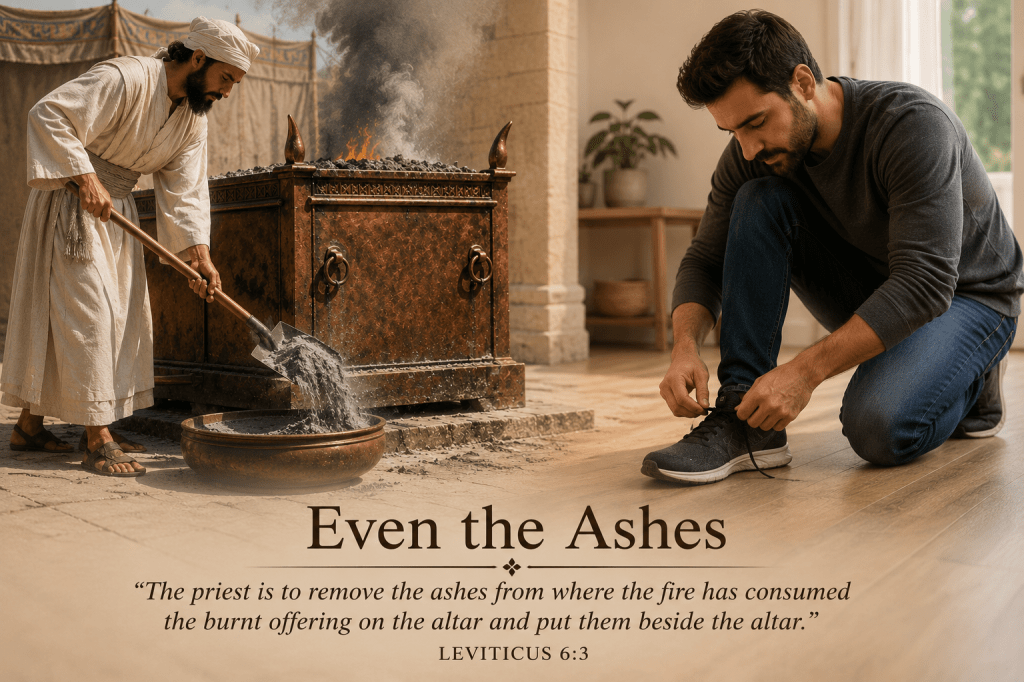
This is an important, even an impressively mundane detail: clean the ash. But as we know from Scripture, there is deep meaning in what is often overlooked.
Most people are familiar with the visible duties of pastoral ministry, yet behind those public expressions exists a multitude of small, seemingly unrelated, and often mundane tasks that quietly sustain the visible work of the pastoral vocation. Even those unseen details, when done in service to the Lord, are holy. The same could, of course, be said for most vocations. Nevertheless, we are all looking for significance, but what if the reminders of it were right before us?
There is a tradition within rabbinic Judaism that one ties the left shoelace before the right. Most of us would probably struggle to believe that the Lord is overly concerned with which shoe we tie first. Perhaps the point is not the shoe itself, but the heart behind the act, and the reminder attached to it.
Biblical faith does not divide life neatly into the “holy” and the “ordinary.” In many other religious systems there is sacred work, and then there is everything else. Yet Scripture presents a different vision. The apostle Paul writes: “And whatever you do in word or deed, do all in the name of the Lord Yeshua, giving thanks to God the Father through Him” (Col. 3:17).
Faithfulness transforms even the smallest act into an offering unto the Lord. Tying a shoe, preparing a meal, cleaning a room, carrying a burden for another person, all of life may become worship when lived with intentionality before Him.
In fact, the act of putting on one’s shoes can be meaningful. In order to tie your shoes, you must first put them on. For the right-handed, the right shoe is put on first, then the left (reversed if left-handed). The custom of tying the left shoelace first was connected to the wrapping of tefillin (phylacteries) upon the left arm. The ordinary act of dressing became a reminder of covenant devotion expressed through the laying of tefillin. Even an insignificant shoelace can call the hearts attention back to the Lord.
This same principle appears in the service of the Tabernacle.
In Leviticus 6:13 the Lord commands that the fire upon the altar was to burn continually. But in order for the fire to keep burning, the ashes had to be removed. Day and night, priests cleared away the remains of what had already been consumed. If you have ever heated with wood or tended to a camp fire, you understand this principle. In the morning service of the Temple, the ashes were placed at the base of the altar. Later, after the priest changes his garments, the ashes were placed outside the precincts of the temple (Lev. 6:10-11).
The Talmud, in Yoma 21a, speaks of a miracle concerning the Golden Altar and the Menorah: “Abaye said: The crop and feathers of sacrificial birds, and the ashes of the inner altar, and the ashes of the candelabrum, which were not removed to the place of ashes outside the Temple like the ashes of the outer altar, were also swallowed in the earth in their places.”
The ashes of the Golden Altar and the Menorah, the remnants of worship, prayer, and light, were received by the earth before the Lord. These “remnants” did not go to waste. Even the remnants belonged to the Lord. This was a miracle few would ever see, but it reminded the serving priests of the sanctity of their work.
The work of sacrifice was not glamorous. It was bloody, smoky, dusty labor. The priests did not casually stand in grandeur before the altar; they cleaned it. They carried ashes. They maintained the fire. Yet not one duty was insignificant.
The Hebrew word often translated “ashes” is דֶּשֶׁן (deshen), a word also connected to richness, fatness, and abundance. It shares the same root as the word “anoint” in Psalm 23:5, “You anoint my head with oil.” In Leviticus 6, these are the “fat ashes,” the remains of what had belonged wholly to the Lord. In the sacrificial system, the fat was the choicest portion. It represented delight, fullness, and offering. After the flames consumed the sacrifice, what remained still belonged to Him. Even the ashes were holy. What we consider remnants, God still claims as His own. Nothing that it His goes to waste.
There is something deeply comforting in that truth. So much of life feels unnoticed, with quiet acts of service disappearing into the routine of daily living. Meals are cooked and forgotten. Floors are swept again and again. Bills are paid. Prayers are whispered. Burdens are carried silently. Many labor faithfully with little recognition. Yet there in the remnant of yesterday’s service, even that which is cleaned away, there is holiness.
The Lord sees the unnoticed faithfulness of His people.
We see this again in the life of Timothy. Timothy was not just an assistant of an apostle. He was a disciple of Paul, entrusted with leadership and pastoral oversight. He was a man of position and prominence. Two epistles bear his name and preserve Paul’s encouragement to persevere in faithfulness. Yet near the end of Paul’s life, we encounter an almost mundane request:
“When you come, bring the cloak which I left with Carpus in Troas, along with the scrolls, and especially the parchments” (2 Tim. 4:13).
Bring my cloak. Bring my books. Bring the parchments. At first glance, it almost sounds beneath Timothy’s calling. But Paul understood something we often forget: there is no act of faithful service that is too small in the Kingdom of God.
Timothy’s errand would warm an imprisoned apostle, preserve the study of the Scriptures, and perhaps help give birth to words that would strengthen generations yet unborn. The Kingdom often advances through simple acts of obedience that seem unimpressive in the moment. Timothy’s assignment was not unlike the priest carrying ashes from the altar: quiet, practical service that nevertheless sustained the work of God.
Someone must carry the ashes. Someone must tend the fire. Someone must cook the food. Someone must bring the cloak and the scrolls. And the Lord, who receives even the ashes of the Golden Altar, does not overlook a single act done faithfully unto Him. The Lord has filled even ordinary things with reminders to lift our daily service unto Him, even the laces of our shoes. Perhaps today the holiest things before you is not a great moment of spiritual triumph, but the quiet faithfulness of carrying ashes and tying your shoes.
Maranatha. Shalom.
 the mountain mensch