
The books of Nehemiah, Ezra, Zechariah, Haggai and Malachi focus on the rebuilding of the Holy Temple and the Jewish people as the first exile ends and the return begins. The prophetic account of returning and rebuilding reminds us that the Lord always finishes what He begins.
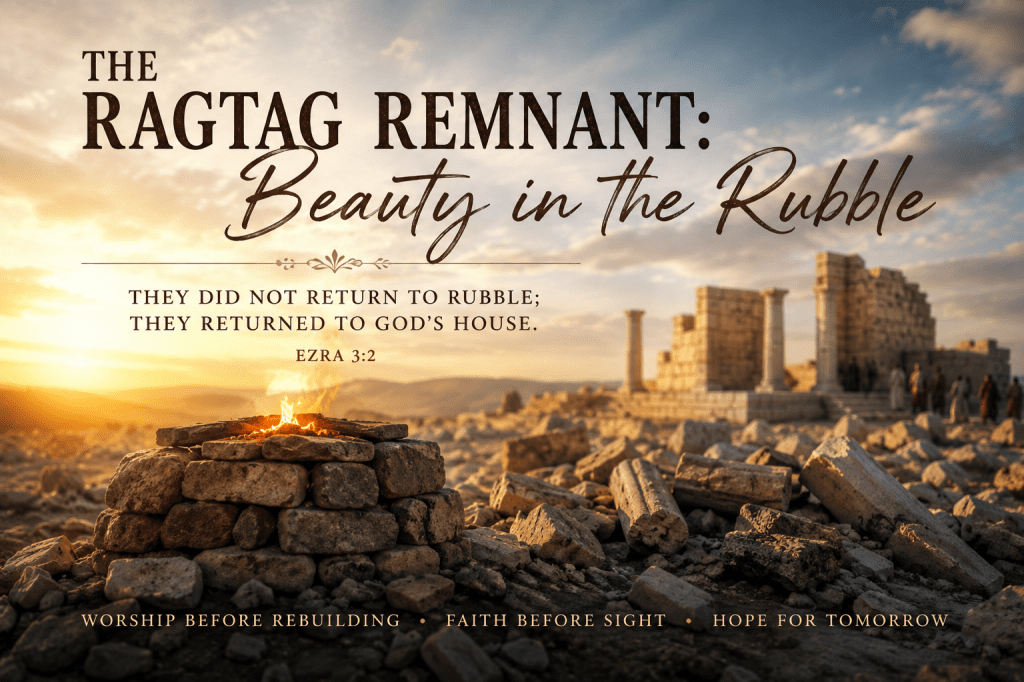
As the Book of Ezra opens, the Lord stirs Cyrus to make a proclamation allowing all the provinces of his kingdom to restore and worship their own gods in their temples.
Cyrus, or Koresh, has been understood to mean “keeper of the furnace,” and if you recall, Isaiah writes of Israel and the judgment leading to their restoration, “Behold, I have refined you, though not as silver. I tested you in a furnace of affliction” (Isa. 48:10).
It is one thing to prophesy the judgment leading to destruction and exile; it’s quite another to name the ruler who would open the way for their return some three hundred (300) years prior to the events depicted in Jeremiah, Ezra and Nehemiah. God names Cyrus. Dear reader, the Lord appointed and named the ruler who would open the way home centuries before Judah entered exile. Before the furnace, the Lord prepared the deliverer (Isa. 44:28).
As Ezra 2 unfolds, those responding to the stirring of the Lord (Ez. 1:5) are accounted for; an accounting that is virtually identical to the one in Nehemiah years later. Why does that matter? Because despite more than twenty years of opposition, setbacks, and discouragement, they endured. It was not pretty, but they completed the rebuilding of the Lord’s House.
It wasn’t a glamorous crowd, this ragtag remnant, perhaps not one that any of us would want to be part of, but they responded to the call to do the Lord’s work, consider the meaning of representative family names in Ezra 2:
“The children of a flea,” the children of the one whom “God has judged,” the children of “the lost, the wayfarer,” the children from the “pit of the father,” the children of the one whom “God saved,” the children of the one who says “Jehovah is Father,” the children of the one “hidden or distant.”
It is as if the Lord is saying: “I build on fleas, upon those whom I have judged, the wayfarers, those delivered out of the pit, the hidden, the unseen, those at the bottom unafraid to join their hands in My work.”
The beautiful lesson of these names is that there is room for all of us, and for everyone to join in His work.
So they set out, and after months of travel, Ezra dedicates one phrase to their journey, “When they arrived at the House of the Lord …” What? That’s it? Yup.
And what did they arrive to? To human eyes, it was nothing more than a heap of rubble. But that’s not how they saw it, they arrived at the House of the Lord. Then some among the leaders gave according to their ability for the work yet to do, and they began to keep the fall feasts.
But first, they built the Lord’s Altar (Ez. 3:2). There were no gates, no outer walls, no foundation, no structure, but they built the Altar. Why?
They arrived at the House not yet seen, and there, in faith, they built the Altar. The rubble was a testimony of past failures, and the Lord’s judgment; but the Altar would speak to His promises, faithfulness, and to the future hope. Worship preceded reconstitution.
As you look to the pages of God’s Book, the Lord’s people built altars in times of crisis, victory, and when they experienced defeat. Altars are places of worship to the Lord expressed through sacrifice, and where those who come before the Lord experience new beginnings (Ro. 12:1). It is a place, where in the face of His magnificent grace, we have an attitude adjustment.
We cannot approach His Altar without believing in Him, desiring Him, and recognizing that He is worth far more than we have to give. He is worth all that we are, all that we will or could hope to be. Yet, by grace through faith He receives us in Messiah (Eph. 2:8-10).
The altar they rebuilt anticipated the perfect sacrifice of Messiah Yeshua, through Whom we now draw near to the Father with confidence.
We are in an age of pressing, surrounded by voices of doubt and frustration. Yet, we cannot leave the work of God – believing in the One He sent – in stalemate: we press on.
As you face your rubble, speak God’s promises to it, just as that returning remnant did. They did not return to a pile of rubble, they returned to God’s House, even in the midst of the rubble.
Place this, dear faithful, in your heart, the words of the apostle Paul, “Things no eye has seen and no ear has heard, that have not entered the heart of mankind – these things God has prepared for those who love Him” (1 Cor. 2:9).
Certainly, in Messiah, the Lord is able to make your latter days greater than your former, as you trust Him (Hag. 2:9). Hallelujah!
Maranatha. Shalom.

 the mountain mensch