How easily we become distracted by pressing circumstances. This is not to say we should make light of the serious matters before us, but such things can so easily divert our attention from the One who is leading us. How does the Lord bring us back to Himself?
The prophet Hosea was given an enormously difficult calling. He was directed by the Lord to marry Gomer, whose life would become a prophetic witness to Israel’s unfaithfulness. Through Hosea’s life, the Lord revealed that His people had gone astray after another בַּעַל (baal), another “master” or “husband,” believing perhaps that someone or something else held the answer to their struggle, pain, or even their boredom.
In one sense, the book of Hosea is utterly unbelievable, yet in another, it is wholly beautiful. The Lord is pursuing His bride, His beloved, whom He will take to Himself in “righteousness, justice, lovingkindness, mercy, and faithfulness,” even though she had gone astray. After reconciliation, He says, וְיָדַעַתְּ אֶת־יְהוָה, “you shall know the Lord” (Hos. 2:20).
As the Lord begins alluring His bride back to Himself, she is led into the Valley of Achor—the Valley of Trouble or Troubling. The path back to the Lord often leads through deep valleys, where the pressures of life seem almost unbearable. Where is He taking us?
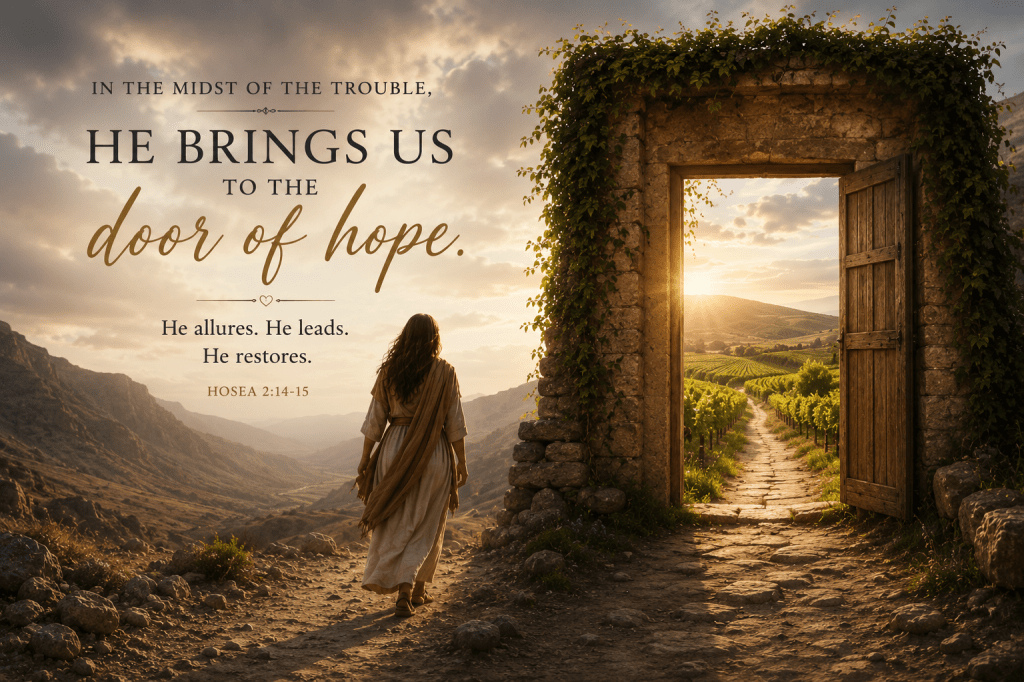
Nearly unbelievably however, it is in the midst of the Valley of Achor—the Valley of Troubling—that we encounter לְפֶתַח תִּקְוָה, “the door of hope.” As we read in Hosea:
“Therefore, behold, I will allure her, will bring her into the wilderness, and speak comfort to her. I will give her back her vineyards from there, and the Valley of Achor as a door of hope; she shall sing there, as in the days of her youth, as in the day when she came up from the land of Egypt” (Hos. 2:14–15).
Translated hope, תִּקְוָה (tiqvah),literally refers to a cord used to attach one thing to another. In the midst of trial, the Lord brings us to the “opening of attachment.” No longer tossed about by the wind and waves, we become fastened to and drawn into His presence.
When we drift because of life’s turbulence, we should not be surprised if we find ourselves in a wilderness—the place where the Lord sets things in order. In the wilderness, as Hosea writes, He speaks comfort. In the vineyards of His people, symbolic of peace and serenity, He restores. And in the deep Valley of Achor, that valley of troubling, we enter the door of hope, much like Israel experienced in the Exodus. When all seemed hopeless, He made a miraculous way through the sea (Heb. 11:29).
Many of us naturally become discouraged while enduring trial, not realizing that in the midst of hardship the Lord is demonstrating His faithfulness to us. At times, the Lord permits us to face great difficulty in order to reveal His overcoming power (Jn. 16:33).
When we go astray and emptiness begins to build within us, the Lord begins to woo us again—speaking tenderly to our hearts and calling us to return to Him.
There are seasons when we find ourselves in that wilderness, when the silence seems deafening, to the point that we feel utterly abandoned. Yet it is often to that very place that the Lord brings us. There, He who is the “door” (Jn. 10:7) rescues us from the troubles surrounding us. He demonstrates His faithfulness in those silent places—not always through words, but through the affection and consolation of the Holy Spirit. Remember: He has covenanted Himself to us in Messiah Yeshua/Jesus, and He will neither leave nor forsake us (Heb. 13:5).
Meditation: Hosea 2:19–20
Maranatha. Shalom.
 the mountain mensch