In the Tomb of a Disciple:The Hope of ResurrectionMatthew 27:57–61

Hope seemed to have ended as Jesus hung dead upon the cross. All of the miracles, signs, wonders, teaching, and personal encounters were now a memory. Yet what seemed an end was only the beginning as the Lord quietly advances the revelation of the Gospel. Matthew’s account of the burial of Yeshua presents a quiet but powerful moment in the Gospel narrative. After the dramatic events of the crucifixion, the scene shifts to a small group of devoted followers who ensure that the body of the Messiah is treated with dignity and honor. What might appear to be a somber conclusion to the story actually reveals deep devotion, divine providence, and the preparation for the greatest triumph in history.

The Gospel of Matthew tells us that a wealthy man from Arimathea named Joseph came forward to claim the body of Jesus (Matthew 27:57–58). Joseph is described as a disciple of Yeshua, though other Gospel accounts clarify that he had previously been a secret disciple (Jn. 19:38). The Gospel of John further records that Joseph was not alone. He was accompanied by Nicodemus, another member of the Jewish leadership (John 19:39). Both men were part of the Sanhedrin, the ruling council in Jerusalem. They were individuals of influence, reputation, and social standing.

Until this moment, their allegiance to Yeshua had remained largely hidden. The political and religious climate surrounding Jesus had become increasingly hostile, making open identification with Him risky. Yet the death of Yeshua becomes the turning point for these men. In an act of courage and devotion, they step forward publicly. The cross scattered the public disciples, but revealed the hidden ones. Joseph goes directly to Pontius Pilate to request the body, showing his prominent position in Jerusalem, while Nicodemus assists in the burial preparations. What had been hidden discipleship becomes visible loyalty. They had the social standing to ensure that the body of Yeshua was laid to rest with dignity, something none of the other disciples were able to do. Their actions demonstrate that true devotion sometimes emerges most clearly in moments of apparent defeat.

Joseph’s tomb itself reveals another dimension of the story. Matthew tells us that Joseph placed the body of Jesus in a new tomb that he had cut in the rock. Such tombs were costly and typically reserved for wealthy families. The location, in a garden near the site of the crucifixion, reflected Joseph’s position and status in society. Yet beyond displaying Joseph’s prestige, the tomb also highlights the sovereign purposes of God.

Matthew also records that Mary Magdalene and “the other Mary” were sitting opposite the tomb, watching where Yeshua was laid (Matt. 27:61). Their presence quietly establishes an important testimony. These women witnessed the burial location firsthand, ensuring that the same tomb that received His body would later be the tomb found empty. Their faithful vigil forms a bridge between the burial and the resurrection morning, reinforcing the reliability of the Gospel account.

Isaiah had foretold centuries earlier that the suffering servant would be associated with the rich in His death (Isa. 53:9). Though the crucifixion itself was the execution reserved for criminals, the burial of Yeshua fulfilled this prophetic detail. Joseph’s status and resources were not accidental; they were providential. The Lord had positioned Joseph in precisely the right place in society so that, at the decisive moment, the prophecy would be fulfilled. Even in what seemed to be the darkest hour—the death of the Messiah—the Lord’s purposes were unfolding exactly as foretold.

Nicodemus’s contribution further emphasizes the honor given to Yeshua in His burial. John records that Nicodemus brought a mixture of myrrh and aloes weighing about seventy-five pounds (Jn. 19:39). This was an extraordinary amount. Even wealthy families normally used only small quantities of such spices when preparing a body for burial. The quantity Nicodemus provided reflects an act of lavish devotion.

In the ancient world, such extravagant burial spices were often reserved for royalty. The Hebrew Scriptures record that kings were buried with large quantities of aromatic spices (2 Chron. 16:14). By bringing this immense amount of myrrh and aloes, Nicodemus effectively treated Yeshua as a king. Though Jesus had been crucified under the charge “King of the Jews,” Nicodemus’s actions silently affirm the truth of that title. Even in death, Yeshua was honored with the care and respect befitting royalty.

At first glance, the sealed tomb appears to mark the end of the story. The stone is rolled into place, and the body of Jesus lies within. For the disciples and followers of Yeshua, the moment must have felt like the final chapter. Yet in the Gospel narrative, the tomb is not the conclusion—it is the preparation for what comes next.

The burial sets the stage for the greatest victory in the history of redemption. The same tomb that holds the body of Yeshua will soon become the place from which resurrection is proclaimed. What appears to be a symbol of death will become the testimony of life. Joseph’s tomb, carved in stone and sealed by human hands, becomes the silent witness to the power of God that will soon raise the Messiah from the grave.

Thus, the burial of Yeshua is not just a historical detail. It reveals courageous discipleship, the meticulous fulfillment of prophecy, and the unfolding of God’s sovereign plan. Even in the stillness of the tomb, the promise of resurrection is already drawing near.

Maranatha. Shalom. 


The Signs of a New Reality

“Truly this was the Son of God!” ~ Matthew 27:54

In Matthew 27:54 the very ones who executed the Messiah, make a profound statement—one that has significant missiological implications—even from the foot of the Cross. 

Matthew’s Gospel records that the death of Messiah Yeshua/Jesus was accompanied by a series of extraordinary, even supernatural signs. These events are not presented as random phenomena but as theological markers announcing that something decisive had occurred in the relationship between God, Israel, and the world. In Matthew 27:51–56, the evangelist recounts the tearing of the Temple veil, an earthquake that split rocks open (cf. Ex. 19:18), the opening of tombs, and the unexpected confession of a Roman centurion. Each of these elements points to the redemptive, cosmic, and missiological significance of the crucifixion.

The first and most striking sign is the tearing of the Temple curtain: “And behold, the curtain of the temple was torn in two, from top to bottom” (Matt. 27:51). The Temple contained multiple curtains, including one that separated the Holy Place from the Holy of Holies. While the text does not explicitly state which curtain was torn, Matthew’s description strongly suggests the inner veil. According to Jewish tradition (m. Shekalim 8:5; cf. m. Yoma 5:1), the veil was immense—approximately forty cubits high and twenty cubits wide (roughly 60’ x 30’), with a thickness of a handbreadth. It functioned as the barrier between the presence of God in the Holy of Holies and the priests who served in the Temple. Only the high priest could pass beyond it, and only once a year on Yom Kippur, the Day of Atonement. 

Matthew emphasizes that the veil was torn “from top to bottom,” indicating that this was an act of God rather than a human action. In Scripture, the tearing of garments often signifies grief or judgment (cf. Matt. 26:65). The tearing of this barrier symbolically declares that the separation between God and humanity has been fundamentally altered through the death of Messiah. In Hebrews, the author interprets this reality explicitly: “Therefore, brothers, since we have confidence to enter the holy places by the blood of Jesus, by the new and living way that he opened for us through the curtain, that is, through his flesh, and since we have a great priest over the house of God, let us draw near with a true heart in full assurance of faith, with our hearts sprinkled clean from an evil conscience and our bodies washed with pure water” (Heb. 10:19–22). In this sense, the torn veil represents the opening of direct access to God through the sacrificial death of Messiah. What the Temple system anticipated through sacrifice and priesthood finds its fulfillment in the Cross.

Some scholars have noted an interesting literary parallel within the Gospel tradition. In Mark’s account of Yeshua’s baptism, the evangelist writes that “the heavens were torn open” (Mark 1:10), using the Greek verb σχίζω (“to tear”). The same verb appears again when the Temple veil is “torn” at the moment of Messiah’s death in Mark 15:38 and Matthew 27:51. The imagery suggests that the ministry of Yeshua begins with heaven opened and culminates with the veil opened. While Matthew does not explicitly frame the narrative in this way, the theological implication remains striking: through the Messiah’s life and death, the barrier between heaven and earth is dramatically opened.

Alongside the tearing of the veil, Matthew records that “the earth shook, and the rocks were split open” (27:51). Earthquakes in biblical literature often signify divine intervention or judgment. The shaking of the earth at the moment of Messiah’s death underscores the cosmic scale of the event. Creation itself responds to the death of its Creator. The splitting of rocks and the opening of tombs further intensify the imagery. Matthew alone records that “many bodies of the saints who had fallen asleep were raised” and that they appeared in Jerusalem after the resurrection of Yeshua (27:52–53). Importantly, Matthew notes that their resurrection occurred only after Messiah’s own resurrection, emphasizing that Yeshua remains “the firstfruits” of those who rise from the dead (cf. 1 Cor. 15:20). Their appearance serves as a sign that the power of death has been broken and that the resurrection age has begun.

Interestingly, later Jewish tradition records unusual phenomena associated with the final decades of the Second Temple. The Talmud, in tractates Yoma 39a and 39b, describes several signs that occurred roughly forty years before the destruction of the Temple in 70 AD. These include the lot for the Lord on Yom Kippur no longer appearing in the high priest’s right hand, the western lamp of the menorah failing to remain lit, and the Temple doors opening by themselves. Rabbinic tradition interpreted these events as ominous signs that divine favor had departed and that destruction was approaching. While these traditions arise from a different interpretive framework, they are striking when placed alongside the Gospel accounts. Both testify to the sense that something profound had shifted in Israel’s relationship with God during this period.

Perhaps the most surprising response to these events comes not from the religious leaders of Israel but from the Roman soldiers overseeing the execution. Matthew records, “When the centurion and those who were with him, keeping watch over Jesus, saw the earthquake and what took place, they were filled with awe and said, “Truly this was the Sonof God” (27:54). For Roman soldiers, the phrase “son of God” would not have carried the same theological weight it did within Jewish or later Christian understanding. In the Roman world, it could refer to divine favor or to imperial ideology associated with Caesar. Yet even within their framework, the soldiers recognized that the death they had just witnessed was unlike any other. The signs accompanying Yeshua’s death compelled them to acknowledge His extraordinary identity.

Significantly, the first group in Matthew’s Gospel to publicly declare Yeshua the Son of God at the moment of His death is a cohort of Gentile soldiers, even if they lacked a full understanding of the meaning of their words. This moment foreshadows the movement of the Gospel beyond Israel to the nations (Acts 1:8). Those who executed Him become the first to confess something of His identity. In Matthew’s narrative arc, this anticipates the Great Commission at the end of the Gospel, when the risen Messiah sends His disciples to “make disciples of all nations” (Matt. 28:19).

Matthew concludes the passage by noting the presence of several faithful women who witnessed these events from a distance, including Mary Magdalene and others who had followed Yeshua from Galilee. Their presence underscores the continuity of discipleship even in the darkest moment of the narrative. While many had fled, these women remained as witnesses to both the crucifixion and the events that followed.

For us, Matthew 27:51–56 invites reflection on the meaning of Messiah’s death. The torn veil reminds the faithful that access to God is no longer mediated through earthly barriers but through the finished work of Christ. The earthquake and opened tombs declare that the Cross is not just a tragic execution but the turning point of redemptive history. And the confession of the Roman centurion reminds us that the revelation of Messiah is not confined to one people but extends to the nations. The death of Yeshua stands at the center of the Lord’s redemptive work, opening the way to the Father and inaugurating the hope of resurrection for all who belong to Him.

Maranatha. Shalom. 

The Darkness and the Cry

As we continue to examine Matthew’s Passion narrative, the evangelist narrows his focus as he approaches the final moments of Messiah’s life. Matthew 27:45–50 details a series of striking signs—supernatural darkness, a cry from the Psalms, the misunderstanding of the crowd, and the final breath of Yeshua/Jesus. These elements are not secondary details within the Passion story. Rather, Matthew presents them as signs that reveal the deeper meaning of Messiah’s death.

Matthew records: “Now from the sixth hour there was darkness over all the land until the ninth hour” (Matt. 27:45). From noon until three in the afternoon the land is covered in darkness. This three-hour shadow falls at the very hour when Israel prepares for the evening sacrifice in the Temple. The timing is deeply significant. At the very moment when the evening lamb is being offered in Jerusalem, the true Lamb of God hangs upon the cross.

The darkness itself carries strong biblical resonance. In the Exodus narrative, darkness was the ninth plague that fell upon Egypt (Ex. 10:21–23). That plague immediately preceded the slaying of the firstborn and the institution of the Passover sacrifice. Here in Matthew’s Gospel a similar pattern unfolds: darkness descends, and the firstborn Son—God’s own beloved Son—is about to be given (cf. Matt. 3:17). The darkness is not some atmospheric coincidence. It is deeply theological. Creation itself bears witness that something decisive is happening. The long-awaited hour of redemption had come.

And then, at about the ninth hour Jesus cries out: אֵלִי אֵלִי לְמָה שְׁבַקְתָּנִי, “Eli, Eli, lama sabachthani?” “My God, My God, why have You forsaken Me?” (Matt. 27:46). These words come directly from Psalm 22:1. In Jewish tradition, quoting the opening line of a psalm often calls to mind the entire psalm, and its meaning. Psalm 22 begins with anguish, but ends in vindication and worldwide proclamation of God’s salvation (Ps. 22:27-28).

The cry therefore reveals both the depth of Messiah’s suffering and the scriptural framework in which that suffering must be understood. Jesus is not abandoning faith; as He still addresses the Father as “My God.” Yet He enters fully into the experience of human abandonment and agony. The Messiah who heals the sick and raises the dead now shares in the deepest human cry—the sense of distance from God in the midst of suffering. Here, He drinks not from man’s cup, but from the cup of God’s wrath (Matt. 26:39, 42).

But some of the bystanders misinterpret His words: “This man is calling Elijah” (Matt. 27:47). The similarity between Eli (“my God”) and the name Eliyahu (Elijah) likely caused the confusion. But their reaction reveals more than a simple misunderstanding.

In Jewish expectation, Elijah was associated with the coming of the Messiah. The prophet Malachi had spoken of a messenger who would prepare the way of the Lord (Mal. 3:1), and specifically that Elijah would come before the great and terrible day of the Lord (Mal. 4:5–6). Isaiah had also foretold the voice crying in the wilderness preparing the way (Isa. 40:3). By the first century many expected Elijah to appear in connection with the Messiah’s arrival. The bystanders therefore speculate that Elijah might come to rescue Jesus, not knowing that Elijah and Moses had already met with Jesus on the Mount of Transfiguration (Matt. 17:1-8).

Interestingly, later Jewish tradition—especially by the medieval period—links Elijah closely with the Passover Seder as the herald of redemption. Yet here, at the crucifixion, we see Elijah already associated with the expectation of the deliverance the Messiah would bring. The crowd waits to see if the prophet will intervene.

One of the bystanders runs to fetch a sponge filled with sour wine and offers it to Jesus. Such wine, common among soldiers and laborers, may have been intended to dull the intensity of pain. Yet others say: “Wait, let us see whether Elijah will come to save Him” (Matt. 27:49). The moment is suspended in dramatic tension. Some seek to relieve His suffering, while others remain curious spectators, waiting to see if some miraculous intervention will occur. But none arrives.

Matthew concludes the scene simply and solemnly: “And Jesus cried out again with a loud voice and yielded up His spirit” (Matt. 27:50). The Messiah does not fade quietly into death. He cries out again—a final declaration of life and authority—and then voluntarily gives up His spirit.

The language suggests intentionality rather than defeat. The life of the Son is not taken from Him; it is given. As Jesus had earlier declared: “For this reason the Father loves me, because I lay down my life that I may take it up again. No one takes it from me, but I lay it down of my own accord. I have authority to lay it down, and I have authority to take it up again. This charge I have received from my Father” (Jn. 10:17–18).

At the hour of the evening sacrifice, under the shadow of supernatural darkness, the true Passover Lamb offers Himself, willingly.

Seen together, these events reveal how Matthew understands the death of Messiah. The darkness recalls the Exodus and signals both divine judgment and redemption. The cry from Psalm 22 reveals both suffering and the fulfillment of Scripture. The expectation of Elijah reflects the hope that Messiah’s coming would be preceded by the prophet who prepares the way. The final cry marks the deliberate offering of Messiah’s life.

The darkness at Golgotha therefore does not just signal tragedy; it signals that a new Exodus, a greater Exodus is unfolding. In the Passover story, the darkness over Egypt preceded the deliverance of Israel through the blood of the lamb. At Golgotha, darkness again precedes deliverance—but now the Lamb is the Messiah Himself, the “fullness of the Godhead bodily” (Col. 2:9). The silver half-shekel in Israel once declared, “Your life belongs to the Lord” (Ex. 30:11-16, Parashat Ki Tisa). At the cross another truth is revealed: the Lord has given His life for yours; the ransom price has been paid (1 Tim. 2:5-6). Jesus paid it all. 

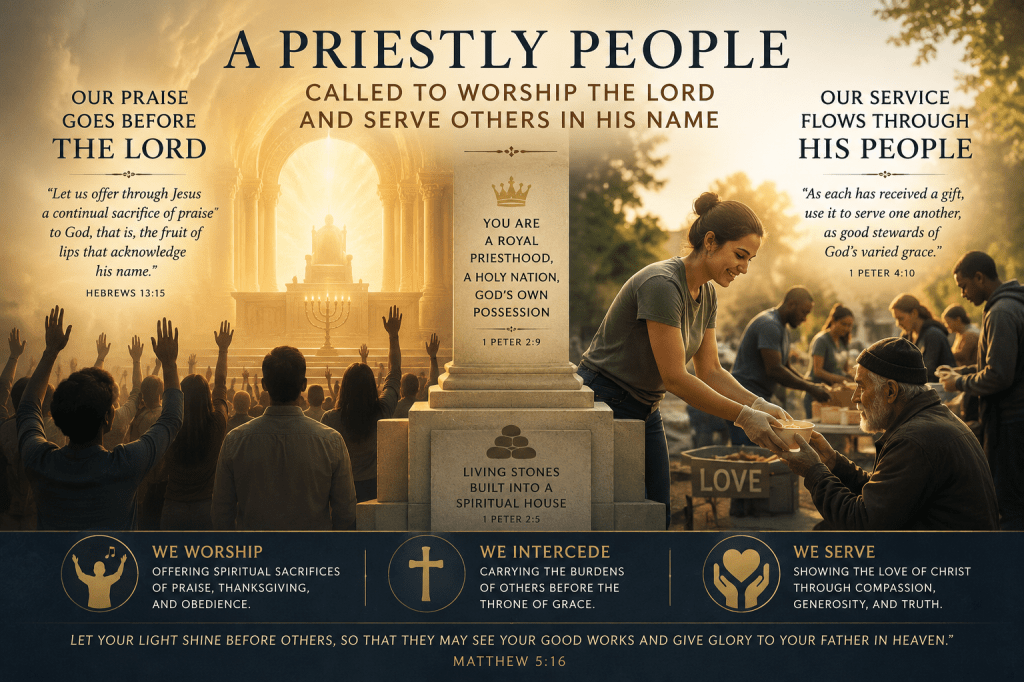
And so the darkness lifts, not because suffering has ended, but because redemption has been accomplished. As Peter exhorts us, “But you are a chosen race, a royal priesthood, a holy nation, a people for his own possession, that you may proclaim the excellencies of him who called you out of darkness into his marvelous light” (1 Pet. 2:9). 

Maranatha. Shalom.