
“She said to him, “Yes, Lord; I believe that you are the Christ, the Son of God, who is coming into the world” (Jn. 11:27).
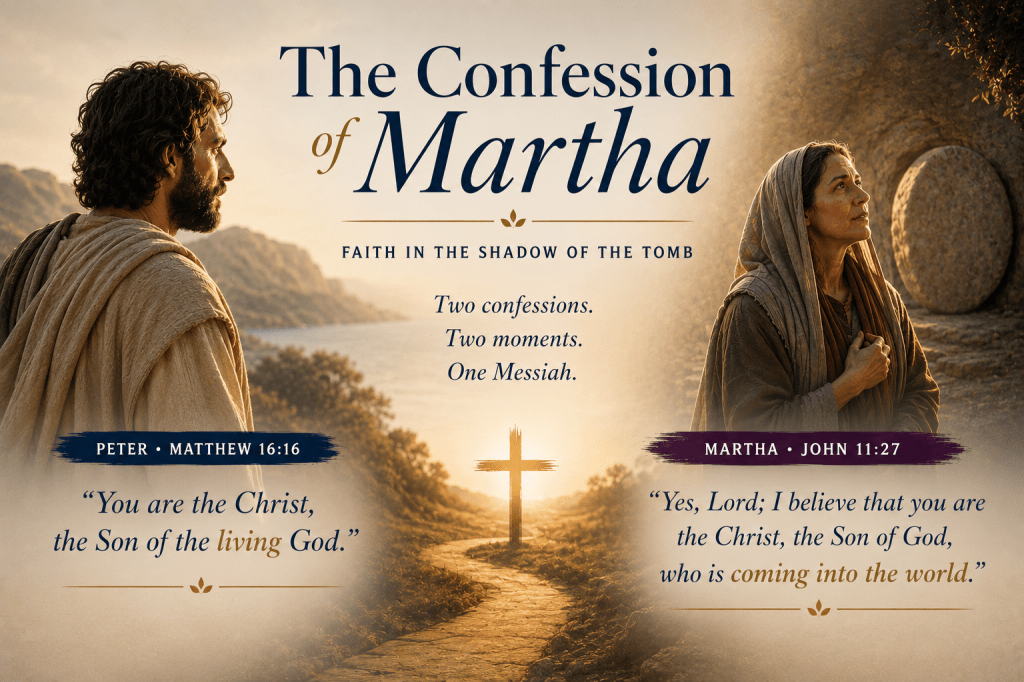
Among the great confessions in the New Covenant, we have two that sound similar, one is generally overlooked while the other is universally recognized. Most faithful readers of Scripture recognize Peter’s declaration at Caesarea Philippi, “You are the Christ, the Son of the living God” (Matt. 16:16). It has rightly occupied a central place in Christian theology because it precedes Messiah’s teaching concerning His ekklesia and the revelation entrusted to the apostles. Far fewer, however, recognize that the apostle John records a remarkably similar confession from Martha in Bethany. Standing before the tomb of her brother Lazarus, she declares to Yeshua, “Yes, Lord; I believe that you are the Christ, the Son of God, who is coming into the world.” Peter’s confession has generated centuries of theological reflection, while Martha’s confession is frequently eclipsed by the miracle that immediately follows.
I would suggest, however, that John intends precisely the opposite. Before Yeshua raises Lazarus from the dead, He first draws from Martha one of the highest Christological confessions recorded in the Gospels. The miracle confirms what the confession has proclaimed. John is not just telling the story of the resurrection; he is revealing the identity of the Resurrection.
This truth captured my heart recently as I read John 11 during my devotional time. Martha stands beside the tomb of her brother, and when Yeshua speaks to her, she replies with a magnificent confession of faith. I found myself praying, “Lord, if I stood where Martha stood, could I have spoken such words of faith and devotion?” Yet she did. This was not a confession born of comfort but in the valley overshadowed by death and mourning.
John’s Gospel is carefully constructed around a succession of witnesses who answer one central question: Who is Jesus? John the Baptist identifies Him as the “Lamb of God.” Andrew announces, “We have found the Messiah.” Nathanael proclaims Him to be “Son of God” and the “King of Israel.” The Samaritans confess Him as the “Savior of the world.” Martha declares Him to be “the Messiah, the Son of God, the One coming into the world.” Finally, Thomas falls before the risen Lord with the climactic confession: “My Lord and my God!” These declarations are not isolated statements but form a deliberate progression that leads to John’s stated purpose: “but these are written so that you may believe that Jesus is the Christ, the Son of God, and that by believing you may have life in his name” (Jn. 20:31). Significantly, John does not reserve these confessions for the twelve apostles alone. They come from a prophet, a fisherman, Samaritans, women, and finally a disciple whose doubts are transformed into worship. Throughout the Gospel, faithful witness is not determined by office or status but by genuine faith in Him.
Within this pattern, Martha’s confession occupies a unique place because it is remarkably similar to Peter’s. As he declared: “You are the Christ, the Son of the living God.” Martha’s confesses, “Yes, Lord; I believe that you are the Christ, the Son of God, who is coming into the world.” Both recognize Yeshua as the promised Messiah. Both identify Him as the Son of God. Both confessions occur at pivotal moments in their respective Gospels, immediately preceding a significant revelation of Jesus’ identity and mission. The similarities are too close to dismiss as coincidence. Rather, John appears to present Martha’s confession as a parallel to Peter’s confession in Matthew. Yet while the content of their confessions is strikingly similar, the circumstances surrounding them could not be more different.
Peter speaks at Caesarea Philippi after months of witnessing Yeshua’s miracles. Surrounded by the other disciples, he answers the Master’s question, “Who do you say that I am?” Jesus immediately declares that this confession has been revealed by the Father and proceeds to speak of the building of His ekklesia. Martha, however, stands not among the disciples celebrating miracles but beside the tomb of her beloved brother. The atmosphere is heavy with grief, disappointment, and the apparent triumph of death. Into that sorrow Messiah proclaims: “I am the resurrection and the life.” Martha’s confession is her response to that revelation. Peter confesses in the confidence of discipleship. Martha confesses in the anguish of bereavement. One speaks in the context of growing expectation; the other in the shadow of death. Both confess the same Messiah.
Perhaps the greatest distinction between these confessions lies in their timing. Peter speaks after witnessing countless demonstrations of Messiah’s authority. Martha believes before seeing Lazarus emerge from the tomb. John records her confession before the miracle occurs. Her faith does not rest upon what she is about to see but upon the One who stands before her. This is underscored by the use of the Greek perfect tense: “I have believed” (ἐγὼ πεπίστευκα). Her words express settled, abiding faith. She is not making a momentary emotional declaration but affirming a conviction that has taken root and continues to shape her life. Even while sorrow overwhelms her heart, her confidence in Messiah remains steadfast. Martha reminds us that biblical faith is not optimism rooted in circumstances, but confidence in the character of the Lord. We are naturally inclined to believe the Lord after He acts, yet Scripture calls us to trust Him before we understand His purposes.
John also presents Martha’s confession as part of a broader pattern in which women serve as faithful witnesses to Messiah. The mother of Yeshua is present at His first sign in Cana. The Samaritan woman becomes an unexpected evangelist to her village. Mary of Bethany recognizes the significance of Yeshua’s approaching death and anoints Him for burial. Mary Magdalene becomes the first witness of the resurrection. Yet Martha stands before the grave of her brother and articulates one of the clearest Christological confessions in the New Testament. John does not diminish the unique role of the apostles, nor does he present Martha as replacing Peter. Rather, he demonstrates that genuine faith and faithful witness are not measured by social or cultural position but by personal knowledge of the Messiah. In a first-century Jewish setting, where public theological testimony was often associated with men, John records one of the Gospel’s highest declarations of Jesus’ identity on the lips of a Jewish woman. This is not incidental to the narrative; it is part of John’s theology of witness.
Yet, we might say that Martha’s confession surpasses Peter’s in one respect by adding a third title: “the One coming into the world.” This expression gathers together the hopes of Israel found throughout the Hebrew Scriptures. Yeshua is not only the promised Son of David, the Messiah, and the royal Son of God envisioned in Psalm 2; He is also the long-awaited Redeemer sent by the Father into the world. Throughout John’s Gospel, Jesus repeatedly speaks of being sent by the Father. Martha’s confession beautifully unites Israel’s messianic expectation with John’s theology of the incarnation. She recognizes that the One standing before her is not just a prophet, miracle worker or teacher, but the fulfillment of the Lord’s redemptive promises.
There is another detail regarding Martha that we should consider. She is often remember primarily for the occasion when she was “worried and bothered about so many things” while Mary sat at the Lord’s feet (Lk. 10:41-42). Too often that moment becomes the lens through which we view her entire life. Yet John presents a different picture. When word comes that Yeshua is approaching Bethany, “Martha, as soon as she heard that Jesus was coming, went and met Him, but Mary remained seated in the house” (Jn. 11:20). John is not diminishing Mary, whose devotion to Messiah is unquestioned. Rather, he allows us to see Martha’s growth and maturity. The woman once known for anxious service is now the first to go out and meet the Lord, and from her lips comes a beautiful and powerful confession. We should be careful not to let one moment of weakness define a disciple whom the Gospel ultimately presents as a remarkable witness to Messiah.
Perhaps the most compelling aspect of Martha’s confession is that it is spoken in the midst of profound personal sorrow. Moments earlier she had lamented, “Lord, if You had been here, my brother would not have died.” These are not words of unbelief but of grief. Scripture never asks God’s people to suppress lament. Abraham mourned Sarah. David wept for his son. Jeremiah poured out his anguish over Jerusalem. The psalmists repeatedly cried, “How long, O Lord?” Even Yeshua wept. Biblical faith does not eliminate sorrow; it sustains the faithful through sorrow. Martha neither denies her pain nor abandons her confidence in Messiah. She teaches us that genuine faith can coexist with tears. Some of the deepest confessions of trust are forged not in the seasons of triumph but in the valley overshadowed by death. Countless believers who have stood beside hospital beds, walked through cemeteries, or buried loved ones have found themselves standing where Martha once stood. Her confession gives voice to a faith that endures even when the Lord’s purposes remain hidden.
John’s narrative ultimately moves from Martha’s confession to Thomas’s. Martha believes before the stone is rolled away. Thomas believes after seeing the risen Lord. Martha stands before a closed tomb; Thomas stands in light of the empty one. Yet both proclaim the identity of Yeshua. It is fitting that John’s Gospel concludes with the blessing: “Blessed are those who have not seen and yet have believed.” In many respects, Martha embodies that blessing before it was spoken. She trusts before the miracle. She confesses before death yields its captive. She believes before she sees.
Peter’s confession becomes the foundation for Yeshua’s teaching concerning ekklesia. Martha’s confession becomes the foundation upon which Yeshua reveals Himself as “the resurrection and the life.” One confession is spoken in the confidence of discipleship; the other is the shadow of the tomb. One is born amid expectation; the other amid grief. Yet both confess the same Messiah. Together they reveal that authentic faith is not confined to moments of victory. Sometimes its clearest expression comes when tears still fill the eyes and questions remain unanswered. For this reason, Martha’s confession deserves to be remembered alongside Peter’s. It reminds us that some of the most profound declarations of faith are spoken not after the Lord has acted, but while we are still waiting for Him to do so. In that sense, Martha’s words continue to speak to the ekklesia across the centuries: “Yes, Lord; I believe that you are the Christ, the Son of God, who is coming into the world.” It is a confession born not in comfort but in suffering, not after the miracle but before it, and for that very reason it remains one of the most beautiful affirmations of faith in all of Holy Scripture.
“Yes, Lord; I believe that you are the Christ, the Son of God, who is coming into the world.”

 the mountain mensch