One Master

The Song of the Mountains – Verse 44  

A Crescendo. 

Yeshua/Jesus has asked us where our treasure is, what sort of treasure it is, and He has instructed us regarding how that treasure causes us to experience the world around us. He now brings this section of the Sermon on the Mount to a crescendo – causing us to ask ourselves, “just who are we serving?”

No one can serve two masters; for either he will hate the one and love the other, or he will stick by one and look down on the other. You cannot serve God and money” (Matt. 6:24). 

The underlying meaning of this verse speaks to an ethic of worship – who are we serving, who are we trusting, and at who’s command do we respond? 

No other.

If you recall the language of the second commandment, “You are to have no other gods before me. You are not to make for yourselves a carved image or any kind of representation of anything in heaven above, on the earth beneath or in the water below the shoreline. You are not to bow down to them or serve them; for I, the Lord you God, am a jealous God, punishing the children for the sins of the parents to the third and fourth generation of those who hate me, but displaying grace to the thousandth generation of those who love me and obey my commandments” (Ex. 20:3-6). 

The second commandment directs the people of God to exclusive worship, based upon His act of salvation referenced in the first commandment. Still, the allure of money, possessions, and the power it seems to bring is always tempting. 

The wallet. 

John Wesley famously remarked that the last part of a person to be converted is his wallet. I can attest from many years of preaching, that few things that I have taught on, in dozens of congregations, causes people to shift in their seats like the mention of money. It might surprise you to learn that regarding the subject of faith, the Apostolic Scriptures has about 500 verses. On the subject of prayer, also, about 500 verses. On the subject of money, however, we find an astounding 2,350 verses, approximately 29% of the Apostolic Scriptures. 

Why would this be? For many of us, money is intimately connected to our understanding of survival, of comfort, and is a direct representation of the fruit of our labor. Keeping all this in mind, unfortunately, we can see that our faith and our finances are closely linked together – undoubtedly warring in our heart. Paul warns us that, “The Love of money is a root for all kinds of evil.” Therefore, money can, if we are not cautious, harden our hearts to the needs of others.

What Yeshua taught. 

Yeshua often spoke of money, and its various applications, in the form of parables. He spoke of investments (Matt. 13:44-45), of savings (Matt. 13:52), of debt (Matt. 18:23-35), of earning wages (Matt. 20:1-16), of capital and interest (Matt. 25:14-30), money lending (Lk. 7:41-43), of inheritance (Lk. 15:11-32), and of the contrast between the rich and poor (Lk. 16:19-31). 

As I have addressed in previous articles on the Sermon on the Mount, earthly treasure does influence how we see and experience this world; and as we walk this life in faith with Messiah, we must be cautious to yield ourselves to the Lord God, and not to the powerful influence of money. 

Life lesson.

On my first trip to Kenya, East Africa, I became aware of a need of particular importance. My host was speaking to a gentleman that I had traveled with about a situation regarding a young man was now orphaned, and the primary provider for his four (4) younger siblings. The family had been fishermen on Lake Victoria, and both of this young man’s parents died within weeks of each other. “Steven,” who had wanted to become a teacher, then took on the burden of the family business, but was soon overwhelmed by it and he turned to drugs and alcohol. 

Having reached the bottom, he had heard of my friend Pastor Peter, who frequently took in orphans, and walked the fifty (50) miles to his house barefoot. After a time, Peter found a sponsor so that he could go to a local teachers college, and I enter the picture after the boy finished his first year, and lost his sponsor.

I had spent a considerable amount of time with “Steven,” and after I learned of his situation I pledged that I would find the money for his second year of college.  

As the Lord would have it, I was preaching at a conference on the compound of the school he attended for a week. I had met the overseer of the school and went to speak with him. He informed me that “Steven” could not return until his fee was paid, but when I guaranteed it, he admitted him marked paid in full – the money was quickly dispatched after I returned home, as my home congregation sponsored the remainder of his education.

“Steven” finished school, found a work-study position to finish a third year qualification to be licensed to teach in any Kenyan school; and when I returned in 2014, he immediately found me and before anything else, brought me to his apartment to introduce me to his wife (he married a young widow with a small daughter), and his new baby. “Steven” not only supported his wife and children, but he paid the school fees for all of his siblings. 

With a little generosity of spirit, lives were changed and bettered. 

Dear reader, individually we are not called to change the world, that is the position of Messiah, but we are called to share joyfully of what we have – and this is not limited to money – and we do this because we love the Lord more than our earthly treasures.

The longer we live in this life of faith, the more that we discover that money makes the same exclusive demands as the Lord; but while one takes of us, the other gives to us. The Lord loves a cheerful giver – one giving freely – because it is a demonstration, of not only our love for our fellow man, but also our love for Him.

Be well. Shalom.  

Idioms, O Idioms!

The Song of the Mountains – Verse 43

Flashlights.

Have you ever had occasion when you needed a flashlight to see in the dark, only to find that the batteries were dead, leaving you to fumble around in the dark to find what you need or make your way? It is an unpleasant, and sometimes dangerous experience for sure. What causes the flashlight to work is that internal charge, its power-supply, the batteries. When the batteries are full, the flashlight gives off a bright light; but as they drain, the light begins to darken until its dead.

The lesson. 

In Matthew 6:22-23 Yeshua/Jesus teaches, “The eye is the lamp of the body. Therefore if your eye is good, your whole body will be full of light. But if your eye is bad, your body will be full of darkness. If therefore the light that is in you is darkness, how great is the darkness!” 

These verses are often approached from an esoteric perspective. Drawing on some hidden meaning of light, darkness, eye and lamp. What does Yeshua mean by “light” and “darkness,” “eye” and “lamp”? I submit that there is nothing inherently esoteric about these verses at all. Their meaning is rather simple, and the lesson flows in perfect harmony with the context of what Yeshua has been speaking about.

Context.

In the past two articles on the Sermon on the Mount, we have been corrected regarding what we treasure, and upon what we rest our hearts – as what we treasure will be the position from which we experience this life. Then, in the verse that follows our present subject, Matthew 6:24, Yeshua tells us that we cannot serve two masters: we cannot serve both God and money

The question we need to ask is this, “How do we demonstrate the location of our treasure? How do we demonstrate that we serve the Lord alone? Yeshua provides the answer, yet He does so in a way that is rather unusual to us, but well known to His audience.

Idioms. 

Yeshua uses two rather well known Hebraic idioms. Every language has idiomatic expressions, which do not often translate well into other languages. In English more than I have space to list, but as examples: “kick the bucket,” “when pigs fly,” “hit the books,” “hit the sack,” “go cold turkey,” “on the ball,” “under the weather,” etc. 

If you speak English, specifically American English, you know what these expressions mean; the imagery, however, created by these expressions is rather confusing to non-American English speakers. One idiomatic expression that I like comes from the Luo Language spoken in the lake district of Kenya, it’s the name for Kale, “sua wiki,” which means “push the week,” meaning in English terms, “I’m broke but this green stuff will get me through the week.” Yeshua is using well-known Hebraic idioms.

The eye doctor. 

The “good eye” in first-century Jewish culture meant to be content and generous; conversely, the “bad eye” meant to be discontented and stingy. 

If we are full of treasure that has been laid up and secured for us in heaven, we are content, generous, selfless and care for the condition of others. If we only care about earthly treasures, we will be discontent, stingy, selfish, and not care for the well-being of others. 

Yeshua is speaking to our inward condition, and how it affects our relation to, and outlook on the world around us. The contextual flow of Matthew 6:19-24 can be paraphrased something like this:

Do not lay up for yourselves treasures on earth that time degrades or thieves steal. Be open handed, trusting in God, thereby laying up treasure in His heavenly depository. It is that treasure that is of real value, and infinite worth. Heavenly treasure allows your eyes to see well beyond natural sight, to the infinite worth of those around you. Earthly treasure closes your eyes as you begin to focus on the glitter of this world, not recognizing the encroaching darkness. In a daze you sleepwalk through life. Serving money, a slave to the very thing you believe you control. Lulled to sleep, the darkness deepens until the light overcomes your darkness.   

We can be abundantly blessed in this life, and never bless others. This is darkness.

We can be abundantly blessed in this life, and share that blessing with others. This is light.

So where is it? Your treasure? 

Messiah has said where our treasure is, there our heart will be. He then inquires as to our generosity – the way in which we “love our neighbor as ourselves.” This section of the Sermon on the Mount will come to a conclusion when Messiah asks us where our allegiance is: with the God’s Kingdom? Or with money? 

Dear reader, I pray that we are walking in His light, and not in the darkness of fear. 

Shalom. Be well.

Trails-less Traveled 3

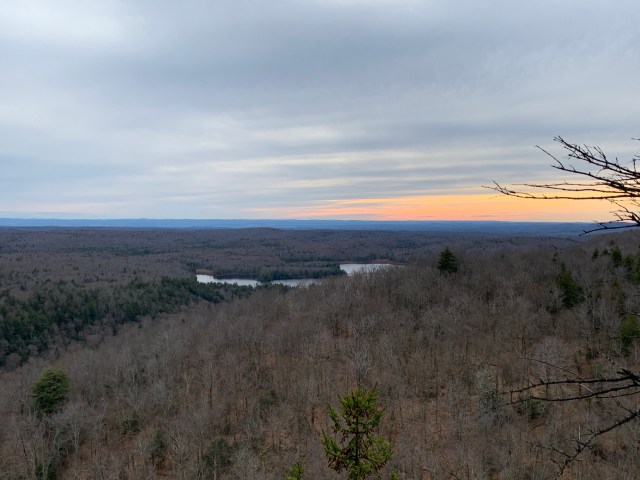
Sunset from Good Luck Cliffs, Arietta NY.

Hike Date: November 12, 2020

Destinations: Sherman Mt, and Good Luck Cliffs
ADK Location: Ferris Lake Wild Forest
Roundtrip Mileage: 8 +/-
Elevation: Sherman (2,641ft), Good Luck (2,151ft.) 
Elevation gain: 1,100 ft. combined.

This was my third trip back to the Chub Lake area. In my previous hikes here I had visited Chub Lake Mt. and North Branch Mt. My plan on this day was to do a bushwhack to Sherman Mt., which sits between Chub Lake Mt. and North Branch Mt, and then, if time allowed, to drive over to do a quick climb up to Good Luck Cliffs, my third visit there this year, and then do a short bushwhack down the north side of the mountain to the Dexter Lake trail.

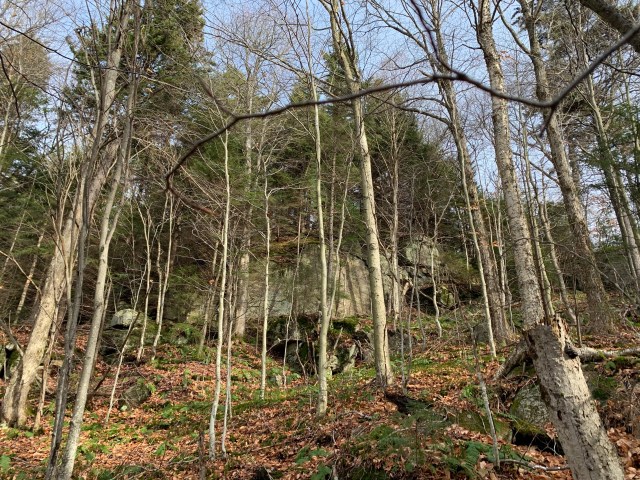
Some of the amazing rock walls at the base of Chub Lake Mt.

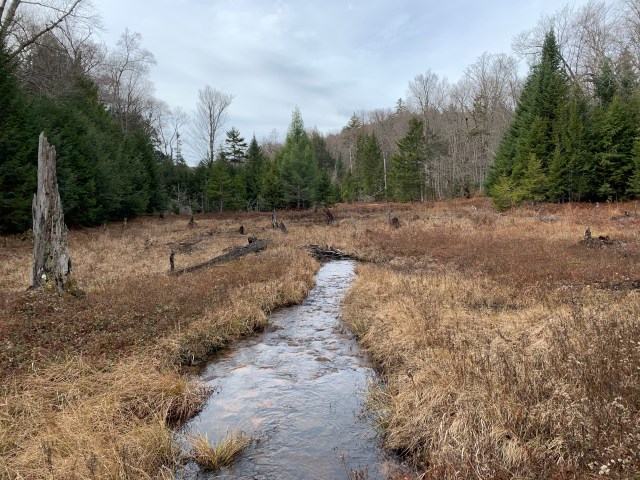
I parked once again at the trailhead for Chub Lake on Rt. 10 in Arietta NY. My plan was to follow the herd path over to the base of Chub Lake Mt. used by hikers and rock climbers, and drop down into the drainage once the herd path turned up the mountain. The drainage was an easy landmark to use with my bearing to Sherman Mt. From the drainage I would drop down a short hill, and then cross a tributary for Chub Lake, see below, another natural feature to help guide the way.

Standing on a beaver dam as I cross the flow between Chub Lake Mt. and Sherman Mt.

As I was nearing my exit from the drainage along the base of Chub Lake Mt., Sherman Mt. came into view. As I checked my bearing, and looked off in the distance, I located a stand of hemlock trees in the area that I had planned to climb to, before turning north to reach the summit.

Looking toward the summit of Sherman Mt., Arietta NY.

Crossing the tributary between Chub Lake Mt. and Sherman Mt. was quick, and without wet feet! I took note of my exit and entry into the woods, and began to climb Sherman Mt. For the first two or three tenths the climb is gentle, and then the grade increases rapidly. The rock features of this mountain come into view quickly, and provide some nice climbing, or an obstacle to get around, if you do not feel like climbing at the moment.

Heading up Sherman Mt.

I arrived at the southern side, the lower side, of the summit exactly where I had planned. I then turned due north and made steady progress to the high point of the mountain. I explored around, descended on the north side to explore some rock formations, and then began to make my way back to my south side exit. While there is no lookout on the summit, there are plenty of breaks in the trees as you wander about to look at the surrounding wilderness.

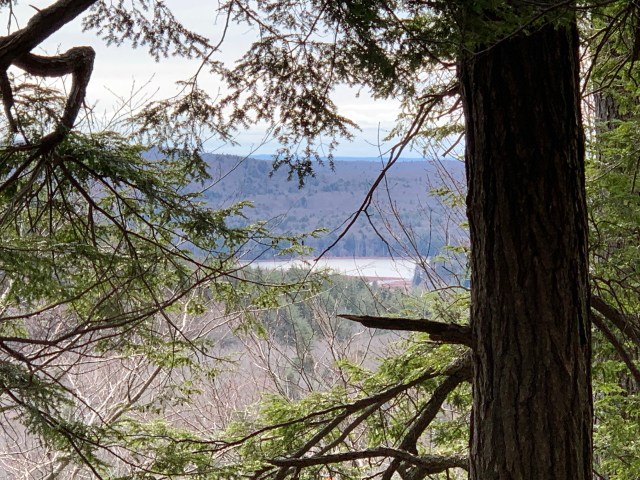
Good Luck Lake across Rt. 10. I would be walking on its shoreline about an hour later.
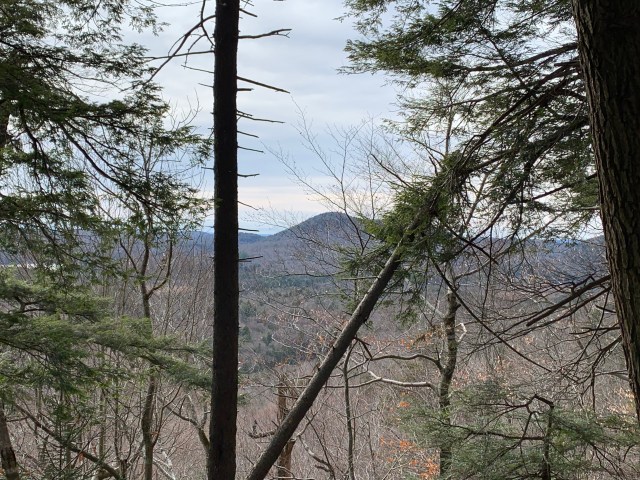
Good Luck Mt. from Sherman Mt.
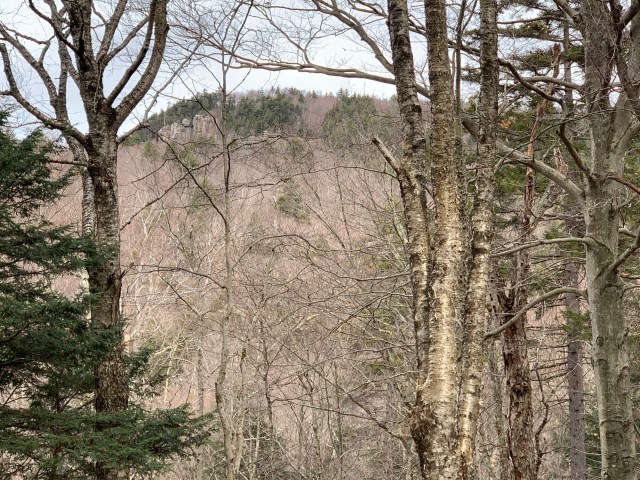
Chub Lake Mt. through the trees.

The hike down and back to the trailhead was uneventful. I stopped and had a quick snack as I crossed the tributary once again, see below, up a short hill to the Chub Lake Mt. drainage, and then reconnected with the herd path back to my vehicle.

Another nice spot.

Now to Good Luck Cliffs.

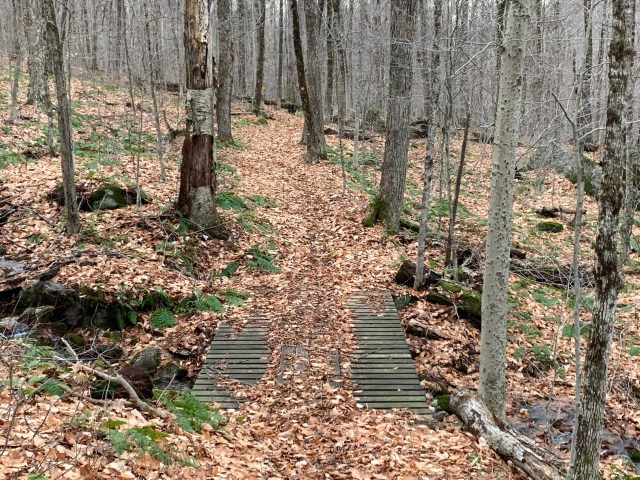
Heading up the trail to Good Luck Cliffs

I have hiked the area around Good Luck Cliffs and Lake many times. Because it is so close to my house I will often drive over to trail run, just for something different to do. I had planned earlier in the day to climb up Good Luck Cliffs, descend down the north side, and then hike out to Dry Lake and Dexter Lake. It had been overcast and chilly all day so when I hit the summit I sat down for another snack and decided that I would descend and head home, saving the lakes for another adventure up a neighboring mountain I have yet to climb. As always, the view from the cliffs is excellent. An extra blessing is that I can see our home mountain off in the distance. Snack over. Now to the bushwhack.

The beginning of the bushwhack down Good Luck Cliffs. The trail is before me, just hidden in the trees and only visible on the compass.

Earlier in the day I had taken the bearing to descend from a spot on the trail, just before the summit, that I knew well. This spot would provide a direct route down the mountain, and connect me to the Dexter Lake trail approximately .4 of a mile away. When I hit the trail, by the snowmobile bridge, I would turn right and hike .3 to the trail register before heading the .6 to the vehicle parking.

It was a quick descent. It is here, however, that I will remind you, and me, to always trust your compass – provided that you have used it properly with a map! As I am beginning my descent I look over to a mountain across the way – State Brook Mountain – and I’m thinking to myself, “I don’t think I have to go over that.” Being that I was still at elevation, more or less, the landscape was playing with my eyes. I looked at my compass again, and said, “I know I took the correct bearing, trust the compass.” Of course, as I dropped down, I could now see – and be reminded of what I had observed on the map – I was descending into the valley between the two mountains, just above State Brook. I landed on the Dexter Lake trail exactly where I had planned, even in spite of my earlier momentary hesitation.

Stepping onto the Dexter Lake Trail, looking toward Dexter Lake.

While this was a much shorter bushwhack than Sherman Mt., it reinforced the importance of proper map and compass use, and application in the field. I walked back to civilization contemplating my trek that day. In my eight mile adventure I only saw one other person, and I was able to have some time of prayer and communion with the Lord. There is also something deeply satisfying about taking a map, finding a landmark or feature, noting that there is no trail, taking a bearing, and traveling there and back again safely with only a compass and map to lead the way. Hard to put into words, but deeply satisfying.

There is a need, on the level of the soul, for a person to go out into the wild places, and reconnect with something pure and natural. The trail, even when there appeared to be no trail, was right there before me. The compass told me where it was, even while I could not see it. It’s a lot like walking by faith, and not by sight.

Be well, Shalom, and happy hiking.