A Lasting Investment

The Song of the Mountains – Verse 42

Teach them well. 

All of us are familiar with the stresses and difficulties of adulthood, not the least of which is financial stress. As a father I have tried to teach financial conservatism by example. Making sure that we save enough, that we consider options before making purchases, and that we measure future considerations appropriately. Most of us desire to ensure that our children can take care of themselves as they leave the nest, and when needed, of course, we help them. Obviously none of us can see the future and adequately prepare for every twist and turn that life has to offer; but you pray that you prepare your children to be as responsible, and equipped as possible for the life that is before them.

The lesson. 

In Matthew 6:19-21 Messiah teaches, “Do not store up for yourselves treasures on earth, where moth and rust destroy and where thieves break in and steal. But store up for yourselves treasures in heaven, where neither moth nor rust destroys and where thieves do not break in or steal. For where your treasure is, there will your heart be also.” 

An important component that must be included in raising children, and the teaching of financial responsibility, is faith. We should teach them to work hard with honesty and integrity in order to support themselves and their families; but that there is a greater treasure to be found in life.

In what do we trust? 

In this lesson, Yeshua/Jesus is teaching us a valuable lesson regarding what we are placing our trust in. Now, He knows that we need financial means to live, and He is not telling us to ignore such concerns. Rather, He is speaking to us regarding treasure that does not tarnish, and cannot be stolen: heavenly treasure.

His disciples. 

One of the first things that we note in our text is this: Yeshua is speaking to us as His disciples, and that we are going to heaven, Amen! Yet, what of the earthly? In our text we find four descriptions of “earthly treasures.”

  1. Possessions: How many of us still own our first television or computer? Many things that we treasured or greatly enjoyed got old, or fell out of fashion with time. The apostle Paul wrote, “Some people, eager for money, have wandered from the faith and pierced themselves with many griefs.” The story is told of a wealthy old man on his death bed, who asked that all of his gold be brought to his bed: jewelry, coins and gold nuggets. He lay on his bed, holding the things that he treasured most, but when he died it slipped from his hands and fell to the ground. 
  2. Earthly Power: Some people have great wealth that brings with it influence over other people, as examples: Jeff Bezos, Bill Gates, Rupert Murdoch or Warren Buffett. Our society highly respects such people, and in many cases, stand in awe of them – but they too will die.
  3. Pleasure: There are many pleasurable things in this life, but some things are taken to excess; yet, pleasures too will end.
  4. Praise: We must be careful not to live for the praise of men, but the praise of God to one day hear, “well done, thy good and faithful servant.” 

Wealth is a blessing, but not the only blessing. 

Scripture has a favorable attitude regarding wealth; as wealth, blessing, and prosperity are an outworking of covenant blessing. Abraham, Isaac, and Jacob were wealthy by the Lord’s design. Job, after being tried, was blessed by the Lord with great wealth once again. Joseph of Arimathea was a wealthy and faithful man, who tended to Yeshua’s body – an act of a disciple. The apostle Paul tells us that there were “not many” wealthy people in the congregation, implying that there were some (I Cor. 1:26). 

However, wealth, and yearning for it, can become a snare. It can lead to a vain attempt to serve both God and money. After a wealthy man refuses to give up his wealth in order to follow Yeshua, He says, “It is easier for a camel to go through the eye of a needle than for a rich man to enter the kingdom of God.” The lingering nature of the old man, with its preoccupation with wealth, can easily influence us to pursue such things under the guise of faith. Paul rightly warns that the “love of money is the root of all kinds of evil” (I Tim. 6:9-10), so it is not money itself that is evil, but the love of it; our treasure leading our hearts in this instance. 

U-Haul?

The bottom line is that earthly treasures and wealth, although not inherently bad, do not last and we cannot take them with us – have you ever seen a U-Haul behind a hearse? Having officiated at many funerals, I have yet to witness such a sight. I recall watching an interview of the chairman of Lehman Brothers back in 2008, the morning after the company collapsed, he was a billionaire the night before and bankrupt the next morning – all while he was sleeping.

Getting to the point. 

So what point am I leading us to? As followers of Messiah, we are not only living for today and the care and concerns of daily life, we must have a mindset of eternity before us as well. There is a poetic verse by Charles Studd that brings this point forward: “Only one life, t’will soon be past; only what’s done for Christ will last.”

Dear reader, where your treasure is, your heart will also be there. Unfortunately, our hearts often follow our currency. The Lord, then, asks us to invest in people, in His Kingdom, both near and far, so that our hearts are always with them, and ultimately, with Him.

The deeds we do in faith, for Messiah, showing care, concern, and love to those around us, both family, friend and stranger, is deposited in our heavenly account from which no one can steal and upon which, no corruption will come. Yeshua asked, “For what will it profit a man if he gains the whole world, and loses his own soul?”

It’s a matter of faith.  

Shalom. Be well.

Trails-less Traveled 2

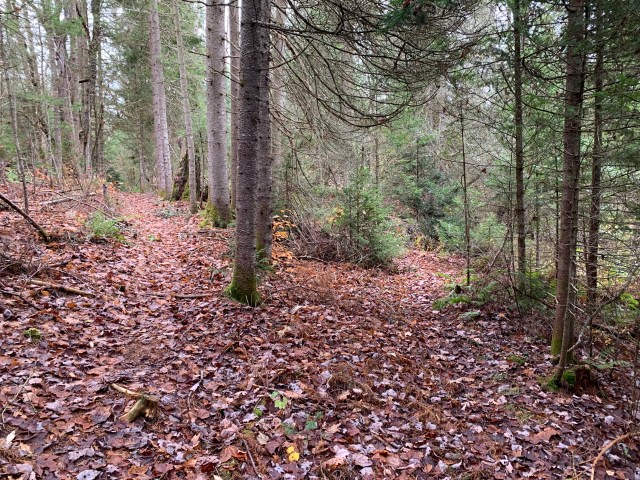
Along the West Branch Sacandaga River, outside of Arietta, New York, about 2.5 miles in.

Hike Date: October 23, 2020

Destination: North Branch Mountain
ADK Location: Silver Lake Wilderness
Roundtrip Mileage: 10 +/-
Elevation: 2738 ft.
Elevation gain: 888 ft.

As in my previous Trails-less Traveled post, this trailhead is one that I have passed frequently. After my visit to Chub Mountain, I decided to investigate other mountains nearby. As I examined my map I noted Sherman Mt., and North Branch Mountain. While there is a trail that leads in their general direction, neither of these mountains have trails to their summits. A perfect place to fine tune some bushwhacking skills. For those who don’t know, a bushwhack is a means of travel that uses map, compass, GPS, and natural landmarks to navigate to a destination where either there are no trails, or you desire to approach from a different direction.

My original plan was to head directly out to North Branch Mountain, which would require about 1.5 mile bushwhack from the end of the trail at the wetland to reach the summit.

I arrived at the trailhead a little later than expected, around 8:45am. I intended to make up the time delay, and move a bit faster while on trail. The first mile or so of the trail has numerous junctions and offshoots that are not indicated on the map, which shows only one junction. With my compass and map, and using my compass and landmarks, I was able to resolve directional issues rather quickly. Yet, I realized that I would probably only get North Branch Mountain on this day, and would have to leave Sherman for another time, as I had an afternoon appointment at my office before Friday evening Shabbat service. So, North Branch it was.

Two vital tools for any trek, trail or no.

I made steady progress to the terminus of the trail indicated on the map, just on the edge of a wetland area; this wetland area would be my baseline landmark for navigating out and back. When you reach the end of the trail, you can see the beginning of North Branch Mountain off in the distance. With the water level low I was able to keep to one side, and then turn into the woods and begin the bushwhack. With the bearing set on my compass, and seeing the faint tracks of another hiker from the day before, I was heading in the right direction. In about .4 of a mile I began my ascent up the steep side of the mountain.

Beginning the ascent up North Branch Mountain.

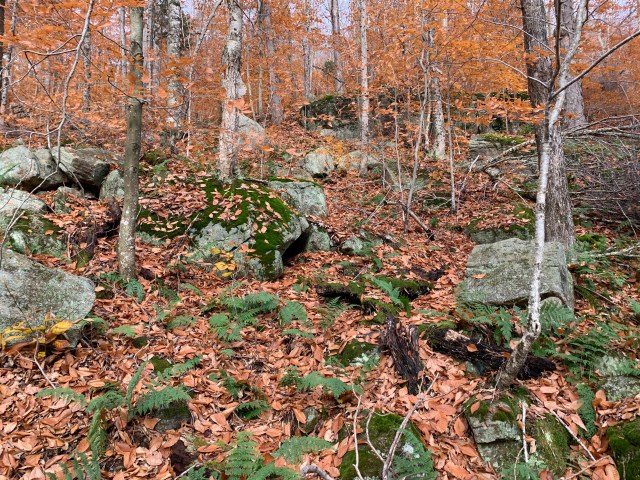
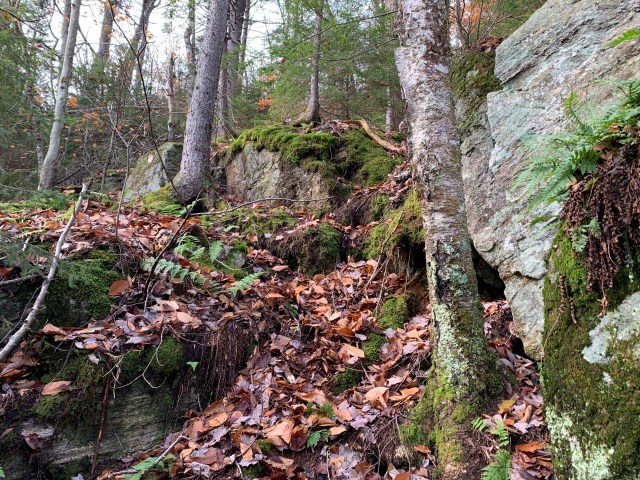
Fallen leaves, on top of wet rocks and mud, can be almost as bad as ice. It had been a rainy week, so the ground was wet. Steady progress up. The summit is wooded, as expected. This trek, however, was not about the views from a summit, but the bushwhack itself. Plotting a course, taking a bearing, identifying landmarks from the map in the field, and safely completing the bushwhack portion of the trek.

An interesting section of North Branch Mountain.

As I descended from the summit I decided to bend toward the draw and follow the drainage down. I knew that this would deliver me about 100 yards from where I began my ascent. Knowing that at the base I would turn right, now following a reverse azimuth, I would begin to listen for the sound of the river that would deliver me back to the wetland where I began my bushwhack.

This is the end of the trail on the map. It is the edge of a wetland, which is just ahead.
This is the view about 100 yards from the beginning of the wetland, you can see a shoulder of North Branch Mountain in the distance.

Dialing in map and compass skills, and identifying geographic features and sounds, noting positions, etc., is key to returning safely from a bushwhack. At one point on my way back, having forgotten that the drainage took me further east than I anticipated, I stopped, had a drink and said, “I think I’m lost.” No. Checking my compass, I was right on track. In fact, I was about 50 ft. from the break in the trees that would allow me to walk along the side of the wetland, the exact spot I passed through earlier. Trusting your tools, once you know how to use them, is vital.

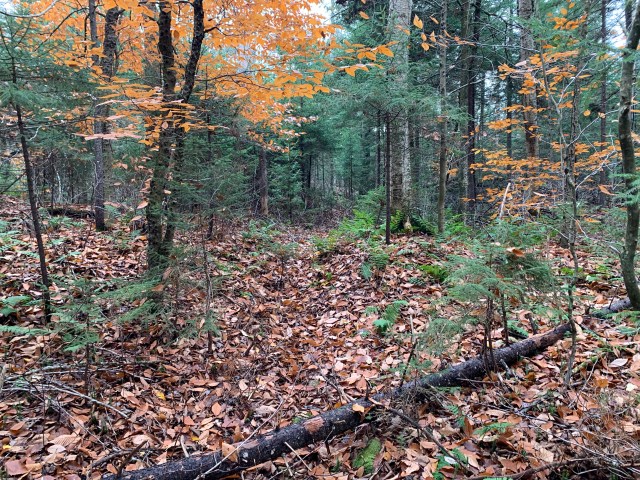
A view along the semi-maintained trail.

The way out was relatively uneventful, but enjoyable nonetheless. This was the longest intended bushwhack I had done, about 3 miles total. I took my time heading out, stopping to admire the river, the beaver huts and dams, and have a snack or two.

Overall, an excellent, short hike in an area not heavily trafficked. I plan to visit again to snowshoe, and explore a little further into the wild.

State marker indicated a wilderness area at the trailhead parking area on Rt. 10 just over the bridge out of Arietta NY. You can enter here, and take the trail on the right to the river, but see below.
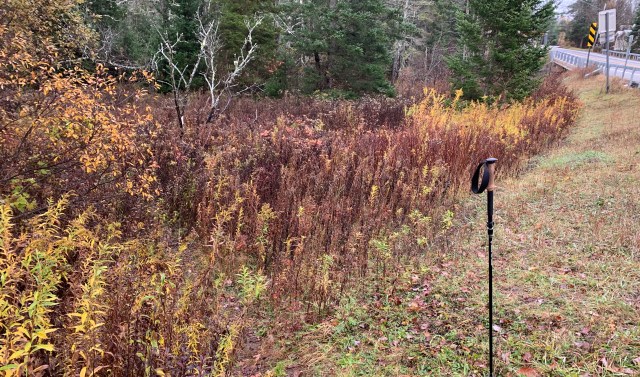
An easier trail to take is at the end of the trailhead parking area toward the bridge. My trekking pole is next to the break in the weeds that begins the footpath.
This is first break in the trail that I was not expecting. Here, you bear left.

Next time, Sherman Mountain.

That’s Not Yours!

The Song of the Mountains – Verse 41

Are they here yet? 

When I was ten, or thereabouts, roller skates were the must have item of the year. Apparently they had made a comeback from some earlier era. I seem to recall my mother ordering them for my birthday; and in the pre-Amazon Prime era, orders would take two or three weeks to arrive from a store catalogue. What a wait! I wanted them so bad. Several of my friends had them already, but a few of us were in a jealous holding pattern. But then, finally, they arrived. As you might expect, after a week or two, perhaps less, after crashing too many times to count, they were put in a closet and I forgot about them. All these years later, I remember the wait more than I do the enjoyment of the skates themselves. Ironic.

Coveting.    

The tenth commandment is the right and logical conclusion to the Decalogue, specifically to the second table regarding interpersonal relationships. If we guard the tenth commandment, we will not murder, commit adultery, steal, or bear false witness against our neighbor as a benefit to ourselves. 

Like the last several commandments, which guard the sanctity of the object of the command, the tenth commandment guards the sanctity of motives. What is motive? Although there are several definitions for motive, depending on its use as a noun or adjective, for our purpose here, motive is the hidden or undisclosed reason for doing something.

The hidden.     

The tenth commandment, then, deals solely with the internal. It is instructing us to guard the sanctity of our motives, which ultimately lead to our actions. Among the ten commandments, it is the only one dealing exclusively with the internal thought life of man. This is an interesting concept, and one that seems contradictory to how the Apostolic and Hebrew Scriptures are taught. Often, Christian Bible teachers will suggest that the Torah, more specifically the ten commandments, are concerned with external action and appearance over that of the internal nature or condition of humanity; while the Apostolic Scriptures, it is argued, are concerned with the internal nature and condition of humanity.

It is an internal safeguard.  

The tenth commandment, among others, demonstrates that the Lord, at the giving of the Torah through Moses, was concerned with the internal condition of His people. Consider these additional examples:

  1. Leviticus 19:17-18, “Do not hate your brother in your heart. Reprove you neighbor, for certain, and bear no sin because of him. Do not take vengeance or bear a grudge against the children of your people. And you shall love your neighbor as yourself. I am the Lord.”
  2. Exodus 25:1-2, “And the Lord spoke to Moses, saying, Speak to the children of Israel, that they take up a contribution for Me. From everyone whose heart moves him you shall take up My contribution.”

Martin Luther wrote that the tenth commandment was not for those who are placed behind bars, but for those who believe that they have conformed to the Law. 

So how should we understand this commandment in messianic faith today?

            The commandment reads:

לֹא תַחְמֹד, בֵּית רֵעֶךָ; לֹא-תַחְמֹד אֵשֶׁת רֵעֶךָ, וְעַבְדּוֹ וַאֲמָתוֹ וְשׁוֹרוֹ וַחֲמֹרוֹ, וְכֹל, אֲשֶׁר לְרֵעֶךָ

            “Do not covet the house of your neighbor; do not covet your neighbors wife, his male servant, his female servant, his ox, his donkey, or anything belonging to your neighbor.” (Personal translation.) 

The first clause commands us not covet our neighbors’ house. The Lord is not referring to his physical dwelling place; but rather, his wife, servants, and possessions, as it concludes, וְכֹל, אֲשֶׁר לְרֵעֶךָ, “or all that belongs to your neighbor.” 

Yeshua/Jesus, and the apostles speak as to the serious nature of negative coveting. James speaks of being enticed, then leading to action based on desire that is sinful (James 1:13-15). Paul writes, “For this you know, that no one who whores, nor unclean one, nor greedy of gain, who is an idolater, has any inheritance in the Kingdom of Messiah and God.” (Eph. 5:5; cf. I Cor. 6:9-10; Col. 3:5). An interesting historical note is that no other ancient near eastern culture had a command against coveting.

If we express this simply, the tenth commandment specifies three things in life that are often coveted: money, sex, and the means to accumulate wealth and power – servants and animals. When the human heart covets, in order to gain what is coveted, it will more than likely be necessary to violate one or more of the other commandments to acquire what is desired; which is perhaps why we find a command guarding the human heart at the close of the Decalogue. 

Defining “covet.”

Covet is from the Hebrew root חמד, meaning: to delight, greatly beloved, covet, lust, or a precious thing. We see that it can be used in both a positive and negative sense. In the positive sense, Paul tells us to “covet” the better gifts (I Cor. 12:31). Additionally, Proverbs tells us to covet our spouse (Prov. 18:22). Further, Peter tells us to “covet” Scripture (I Pet. 2:2). Moreover, Paul also tells us that it is acceptable to “covet” a leadership position (I Tim. 3:1). It is interesting that Paul mentions the tenth commandment specifically with regard to his conversion experience, as covetousness was the sin that took occasion in him, and did a work in him (Ro. 7:7-12), as he writes, “And the command which was to result in life, this I found to result in death.

What is the cure for coveting?

Rabbi Dr. Joseph Hertz explains, “This Commandment goes to the root of all evil actions – the unholy instincts and impulses of predatory desire, which are the spring of nearly every sin against a neighbor. The man who does not covet his neighbor’s goods will not bear false witness against him; he will not rob nor murder, nor will he commit adultery. It commands self-control; for every man has it in his power to determine whether his desires are to master him, or he is to master his desires. Without such self-control, there can be no worthy human life; it alone is the measure of true manhood or womanhood. ‘Who is strong?’ ask the rabbis. ‘He who controls his passions,’ is their reply.”

We would certainly find this definition compatible and consistent with messianic teaching. Consider the fruit of the Spirit in the teaching of Paul, “But the fruit of the Spirit is love, joy, peace, patience, kindness, goodness, trustworthiness, gentleness, self-control. Against such there is not instruction” (Gal. 5:22-23). Or Paul’s words to Timothy, “For God has not given us a spirit of cowardice, but of power and of love and of self-control” (II Tim. 1:7). Furthermore, Paul’s comments regarding the last days, “For men shall be lovers of self, lovers of silver, boasters, proud, blasphemers, disobedient to parents, thankless, wrongdoers, unloving, unforgiving, slanderers, without self-control, fierce, haters of good, betrayers, reckless, puffed up, lovers of pleasure rather than lovers of God” (II Tim. 3:2-4). We might say that we have surely arrived at this today, yet Paul’s description is consistent with all ages. 

Be satisfied.  

Hebrews teaches us that the key is to be satisfied; we read, “Let your way of life be without the love of silver, and be satisfied with what you have. For He Himself has said, ‘I shall never leave you nor forsake you” (Heb. 13:5).

Being satisfied, or content, is not our natural condition; but in faith, it is the antidote to covetousness. To covet is to demonstrate a lack of faith in the Lord. If we needed more, He would provide. If He needed us to do, He would enable. If we were ready, He would set in place. If we were adequately prepared for a different stage in life, it would happen. Yet, in all matters and circumstances, we are to praise Him, even if that circumstance is an apparent lack.  

It’s a theological problem. 

The issue before us is, actually, theological. Coveting is a theological problem, as it is the result of a lack of, or weakness in faith. The Westminster Shorter Catechism explains succinctly, “The Tenth Commandment requireth full contentment with our own condition, with a right and charitable frame of spirit toward our neighbor and all that is his.”

It’s a common problem.  

All of us have coveted at some point, over some thing: a neighbor’s new car; a co-workers raise; the recognition of academic achievement of another, roller skates, etc.  So when we come to the recognition of our sin of covetousness, the same remedy is available to us, as with every other sin – Messiah Yeshua. Remember, when we are in Yeshua, the Father sees us as if we have obeyed perfectly, never having sinned; seeing only the righteousness of His Son. We will fall short, again, and again. We will momentarily lose focus on the Lord, His provision, purpose and plan; but the Holy Spirit will gently correct. 

Let this be an encouragement. 

Paul wrote, “Not that I speak concerning need, for I have learned to be content in whatever state I am” (Phil. 4:11). Yet, as he wrote elsewhere, he was not teaching from a position of having arrived at the goal of perfection (Phil. 3:12); but from the place of the Lord’s work in progress – just as we are. This commandment, then, is a guard for the heart. 

Shalom. Be well.