
At the close of Parashat Nasso (Numbers 7), the leaders of the tribes of Israel come before the Lord with offerings for the dedication of the altar. For twelve days, each prince brings the very same gift. Scripture carefully repeats each offering in full, tribe after tribe, without alteration or abbreviation. At first glance, the repetition can seem unnecessary. Why did they all bring identical gifts? Why not allow each tribe to distinguish itself with something unique or greater?
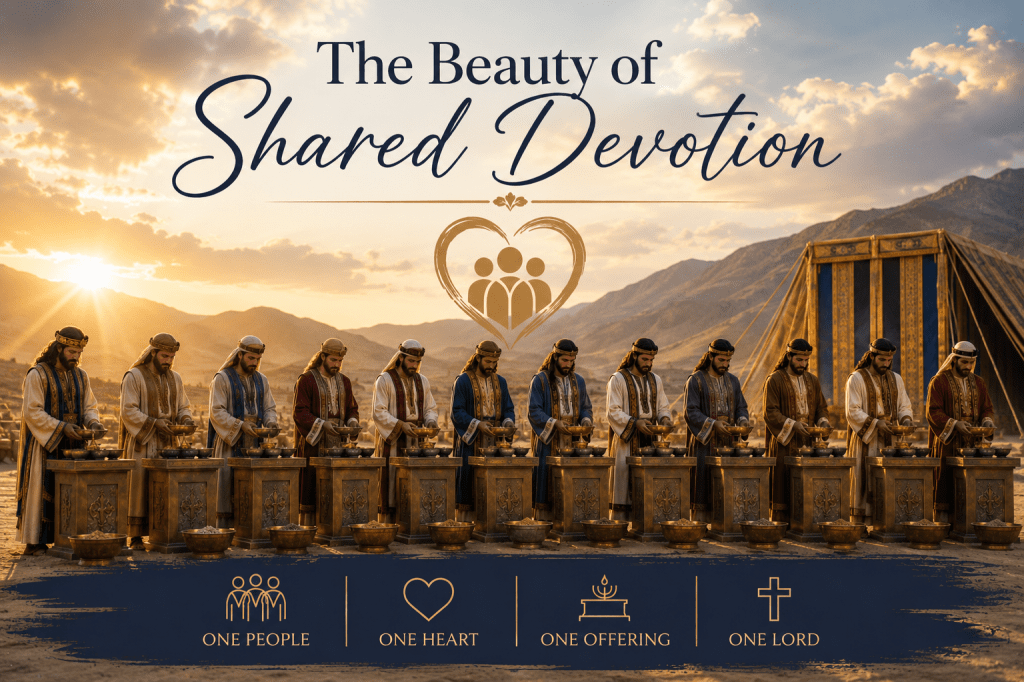
The sages addressed this very question, as they viewed the identical offerings not as repetition, but as a sign of spiritual unity among the tribes, with each leader honoring the others rather than seeking distinction for himself.
This is a beautiful picture of the people of God, almost idyllic. In a culture often driven by comparison, recognition, and personal distinction, the princes of Israel chose another path. They did not compete for prominence before the Lord. They did not attempt to outshine one another. Instead, they honored the sacred unity of Israel’s worship.
Even more striking, Numbers 7 opens by saying, וַיְהִי בְּיוֹם כַּלּוֹת מֹשֶׁה לְהָקִים אֶת־הַמִּשְׁכָּן “And it came to pass on the day that Moses set up the tabernacle…” (Num. 7:1). Though the offerings were brought over twelve days (Num 7:10-11), the Torah regarded them as one unified act of devotion. Heaven saw not twelve competing tribes, but one people with one heart.
There is a lesson here for every congregation, ministry, and believer.
Our service before the Lord is not a competition, although it often feels like it. The Kingdom of God is not advanced through rivalry, envy, or the need to be seen above others. True spiritual maturity rejoices when others serve faithfully. Unity in the Spirit is itself an offering pleasing to God, and it is a revelation of Messiah’s prayer in John 17.
The Apostle Paul later echoes this same truth when he writes that there are many members, yet one body (1 Cor. 12:12). Different callings do not diminish unity; they strengthen it when surrendered to the Lordship of Messiah.
The enemy delights in comparison because comparison breeds pride in some and discouragement in others. But the Spirit calls us into mutual honor, shared devotion, and common purpose. Sometimes the holiest thing we can do is faithfully bring our offering without needing it to be greater than someone else’s.
The princes of Israel remind us that the Lord values harmony among His people. When hearts are united in humble devotion, the Lord receives the service of each as a blessing shared by all.
May we learn to serve with that same spirit of humility — not striving to outshine one another, but walking together in the unity of His Spirit, offering our gifts with faithfulness, humility, and love.
Maranatha. Shalom.
 the mountain mensch