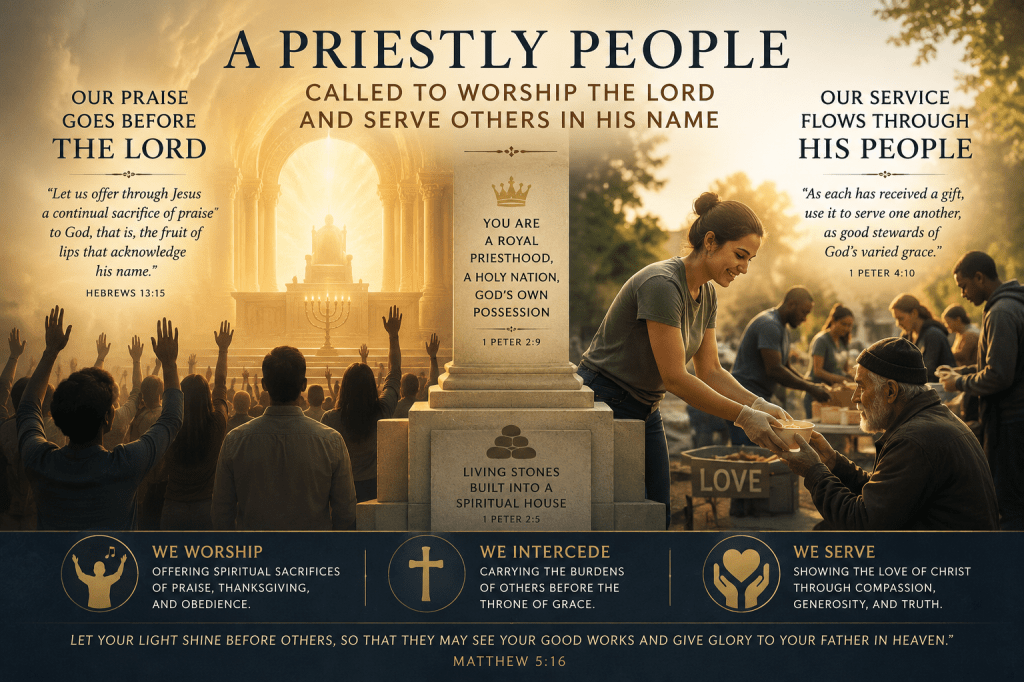
Of the images used by the apostles to describe the Body of Messiah, one of the most beautiful is that of a priestly people gathered in the presence of the Lord. The New Testament does not just portray the faithful as forgiven sinners awaiting their departure to heaven; it presents the redeemed as a holy priesthood, called to minister before the Lord and to serve others in His name. This imagery draws deeply from the language of the Hebrew Scriptures, where Israel is called a “kingdom of priests and a holy nation” (Ex. 19:6). Now, through Messiah Jesus, that ancient calling finds its fulfillment in the ekklesia, those called out.
The Hebrew word most often used for priest is kohen (כֹּהֵן), a term describing one who stands before the Lord on behalf of the people and before the people on behalf of the Lord. The priest was entrusted with sacred service, teaching the Word of God, offering sacrifices, and preserving holiness among the covenant community. The Greek word used in the Septuagint and reflected in the New Testament priestly tradition is hiereus (ἱερεύς), also referring to one consecrated for holy service. The hiereus (ἱερεύς) is one devoted to sacred service and care of holy things. While the New Testament recognizes Yeshua as our great High Priest, the apostles teach that all believers participate in His priestly ministry through union with Him.
The Apostle Peter makes this truth explicit when he writes, “You yourselves like living stones are being built up as a spiritual house, to be a holy priesthood, to offer spiritual sacrifices acceptable to God through Jesus Christ” (1 Pet. 2:5). Just a few verses later he declares, “But you are a chosen race, a royal priesthood, a holy nation, a people for his own possession, that you may proclaim the excellencies of him who called you out of darkness into his marvelous light” (1 Pet. 2:9). Peter intentionally echoes Exodus 19, showing that the Church participates in Israel’s priestly vocation through Messiah. It would be incorrect to see ourselves as individuals with a private faith; rather, we are living stones joined together into the Lord’s holy temple. The priesthood of the believer is profoundly communal. Priests are not called to exist in isolation. They belong to the sacred household and participate in a shared ministry before the Lord.
The Apostle Paul develops this same temple imagery throughout his letters. To the Corinthians he writes, “Do you not know that you are God’s temple and that God’s Spirit dwells in you?” (1 Cor. 3:16). Significantly, the pronoun “you” is plural. Paul is speaking not just to individual bodies, but to the gathered community of the faithful. Further, in Ephesians 2:21-22, he describes the Church as a holy temple being fitted together into a dwelling place for God by the Holy Spirit. The apostolic vision is not that of disconnected Christians pursuing personal spirituality, but of a covenant people being formed into sacred space where the Lord’s presence dwells.
The priestly identity carries with it a call to holiness. Priests were consecrated for the Lord’s service and distinguished from the surrounding culture. Holiness does not mean withdrawal from the world, but faithful dedication to the Lord’s purposes while living in it. Peter exhorts the faithful, “Be holy, for I am holy” (1 Pet. 1:16; cf. Lev. 19:2). The Church’s witness depends not only upon its proclamation but upon its character. Indeed, the Church is called to shine forth Christ into a darkened world. A holy priesthood reflects the holiness of the Lord it serves.
Yet priesthood is never solely about personal sanctification. It is also about ministry. The New Testament teaches that the faithful offer spiritual sacrifices of praise, thanksgiving, generosity, intercession, and obedient lives. As priests, we carry the burdens of others before the throne of grace. We pray for the sick, encourage the discouraged, teach the faith, serve the needy, and embody the Lord’s mercy within our communities. The priesthood of the believer is not a license for independence from the gathered assembly; rather, it is a call to active participation in the life of the Body. Every member has a ministry because every member shares in Messiah’s priestly work.
Individualism is prized in our culture, but the apostolic vision reminds us that we belong to Someone greater than ourselves. We are living stones in a spiritual temple, members of a holy priesthood, and participants in His mission to the world. The Church exists not just to gather for worship, but to show forth His presence through lives of holiness, service, and love. As priests of the Most High God, we stand together before Him, offering ourselves as living sacrifices and carrying His light into a world that desperately needs His grace.
May we never forget the dignity of this calling. Through Jesus the Messiah, our great High Priest, we have been brought near to the Father and commissioned as His priestly people. Let us therefore serve faithfully, walk holy lives, and minister to one another with the humility and compassion that is befitting those who dwell in the courts of the King.
Maranatha. Shalom.
 the mountain mensch