
Matthew 28:1–10
Then Jesus said to them, “Do not be afraid; go and tell my brothers to go to Galilee, and there they will see me” (Matt. 28:10).
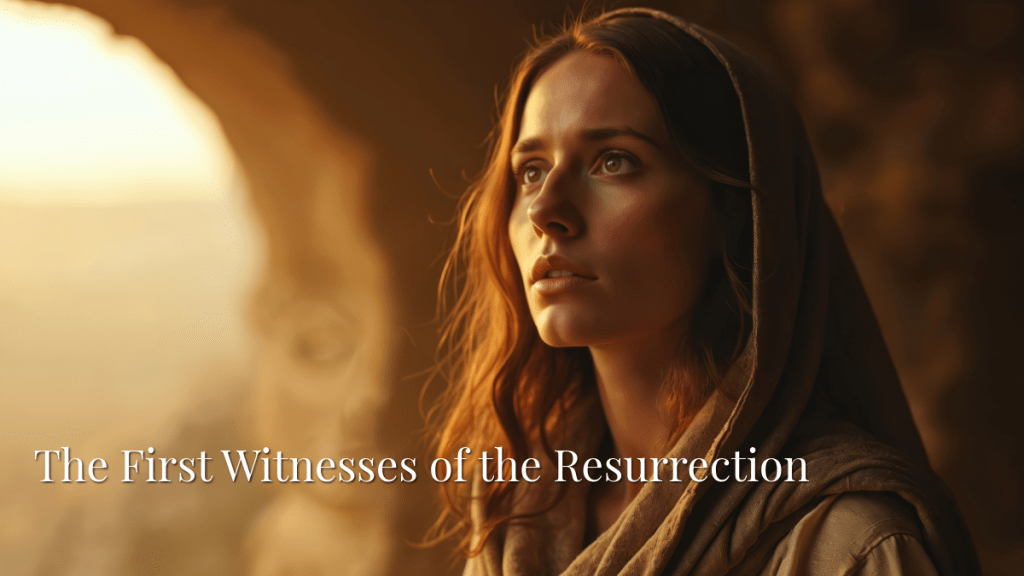
The resurrection narratives of the Gospels are filled with theological depth and historical detail. Yet one feature of the account stands out with striking clarity—and historical surprise: the first witnesses of the resurrection were women.
In the ancient world, this detail would not strengthen the story; it would weaken it. Women were rarely considered credible legal witnesses. Yet the Gospel writers record without hesitation that the first people entrusted with the message of the empty tomb were Mary Magdalene and the other Mary.
Matthew tells us that “after the Sabbath, toward the dawn of the first day of the week,” the women came to the tomb (Matt. 28:1). These were not casual observers who simply happened by. They were the very women—Mary Magdalene and the other Mary—who had watched as Joseph of Arimathea and Nicodemus carefully laid the body of Yeshua in the tomb (Matt. 27:57–61; cf. Jn. 19:39).
When many others had fled in fear or despair, these women remained—at the cross and at the tomb. They witnessed His burial. They knew where He was laid. And now, at the earliest possible moment after the Sabbath, they returned. Their presence at both the burial and the resurrection scene forms an important historical thread: they knew exactly which tomb to visit, and they came expecting to mourn, not to celebrate.
Suddenly, Matthew records another dramatic moment: an earthquake shakes the earth. An angel of the Lord descends from heaven and rolls away the stone from the entrance of the tomb. The scene is filled with awe and terror. The guards stationed at the tomb—Roman soldiers tasked with preventing any tampering—collapse in fear. Matthew describes them as becoming “like dead men” (Matt. 28:4). Ironically, the living guards fall as though dead, while the one who had been crucified now lives. Yet the angel’s first words are not addressed to the soldiers but to the women.
The angel says to them: “Do not be afraid, for I know that you seek Jesus who was crucified. He is not here, for He has risen, as He said.” Fear dominates the scene—earthquake, angelic glory, unconscious guards—but the women receive reassurance. The angel invites them to examine the evidence: “Come, see the place where He lay.” Our Messianic faith is not grounded in myth or vague spiritual experience alone. The angel points to a physical reality: the tomb is empty. The place where His body was laid is now vacant. The resurrection is proclaimed not as abstract theology, but as an observable historical event.
After inviting them to see the evidence, the angel gives the women a mission: “Go quickly and tell His disciples that He has risen from the dead.” In that moment, the women become the first proclaimers of the resurrection. Before the apostles preach, before Pentecost, before the gospel spreads across the Roman world, these women are entrusted with the central message of the Christian faith. They are sent as evangelists of the resurrection.
As they run to tell the disciples, Matthew records another extraordinary moment: Jesus Himself meets them along the way. He greets them simply, and they respond by falling at His feet and worshiping Him. The resurrection is no longer a report received from an angel—it is personally experienced. Then the risen Messiah repeats the commission: “Do not be afraid; go and tell my brothers to go to Galilee, and there they will see me.” The message of the resurrection is now confirmed both by the angel and by the risen Lord Himself. Once again, the women are entrusted with the responsibility to carry the message.
From a historical perspective, this detail is deeply significant. In the ancient world, women were generally not considered reliable legal witnesses. Their testimony carried little or no weight in formal proceedings. Jewish and Greco-Roman sources both reflect this cultural reality. If someone in the first century were inventing a story about the resurrection in order to persuade others, placing women as the primary witnesses would be a highly unlikely choice. It would not strengthen the claim—it would weaken it.
In fact, later critics of the Christian faith used this very feature to attack the gospel accounts. The second-century philosopher Celsus mocked the resurrection as the report of a “hysterical woman,” dismissing the testimony of the Marys as unreliable gossip (Origen’s Contra Celsum 2.55). Their testimony was treated as evidence against the credibility of the resurrection story. Yet the Gospel writers preserved the account exactly as it happened. They did not reshape the story to make it more persuasive by ancient standards. Instead, they recorded what occurred: the risen Messiah first revealed Himself to faithful women.
This is precisely the kind of detail historians often look for—an element that would be embarrassing or counterproductive if the account were fabricated.
What does this mean for us today? First, it reminds us that the Lord often entrusts His greatest works to those the world undervalues. The culture of the time dismissed the testimony of women, yet the Lord chose them to carry the most important message in history: He is risen.
Second, it challenges the people of faith to recognize the importance of the witness of women in the life of the community of believers. From the first resurrection dawn onward, women have stood among the faithful proclaimers of the good news.
Finally, the passage reminds us that the resurrection message is not meant to remain private. Just as the women were told, “Go and tell,” so the same commission continues today. The “go and tell” is now “go and make disciples.” The good news of the risen Messiah is meant to be carried from person to person, and generation to generation, even to the ends of the earth (Matt. 28:18-20).
The women came to the tomb in grief, expecting death. Instead, they encountered the greatest victory in history.
Their story teaches a powerful lesson: those who remain faithful in the darkest moments are often the first to witness the dawn of resurrection. The same Lord who said to them, “Do not be afraid; go and tell,” still sends His people today.
The message first carried from that empty tomb continues to move from person to person and generation to generation:
He is not here. He is risen.
Maranatha. Shalom.

 the mountain mensch