
“When Jesus saw her, he called her over and said to her, “Woman, you are freed from your disability.’ And he laid his hands on her, and immediately she was made straight, and she glorified God” (Lk. 13:12-13).
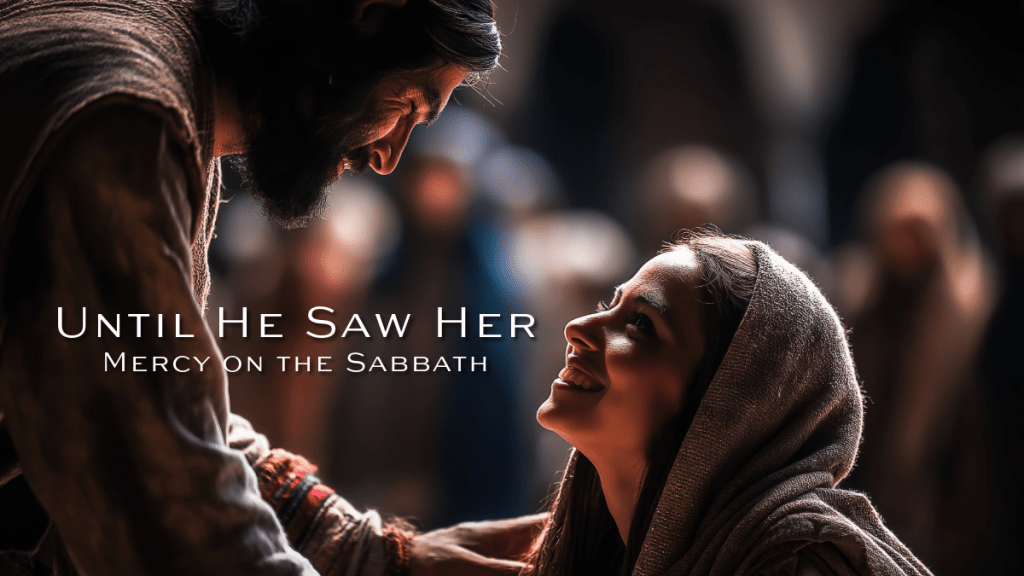
In Luke 13:10–17, we encounter a tender and quiet but revolutionary moment in the ministry of Yeshua/Jesus. He is teaching in a synagogue on the Sabbath, a setting of formality defined by Scripture, tradition, and order. In that sacred space stands a woman bent double for eighteen years, “unable to fully straighten herself” (Lk. 13:11). Luke tells us she had “a spirit of weakness (πνεῦμα ἀσθενείας),” language denoting debilitating weakness, whether physical or spiritual. She is present, but unnoticed. She is faithful, but seemingly forgotten. But then Jesus sees her.
The text begins with a simple yet profound phrase: “When Jesus saw her” (Lk. 13:12). In a crowded synagogue, amid the scrolls, the teachings and the voices, He sees the one whose suffering had become background noise. For eighteen years she had lived bowed over, her life shaped by pain, her gaze fixed toward the ground. But Messiah’s eyes lift her before His hands ever do. Her healing begins with His attention. He sees what others have normalized. He notices what hardened religion has learned to step around and avoid.
Jesus calls her forward. The initiative is His. She did not cry out like blind Bartimaeus, or reach through a crowd like the woman with the issue of blood. She simply responds when summoned. And in front of the congregation He speaks a declarative word: “Woman, you are loosed from your disability/infirmity.” Then He lays His hands upon her, and immediately she is made straight, and she glorifies God (Lk. 13:13) for this gracious answer to prayer.
This healing is physical, but it is also spiritually symbolic. The bent woman embodies the condition of humanity under the weight of sin, suffering, and spiritual bondage. Eighteen years of curvature, nearly two decades of diminished horizon and hope. When Yeshua touches her, she stands upright. Restoration in Scripture is often described as being made straight, aligned again with God’s design. The One who forms humanity from the dust now reforms what has been distorted.
Yet the miracle exposes another distortion, not in her spine, but in the synagogue ruler’s heart and theology. Instead of rejoicing, he is indignant. He protests that there are six days for work and that healing should occur then, not on the Sabbath (v. 14). His objection reflects the common guarding of Sabbath boundaries prevalent at the time regarding methods of permissible healing on the day of rest, a subject too nuanced for proper treatment here. Still, his concern was common, and not entirely frivolous, as sabbath observance was central to Israel’s covenant identity. But this application reveals a rigidity that stressed rule over restoration.
Yeshua responds sharply: “Hypocrites!” If they untie (λύει) an ox or donkey to lead it to water on the Sabbath, how much more should this “daughter of Abraham, whom Satan bound for eighteen years, be loosed (λυθῆναι) from this bond on the Sabbath day?” (Lk. 13:15–16). The underlying wordplay is deliberate. They “loose” animals; but Jesus “looses” a daughter of Abraham. Shabbat, the day of rest, is precisely the right day for liberation. The Sabbath commemorates God’s rest after creation, but also Israel’s deliverance from Egypt (Deut. 5:15). What could be more Sabbath-shaped than setting someone free?
Here Jesus corrects a form of religion that has forgotten its telos, its purpose. The law was never meant to hinder mercy. The Sabbath was not given to prevent healing, but to proclaim wholeness and rest to a nation of freed slaves. In confronting the synagogue ruler, Jesus does not abolish the Sabbath; He restores its heart. Mercy is not a violation of holiness; it is its fullest expression.
The crowd rejoices at His glorious deeds, while His adversaries are put to shame (Lk. 13:17). The dividing line is not between those who love Scripture and those who do not, but between those who recognize the Messiah’s compassionate authority to heal on Shabbat, and those who cling to their own position.
What is the application for today? It is possible to inhabit sacred spaces, defend orthodox positions, and yet fail to see the bent, the burdened, and the silenced among us. Churches can become so structured, so protective of programs and propriety, that they inadvertently resist the disruptive mercy of Christ. We may not protest healing on the Sabbath, but we may quietly resent the inconvenience of grace when it interrupts our schedule, our expectations, or our sense of decorum.
This passage calls us to cultivate Christlike sight. Who stands bent in our midst: physically, emotionally, spiritually? Who has carried affliction so long that we no longer notice? The church must be the place where such persons are called forward, touched with compassion, and reminded that they are sons and daughters of Abraham, heirs of promise (Gal. 3:29).
Moreover, Luke 13 challenges leaders in particular. Authority in the kingdom is not exercised by guarding systems at the expense of people, but by shepherding souls toward or into deeper freedom. Where religious convention conflicts with mercy, Jesus sides with mercy. This is a necessary adjustment and alignment for many of us in leadership.
The gospel is a straightening word spoken over bowed lives: “You are loosed.” And when Messiah lays His hand upon a person, the proper response is not suspicion, but praise. Amen!
Maranatha. Shalom.
 the mountain mensch