The biblical fall feasts, Rosh Hashanah (Yom Teruah), Yom Kippur, and Sukkot, form a holy triad of repentance, redemption, and restoration. Rooted in Leviticus 23, and echoed throughout Scripture, these mo’adim (מוֹעֲדִים/appointed times) are not just historical observances, but prophetic rehearsals of the return of Messiah, and the healing of the nations. They trace a divine arc: awakening through the shofar/trumpet, cleansing through atonement, and dwelling in joy under God’s shelter. For disciples of Messiah Yeshua/Jesus, this progression reveals the heart of the gospel and the hope of the age to come.
In Leviticus 23:23–25, “And the Lord spoke to Moses, saying,“Speak to the people of Israel, saying, In the seventh month, on the first day of the month, you shall observe a day of solemn rest, a memorial proclaimed with blast of trumpets, a holy convocation. You shall not do any ordinary work, and you shall present a food offering to the Lord.”
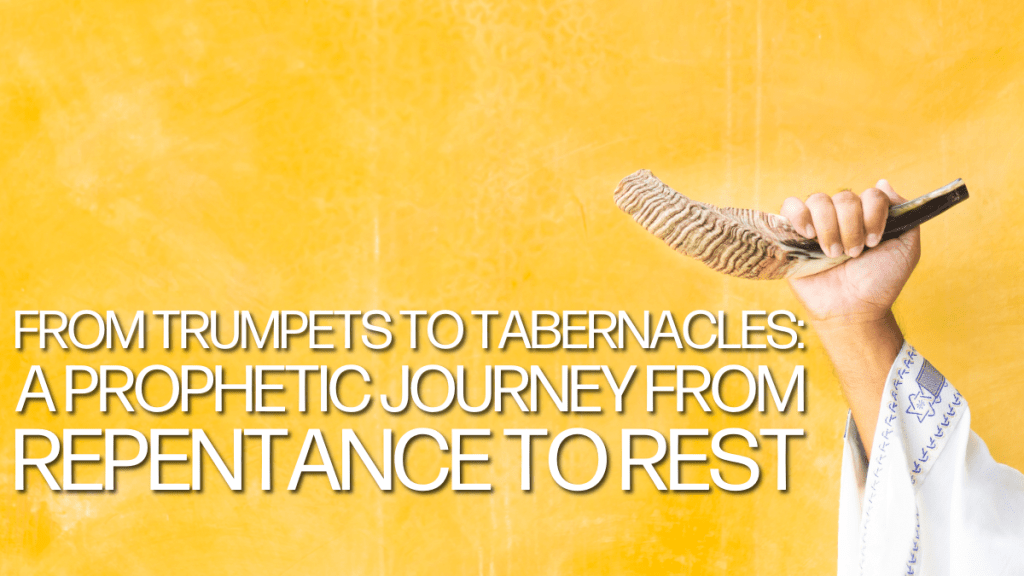
Rosh Hashanah (רֹאשׁ הַשָּׁנָה), or Yom Teruah (יוֹם תְּרוּעָה/Day of Trumpets), marks the beginning of the civil year, traditionally, and initiates the Ten Days of Awe (יָמִים נוֹרָאִים). The shofar blast pierces the soul, calling God’s people to awaken from spiritual slumber. Rabbinic tradition teaches that the shofar is a divine alarm clock, “Even though the sounding of the shofar on Rosh Hashanah is a decree, it contains an allusion. It is as if it is saying: Wake up you sleepy ones from your sleep and you who slumber, arise. Inspect your deeds, repent, remember your Creator. Those who forget the truth in the vanities of time and throughout the entire year, devote their energies to vanity and emptiness which will not benefit or save: Look to your souls. Improve your ways and your deeds and let every one of you abandon his evil path and thoughts” (Rambam, Hilchot Teshuvah 3:4).
The month of Elul (אֱלוּל), preceding the month of Tishrei (תִּשְׁרִי) when the fall feasts occur, is a time of introspection. The sages say, “The King is in the field,” a metaphor indicating accessibility to the Lord. Isaiah exhorts us, “Seek the Lord while he may be found; call upon him while he is near.” This season is inviting us to approach God not in fear, but in intimacy.
The Apostle Paul writes, “For the Lord himself will descend from heaven with a cry of command, with the voice of an archangel, and with the sound of the trumpet of God. And the dead in Christ will rise first” (1 Thess. 4:16). Prophetically, the shofar heralds the return of Messiah, the resurrection of the dead, and the gathering of the elect (Matt. 24:31). It is both coronation and warning, it is a sound calling humanity to prepare for judgment. We need to ask ourselves, where do we stand?
Yom Kippur (יוֹם כִּיפּוּר) is the day of atonement and intercession. In Leviticus 23:30 we read, “For on this day shall atonement be made for you, to cleanse you; from all your sins shall ye be clean before the Lord.” Yom Kippur is the holiest day of the biblical calendar, a solemn fast marked by confession, prayer, and repentance. In ancient Israel, the high priest entered the Holy of Holies to offer blood for the sins of the people. The scapegoat, bearing the nation’s transgressions, was sent into the wilderness to Azazel (Lev. 16).
Rabbinic tradition holds that on Yom Kippur God seals the verdict written on Rosh Hashanah, expressed in the prayer “Unetaneh Tokef” as “On Rosh Hashanah it is written, on Yom Kippur it is sealed.” The Mishnah (Yoma 8:9) teaches, “For transgressions between man and God, Yom Kippur atones; but for transgressions between man and his fellow, Yom Kippur does not atone until he appeases his fellow.” This underscores the relational dimension of repentance, the horizontal dimension of repentance between men, not just the vertical between men and God.
Nevertheless, Yeshua, our High Priest, entered the heavenly sanctuary once for all, offering His own blood for eternal redemption (Heb. 9:11–14). No longer would the blood of bulls, sheep, goats or doves be needed, as the One to whom they pointed dwelled among us, even gave Himself completely for us. Yom Kippur prophetically points to the final judgment, even more, the repentance of Israel: “And I will pour out on the house of David and the inhabitants of Jerusalem a spirit of grace and pleas for mercy, so that, when they look on me, on him whom they have pierced, they shall mourn for him, as one mourns for an only child, and weep bitterly over him, as one weeps over a firstborn” (Zech. 12:10; cf. Ro. 11:26-27). Praise the Lord for Yeshua.
The season reaches its prophetic arc in Tabernacles: “You shall dwell in booths for seven days. All native Israelites shall dwell in booths, that your generations may know that I made the people of Israel dwell in booths when I brought them out of the land of Egypt: I am the Lord your God” (Lev. 23:42-43).
Sukkot (ֿסֻכּוֹת/Tabernacles) is a week-long celebration of God’s provision and presence. Families build temporary shelters (sukkot) to remember the wilderness journey and God’s faithfulness. It is a feast of joy, hospitality, and unity. The Talmud (Sukkah 11b) interprets the booths as symbolic of the divine clouds of glory that surrounded Israel. The Midrash adds that Sukkot anticipates the Messianic age, when all nations will come to worship the King. The Apostle John connected the incarnation of Messiah in John 1:14 with tabernacles, “And the Word became flesh and dwelt among us..” or “tabernacled among us,” even more, “pitched His tent among us.”
Zechariah 14:16 declares: “Then everyone who survives of all the nations that have come against Jerusalem shall go up year after year to worship the King, the Lord of hosts, and to keep the Feast of Booths” (cf. Rev. 21:24-26). Sukkot foreshadows the ingathering of the nations and the dwelling of God with humanity. In Revelation 7:15, John records, “Therefore they are before the throne of God, and serve him day and night in his temple; and he who sits on the throne will shelter (fix His tabernacle) them with his presence.” Revelation 21:3 echoes this: “And I heard a loud voice from the throne saying, “Behold, the dwelling placeof God is with man. He will dwell with them, and they will be his people, and God himself will be with them as their God.” Here we find the reversal of Genesis 11, the healing of Babel’s scattering.
Genesis 11 recounts humanity’s rebellion at Babel, where God confused languages and scattered the people. This judgment fractured human unity, and birthed tribalism. But Sukkot envisions a restored, redeemed humanity through the Gospel, diverse yet united in Messiah. The shofar of Rosh Hashanah calls the nations to awaken. Yom Kippur invites them to repent. Sukkot gathers them into God’s presence. The fall feasts are a picture of reconciliation.
In Bava Batra 75a Rabbi Yohanan comments: “In the future, the Holy One, blessed be He, will prepare a sukkah for the righteous from the skin of the leviathan,” a poetic image of divine shelter, and eschatological joy, when all the big questions of life (represented by leviathan skins) are settled.
The journey through the fall feasts begins not with celebration but with contrition. We enter in a posture of repentance. The shofar is not a party horn, it is a broken cry for mercy. The Days of Awe are a spiritual corridor, leading from self-examination to divine embrace.
Micah 6:8 reminds us: “He has told you, O man, what is good; and what does the Lord require of you but to do justice, and to love kindness, and to walk humbly with your God?” Repentance (teshuvah) is not shame, it is return. As Paul tells us, “For the Scripture says, “Everyone who believes in him will not be put to shame” (Ro. 10:11). It is the heart’s homecoming, as the Psalm 34:18, “The Lord is near to the brokenhearted and saves the crushed in spirit.”
How do we apply this today?
- Awaken: Let the trumpet stir your soul. Examine your life and renew your devotion.
- Repent: Embrace the grace of Messiah. Confess, forgive, and be reconciled.
- Celebrate: Build your “booth,” a space of joy, gratitude, and presence. Invite others in.
- Hope: Live with expectancy. Messiah is coming to tabernacle among us and restore all things.
In a fractured world, the fall feasts point us to healing. They remind us that judgment is not the end for those in Christ, dwelling is. That repentance leads to joy. That Messiah will return to bring us to the place of rest He has prepared for us.
The fall feasts are not relics of the past, they are rehearsals for the future. They invite us into God’s rhythm of redemption and point to the glorious return of Messiah, the healing of the peoples, and the dwelling of God with His people.
As believers, we do not just observe, we participate and are immersed in them. We sound the trumpet, we rest in His atonement, and we build a tabernacle of praise. And in doing so, we proclaim: בָּרוּךְ הַבָּא בְּשֵׁם יְהוָה ,“Blessed is He who comes in the name of the Lord” (Ps. 118:26).
Maranatha. Shalom.
 the mountain mensch
Thank you Rabbi for the reminder, the awakening and the coming of Yeshua ❤️🙏🏻🙏🏻
Sent from Yahoo Mail for iPhone
LikeLike