In this week’s Torah portion, the Lord seems to be making a radical departure from a more personal narrative, to one that seems to focus on the legal matters of a nation. Is there a reason for this besides the obvious? Can the Lord be teaching us something important for the life of faith in Messiah Yeshua/Jesus? Yes, and amen. The Lord begins to transform memory. Give a listen.
“And these are the judgments/ordinances that you are to put before them.”
This is the beginning of the legal code, understood to be a continuation of the Sinai revelation. This portion contains twenty-three (23) positive commandments, and thirty (30) prohibitions. Most of these are formulated as casuistic statements, case law, or: “if … then” conditionals. In the previous portion of Yitro/Jethro, the ten commandments were formulated as apodictic commandments.
Considering these together, apodictic commandments, such as “you shall not murder,” gives a general prohibition, but does not address accidental death, or manslaughter. Casuistic laws give general circumstances from which a determination can be made in a specific situation.
In Exodus 21:22, we find an example of a casuistic law that deals with the harm done to an unborn child. This law protects the life of the unborn, and defines a pattern of justice for harm done. In this case, the Law of Talion, “eye for eye” and so on. The Law of Talion is understood to be concerned primarily with monetary damages for bodily harm, except in the case of murder, when it was life for life. It is not, as Mr. Gandhi suggested, a law of mutilation.
It is important to study, reflect on, and rightly apply the Word of God to life and community, particularly in these days of popularized relative morality, and a feel good ethic. The Word of God is forever, unchanging, and contains the eternal ethical norm of the Living God (Ps. 119:89). While not everything in the law, or the Torah, is literally normative for us today, by the Lord’s design, it remains His will, as a revelation of His heart and character.
When we consider portions like Mishpatim, filled with legal code that allows me to rattle off $5 words, and an occasional $10 word dealing with the technical issues of the Torah, it is difficult to inspire the next generation, or even our current generation, if we sermonized the legal code of the Torah in public exposition. How then, do we transmit the principles of our biblical faith from one generation to the next, to include this dense ethical matter? This portion illustrates for us the importance of ethical, social and religious norms, but we must remember in our exposition that the Lord desires to speak to the heart as well as the mind.
The apostle Paul aids us in our consideration here, as he writes, “And do not get drunk with wine, for that is debauchery, but be filled with the Spirit, addressing one another in psalms and hymns and spiritual songs, singing and making melody to the Lord with your heart, giving thanks always and for everything to God the Father in the name of our Lord Yeshua/Jesus the Messiah,” (Eph. 5:18-20).
Song. Song penetrates the heart, especially spirit-filled song. Paul encourages us to “pluck the heart” as an instrument, and to sing from the heart. There is a rabbinic expression that says, “words spoken from the heart enter the heart.” If this is true, then it stands to reason that words sung from heart enter the heart as well.
Song is vitally important in Scripture. Consider some examples:
Revelation 15:3: we find the redeemed of the Lord singing the Song of Moses, and the Song of the Lamb. Revelation 14:3: the 144,000 stand before the Throne and sing a new song to the Lord. Matthew 26:30: before departing for the Mt. of Olives, Messiah and the disciples sing the Hallel of the Passover Seder.
One of the greatest poems of love is called the Song of Songs/Solomon. Further, many of the Psalms open with: מִזְמוֹר לְדָוִד, “this is a song/melody of David.” In Exodus 15:1, after the crossing of the Red Sea, it was not a great sermon that the children of Israel listened to, it was a song they sang.
The entire Hebrew Bible, Old Testament, is, in fact, one long melody … even the legal bits.
Song permeates the life of my home congregation, Messiah Congregation. As the congregational rabbi and song leader, I love song in communal life, songs about the Lord. Whether before, during, or after a service, or during the week, you will hear song echoing through our congregational building.
In Deuteronomy 31:19, when speaking of the Torah, the Lord speaks of it as a song: “Now therefore write this song and teach it to the people of Israel …” When we approach the Torah, whether we study, memorize, or read in the congregation, the Lord says, “write this song for yourselves … learn it by heart.”
The Lord likens the Torah to a song, and it is sung from week to week with a melody all its own. Here we return to a connection to the next generation.
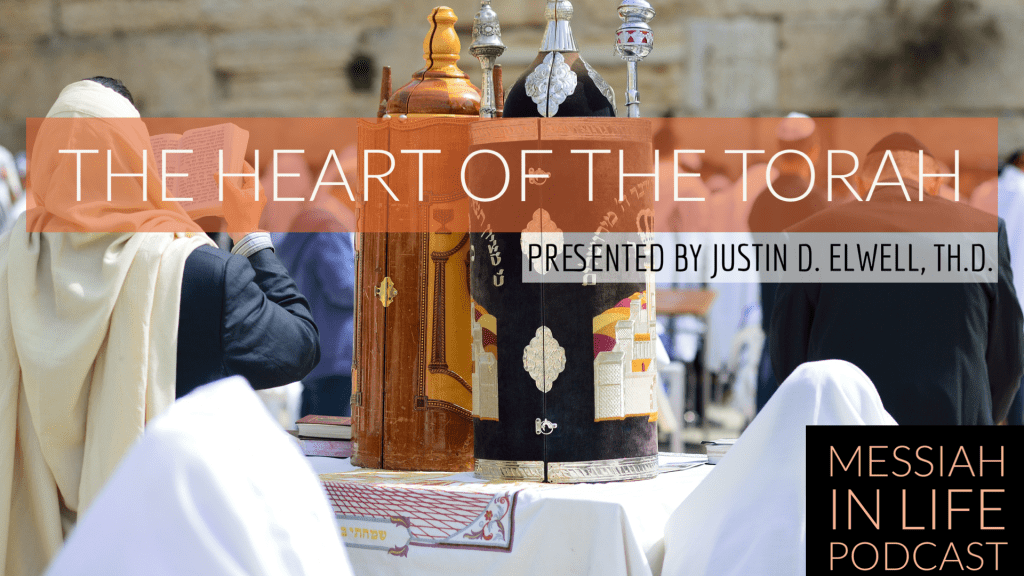
The rabbis find in Deuteronomy 31:19 a command that the Israelite must write a copy of the Torah for himself. Yet, not everyone has the skill to do so. A later tradition developed that as a scribe wrote the final lines of a Torah scroll, he would simply outline the final letters, not filling them in. As the scroll of the Torah is being completed, each letter in the final lines are filled in by different people to fulfill the words of Deuteronomy 31:19; and a joyous celebration called סיום/Siyyum (completion) is held. In this celebration, we find the generations present in joy and song.
See our songs of faith, hope, love, and even theology become the outline of the letters of the Torah. At this point the Torah can still be read, but they must be filled in. We help fill in the letters of the next generation by teaching their meaning, and being examples of their meaning in life. The letters are filled by the renewed heart in faith. Intellect wrote the letters, but the heart fills them with life.
Song, praise, and psalms are not only important in worship of the Living God, they help to transmit the substance of the dense theological matter contained in these more difficult passages. For one generation, the letters have been filled with meaning, to the next, the outline is being drawn: with the heart, and to the heart in song.
From generation to generation, the song of the Word continues, even as the Lord Himself “rejoices over you with singing” (Zeph. 3:17).



 the mountain mensch