
“And over His head they put the charge against Him, which read, ‘This is Jesus, the King of the Jews’” (Matt. 27:37).
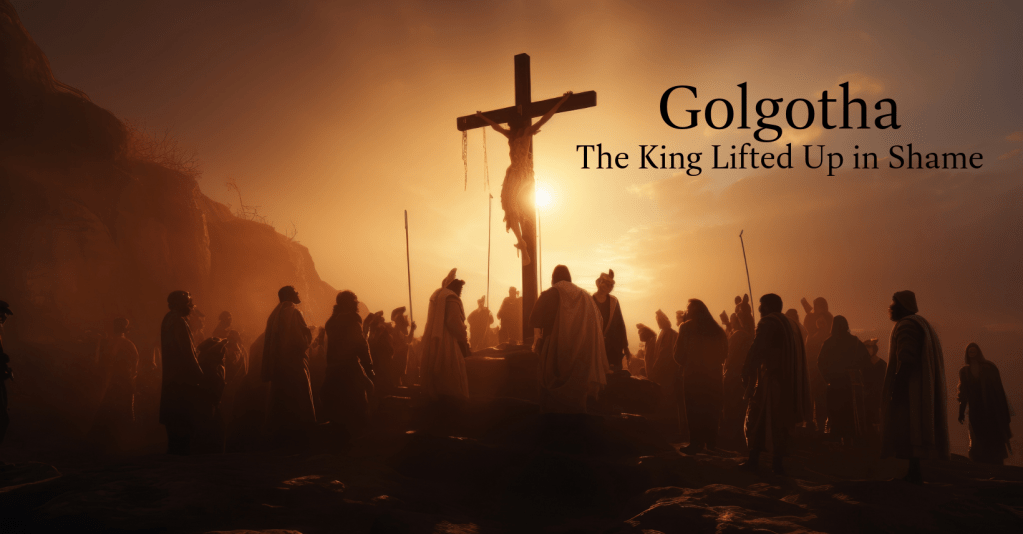
When Matthew brings us to Golgotha, he slows the narrative. The placename itself arrests us: Golgotha, Γολγοθᾶ, from the Aramaic/Hebrew גֻּלְגֹּלֶת (gulgōlet), “the place of a skull” (Matt. 27:33). This was not a hidden, dark corner of Jerusalem. Rome preached terror from crosses; God preached redemption from one. Mark notes that “those who passed by” reviled Him (Mk. 15:29), suggesting a location along a busy roadway, especially crowded during Pesach/Passover. Rome chose prominence for deterrence. God chose prominence for redemption.
Matthew records that Yeshua/Jesus was offered wine to drink mixed with gall (27:34). Mark specifies wine mingled with myrrh (Mk. 15:23). It was a mercy of sorts. Women in Jerusalem were known to provide a narcotic in this mixture to dull the agony of crucifixion. Yet Messiah tasted it and refused. He would not numb the cup the Father had given Him. The Cross would not be endured in partial consciousness. The Son would drink suffering to its dregs. The agony—physical, spiritual, judicial—would be fully borne. The Lamb would be lucid.
Still, crucifixion was not just execution; it was humiliation. The victim was stripped naked. The One who clothed Adam and Eve (Gen. 3:21) now stands unclothed before the world He made. “They divided His garments among them, casting lots” (Matt. 27:35). The soldiers, indifferent and methodical, gamble at the foot of the Cross. Matthew alludes unmistakably to Psalm 22: “They divide my garments among them, and for my clothing they cast lots” (Ps. 22:18). What David lamented in poetic anguish becomes literalized in Messiah’s suffering. The Scripture does not just echo here—it unfolds.
Christ bears not only pain but shame. The stripping of His garments mirrors the stripping away of dignity. But this is no accident of history. As Isaiah 53 declares, He bore our griefs and carried our sorrows; the chastisement that brought us peace fell upon Him. Our shame is transferred. Our nakedness is covered by His exposure.
“And sitting down, they kept watch over Him there” (Matt. 27:36). They waited for Him to die.
What chilling ordinariness. The soldiers settle in beneath the Cross as though beneath a tree’s shade. They are numb to the agony just above them. And the passing world watches its Maker gasp for breath.
Above His head they fasten the charge visible for all who care to know: “This is Jesus, the King of the Jews” (27:37). While Rome intends mockery, heaven declares truth. The sign is meant as accusation; it becomes proclamation. The King reigns from a throne of wood stained with blood.
The humiliation crescendos. Passersby wag their heads. Chief priests, scribes, and elders sneer with theological precision: “He trusts in God; let God deliver Him now, if He desires Him” (Matt. 27:43). Again, the language of Psalm 22 resounds: “He trusts in the Lord; let Him deliver him” (Ps. 22:8). The religious leaders, supposed guardians of Scripture, unknowingly recite prophecy as they ridicule its fulfillment. Their scorn is not only aimed at the Son—it is aimed at the Father. If this Man is the beloved Son, let God prove it.
Even the robbers crucified with Him join in the reviling (Matt. 27:44). Messiah is encircled by contempt: Rome below, Israel above, criminals beside Him. And there He hangs in total rejection.
Yet herein lies the mystery: the mockery confirms the mission. The One they challenge to “come down from the Cross” remains upon it precisely because He is the Son. Salvation requires endurance, not escape. Psalm 22 reads as a prophetic crucifixion narrative centuries before Rome perfected the practice: pierced hands and feet (Ps. 22:16 LXX), exposed bones, mocking crowds, divided garments. David writes in lament, but the Spirit carries his words forward into redemptive history.
Yet Psalm 22 does not end in despair. It moves from abandonment to proclamation: “All the ends of the earth shall remember and turn to the Lord” (Ps. 22:27). The Cross is both the depth of humiliation and the seed of global mission and worship. Likewise, Isaiah 53 frames the suffering as substitution. He is pierced for our transgressions. He bears the punishment rightly due to us. What appears as defeat is covenant fidelity. What appears as abandonment is atonement.
Here, at the place of Golgotha, we see the theology of the Cross of Messiah.
Public shame: Messiah exposed before the nations.
Prophetic fulfillment: Scripture embodied in flesh and blood.
Substitutionary suffering: the Innocent in the place of the guilty.
Unyielding obedience: the Son trusting the Father amid abandonment.
He refuses the narcotic. He endures the scorn. He remains upon the Cross. Not because He lacks power, but because He loves His people. The place of the skull becomes the place of new creation. The King enthroned in mockery inaugurates a kingdom not of coercion, but of sacrifice. The One stripped naked clothes a redeemed humanity in righteousness. Golgotha stands as both warning and wonder: a deterrent to rebellion in Rome’s design, and the decisive act of redemption and reconciliation by the Lord’s design.
Maranatha. Shalom.
 the mountain mensch