
Shepherds After God’s Own Heart

Pastoral ministry is not a profession, it is a vocation, even a sacred trust. The apostle Paul, in his farewell to the Ephesian elders, reminds us that the flock we tend was purchased at the highest cost: the precious blood of Messiah. This truth alone should fill every pastor’s heart with trembling reverence and holy resolve.
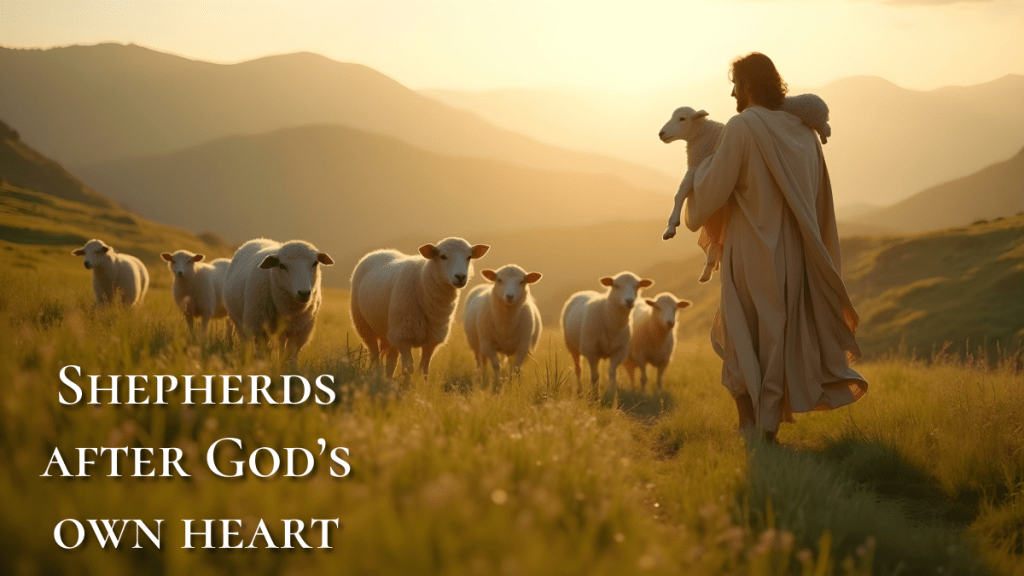
“Take heed to yourselves and to all the flock, among which the Holy Spirit has made you overseers, to shepherd the church of God which He purchased with His own blood” (Acts 20:28).

Our vocation comes by the calling of Christ. Our training by the study of God’s Word, taught by the Holy Spirit, at the feet of proven, elder ministers and teachers. Our principal study is the Word of God, with our mission the tending to and salvation of souls. Keeping always before us this high calling cuts through distractions and vain ambitions. Faithfulness in prayer, worship and devotion will continually draw us back to the two pillars of pastoral vocation: the Word and the care of the soul. 

The Anglican Bishop JC Ryle wrote:

 “Like the sower, the preacher must sow good seed if he wants to see fruit. He must sow the pure Word of God, and not the traditions of the church or the doctrines of men. Without this, his labor will be vain. He may go to and fro, and seem to say much, and to work much in his weekly round of ministerial duty, but there will be no harvest of souls for heaven, no living results, and no conversions.

Like the sower, the preacher must be diligent. He must spare no pains; he must use every possible means to make his work prosper; he must patiently sow beside all waters, and sow in hope. He must “instant in season and out of season,” he must not be deterred by difficulties and discouragements; “he that observeth the wind shall not sow.” No doubt his success does not entirely depend upon his labor and diligence, but without labor and diligence success will not be obtained (Isa. 32:30; 2 Tim. 4:2; Ecc. 11:4). 

Like the sower, the preacher cannot give life. He can scatter the seed committed to his charge, but he cannot command it to grow: he may offer the word of truth to a people, but he cannot make them receive it and bear fruit. To give life is God’s solemn prerogative: “It is the Spirit that quickenth.” God alone can “give the increase” (Jn. 6:63; 1 Cor. 3:7). 

Let these things sink down into our hearts. It is no light thing to be a real minister of God’s Word. To be an idle, formal workman in the church is an easy business; to be a faithful sower is very hard. Preachers ought to be specially remembered in our prayers.”

Rabbi Jonathan Sacks, reflecting on leadership, said, “A leader is one who takes responsibility.” In the pastoral context, this means bearing the burdens of the people with compassion, while lifting their eyes to the greatness of God. We are not CEOs or entertainers, we are under-shepherds of the Good Shepherd, entrusted with the care of eternal souls.

Paul’s exhortation in Acts 20 is both sobering and empowering. “The Holy Spirit has made you overseers,” you did not appoint yourself. You were chosen, anointed, and sent. This divine commissioning is not a burden to bear alone, but a grace we walk in daily with the Holy Spirit.

Dear shepherd of God’s people, when the weight of ministry feels heavy, remember: you are not alone. The Chief Shepherd walks with you. The Word you preach is living and active. The people you serve are beloved of God. Your labor is not in vain.

Let your study of Scripture be a sanctuary. Let your care for souls be your joy. Let your leadership be marked by humility, courage, and love. You are doing holy work. You are laboring in His harvest field. You are, and you should prayerfully be, a shepherd after God’s own heart.

Lord, strengthen every pastor who reads this. Renew their vision, restore their joy, and remind them of the sacredness of their calling. May they teach Your Word with clarity, care for Your people with compassion, and lead with wisdom born of a deep relationship with Jesus. Let them feel Your pleasure in daily walk and work. Protect and encourage their families. Give them strength to labor, and wisdom to rest. And may all they do be for Your glory. Amen.

Be encouraged, the Lord knows your heart and commitment. 

Maranatha. Shalom. 

Shepherds

“I am not able to carry all these people by myself. The load is too heavy for me! If this is how You are treating me, kill me now! If I have found favor in Your eyes, kill me please—don’t let me see my own misery!” (Num. 11:14-15).

Unlike the other books of the Torah that record the history of the children of Israel in the wilderness, the Book of Numbers contains a very personal record of not only the peoples struggles in faith, but the leaders struggle as well. The Torah portion Beha’alotecha (meaning “when you raise” Numbers 8:1 – 12:16) reminds us that even in relationship with the covenant Lord, Creator of the Heavens and Earth, we are all still very much human and in need of His grace.

The rabbis have wrestled with the Torah’s inclusion of the struggles of Moses, Aaron and Miriam, all of whom display moments of weakness in Beha’alotecha. Should the Torah have included the cry of Moses to the Lord of הָרְגֵנִי נָא, “kill me now” (Num. 11:14-15)? Or, Miriam and Aaron speaking Lashon Harah (evil speech) about Moses (Num. 12:1-2)? In my opinion, yes; but perhaps not for the reason you might think.

It is common today for members of a congregation or laborers in a ministry to forget that pastors (or leader, whichever language is comfortable for you) are human. We have personal struggles, areas of weakness, family concerns, economic concerns, health battles, and physical limitations just like everyone else. We have not graduated to a higher “level” of perfection because of ministry calling – only greater responsibility. One key difference is that a pastor usually has dozens, if not hundreds, of lives connected to him all in need of some type of care and counsel.

When a pastor is overcome by the pressures of life and ministry, onlookers may view this as a weakness in character, failure in vocation, or spiritual immaturity. For this reason pastors are often afraid to share their personal, moral or family struggles with their elders, organizational presbytery, even their accountability partners. Instead, many suffer in silence, in some type of emotional isolation, which ultimately causes the congregational family to suffer, without an awareness as to why. Most importantly, the pastors family suffers and struggles as well. I can say from personal experience, there were too many instances when I was physically present with my family, but mentally distant, attempting to work through an issue related to ministry. This I’ve tried to rectify and make up for in recent years.

The apostle Paul demonstrates for us a proper way of handling our (all disciples of Messiah) struggles, our shortcomings and our fears when he writes, “I pleaded with the Lord three times about this, that it might leave me. But He said to me, ‘My grace is sufficient for you, for power is made perfect in weakness.’ Therefore I will boast all the more gladly in my weakness, so that the power of Messiah may dwell in me. For Messiah’s sake, then I delight in weakness, in insults, in distresses, in persecutions, in calamities. For when I am weak, then I am strong” (2 Cor. 12:8-10). Paul struggled with an undisclosed “thorn in the flesh” (2 Cor. 12:7). This thorn humbled Paul, and caused him to rely solely on the power of God in Messiah by the Holy Spirit – not his own strength, wisdom or eloquence.

While we should certainly avoid glorifying the source of our weakness, we must recognize that the weakness is there, and that by the power of God we continue, even in weakness, in order that His power might be perfected in us. Paul experienced many of the same struggles that pastors and leaders experience today: rejection, fatigue, resistance, obstacles, etc., yet he remained faithful by being sensitive and submissive to the Holy Spirit (Acts 16:6), not to the whims of men. This pattern has not changed. Still, there is more to this.

The Torah, and the entire narrative of the Bible for that matter, does not hide or diminish the failures of the “heroes” of the faith. The text is faithful to record their failures and triumphs. Moses, as we read above, has a terrible moment of weakness as he is confronted by the daunting task of shepherding the children of Israel. He cries out “kill me now” in that frustration. The Lord, in His grace, does not dignify this cry of desperation; rather, He asks Moses to “bring me 70 of the elders of Israel whom you know to be elders of the people and their leaders” (Num. 11:16). The remedy for the stress that Moses faces is a support staff of leaders to work closely with him, similar to the advice given by his father in law Jethro in Exodus 18:17-26.

Just as the people of a congregation need to have a shepherd in their lives to guide, advise and correct, pastors need trusted leaders (elders) to help bear the responsibility of ministry and advise them in times of struggle. Pastors need to be told to rest, delegate, seek the Lord in prayer and worship, take care of family first, and be free, at times, to be human just as Moses, Aaron, Miriam, Joshua, David, Peter, James, John, Paul, etc., were.

Now, some of you may be tempted to say, “I’ve read this devotional and it’s all about leaders and their needs.” As a pastor and overseer myself, I can tell you that I have witnessed too many good couples in ministry quit because, rather than support in a season of struggle, they received correction and rejection because they appeared too human to be solid or qualified shepherds. It is imperative beloved friends to remember that the under-shepherds of the flock remain sheep of the fold themselves, and are in need of the same love, support and help that you seek of us.

Leadership does not mean you will never face challenges in life, it means being transparent enough before the Lord to admit that you need help – just as Moses and Paul exampled. This is not a weakness. Quite the opposite, it’s one of a leaders most important qualities – knowing that you need the Lord, recognizing that He is with you, and that you are trusting Him with your life, your heart and your reputation.

“Remember that the Holy Spirit lives inside you, and he battles on your behalf even when you don’t have the sense to. Remember to that in Christ you’ve already been given everything you need to be what you’re supposed to be and to do what you’re supposed to do in the place where God has positioned you. And remember that since Emmanuel is with you, it’s impossible to ever be alone in the moment-by-moment war that is pastoral ministry.” Dr. Paul David Tripp

Do not be tempted to labor alone, the Lord will always provide a plurality of eldership, and able hands, to labor beside us as shepherds. This I’m still learning, and I can assume you are as well; but for all of our faults, failures, imperfections and inabilities, the One Who saved us, will never leave, nor forsake us.

Be well. Shalom.