
In the midst of the plague narrative of Exodus, the Lord gives the children of Israel a continual remembrance even as He commands a yearly remembrance. How are the two, applying a physical reminder and Passover, related?
In Exodus 13:9, 16 we read, “And it shall be to you as a sign on your hand and as a memorial between your eyes, that the law of the Lord may be in your mouth. For with a strong hand the Lord has brought you out of Egypt … It shall be as a mark on your hand or frontlets between your eyes, for by a strong hand the Lord brought us out of Egypt.”

The rabbis understand this literally: a physical application of the words above upon the body. The practice of laying Tefillin, defined below, endured through Israel’s long history, to the time of Yeshua/Jesus, even to today. Perhaps some background will aid our understanding.
The word תְּפִילִּין/Tefillin is the plural of Tefillah, meaning to pray. The word “tefillin” is not found in the Bible; rather, the Torah refers to Tefillin as: ot, zikaron, or ṭoṭafot, sign, remembrance and something immovable, respectively.
When the Jewish translators of the Septuagint were searching the Greek language to translate, וְהָיוּ לְטטָפת בֵּין עֵינֶיךָ, “they shall be as frontlets between your eyes,” they settled on φυλακτήριον/phylaktērion, phylacteries, meaning: guarded post, safeguard, or security; as the Word of God is to guard, protect, and keep the people of God, something, as noted above, that is immovable. Why?
The command for תְּפִילִּין/Tefillin is found in Exodus 13:9, 13:16; Deuteronomy 6:8 and 11:18.
These four paragraphs are written on parchments inserted into the תְּפִילִּין/Tefillin – one compartment in the hand tefillin, and four compartments in the head tefillin. There is one parchment in the hand תְּפִילִּין/Tefillin, and four in the head תְּפִילִּין/Tefillin, from the singular and plural language found in the text of the Torah. As Deuteronomy 6:4-9 commands, the Word is to be applied to the head and the hand in order to demonstrate the love of God with all our heart, mind/soul and strength, more on this below.
Going a little deeper. The תְּפִילִּין/Tefillin are made from the skin, hair and sinew of kosher animals. The rabbis explain this demonstrates that the “animal nature” of man must be submitted to the will of God, or in Christian parlance: “the flesh/sin nature.”
Numbers play a symbolic role in the Tefillin as well. The boxes are each sealed with 12 stitches: for 12 months of the year. The number seven is found in the windings on the arm, as well as the Hebrew letter ש/shin found on two sides of the head תְּפִילִּין/Tefillin. The seven stems found on the two ש/shin letters may represent the patriarchs and matriarchs (7 total), the week of creation, or the perfect plan of God. The number seven in Hebrew is שָׁבַע, meaning to “to bind oneself by seven things,” also means to “make covenant,” the covenant partner being the one we are bound to. In Revelation 1:4, the Bride of Messiah, is represented by seven, as in the seven letters.
The two straps hanging from the head תְּפִילִּין/Tefillin represent love and judgment – love on the right, and judgment on the left, reaching down to creation. The three windings on the middle finger of the weaker hand represent betrothal.
As you apply the תְּפִילִּין/Tefillin, the following blessings are recited:
בָּרוּךְ אַתָּה ה’. אֱלהֵינוּ מֶלֶךְ הָעולָם. אֲשֶׁר קִדְּשָׁנוּ בְּמִצְותָיו. וְצִוָּנוּ לְהָנִיחַ תְּפִלִּין
“Blessed are you, Lord our God, Ruler of the Universe, who sanctified us with God’s commandments and commanded us to place the tefillin.”
בָּרוּךְ אַתָּה ה’ אֱלהֵינוּ מֶלֶךְ הָעולָם. אֲשֶׁר קִדְּשָׁנוּ בְּמִצְותָיו וְצִוָּנוּ עַל מִצְוַת תְּפִלִּין
“Blessed are you, Lord our God, Ruler of the Universe, who sanctified us with God’s commandments and commanded us regarding the mitzvah of tefillin.”
בָּרוּךְ שֵׁם כְּבוד מַלְכוּתו לְעולָם וָעֶד
“Blessed is the name of the Glory of God’s Kingdom forever.”
As the hand is wrapped:
וְאֵרַשְׂתִּיךְ לִי, לְעוֹלָם
וְאֵרַשתִּיךְ לִי בְּצֶדֶק וּבְמִשְׁפָּט וּבְחֶסֶד וּבְרַחֲמִים
‘וְאֵרַשתִּיךְ לִי בֶּאֱמוּנָה. וְיָדַעְתְּ אֶת ה
“I betroth you to me forever. I betroth you to me in righteousness, justice, lovingkindness, and mercy. I betroth you to me in faithfulness, and you shall know the Lord” (Hosea 2:21-22).
The verses from Hosea 2:21-22 brings the picture together. The donning of the טַלִּית/tallit, the Jewish prayer shawl, and the laying of the תְּפִילִּין/Tefillin is a picture of a bride preparing: a bride in identifying attire. In Hebrew bride and betrothed is כַּלָּה/kallah, from the root כָּלַל/kalal, meaning to make perfect or complete: to put a crown upon.
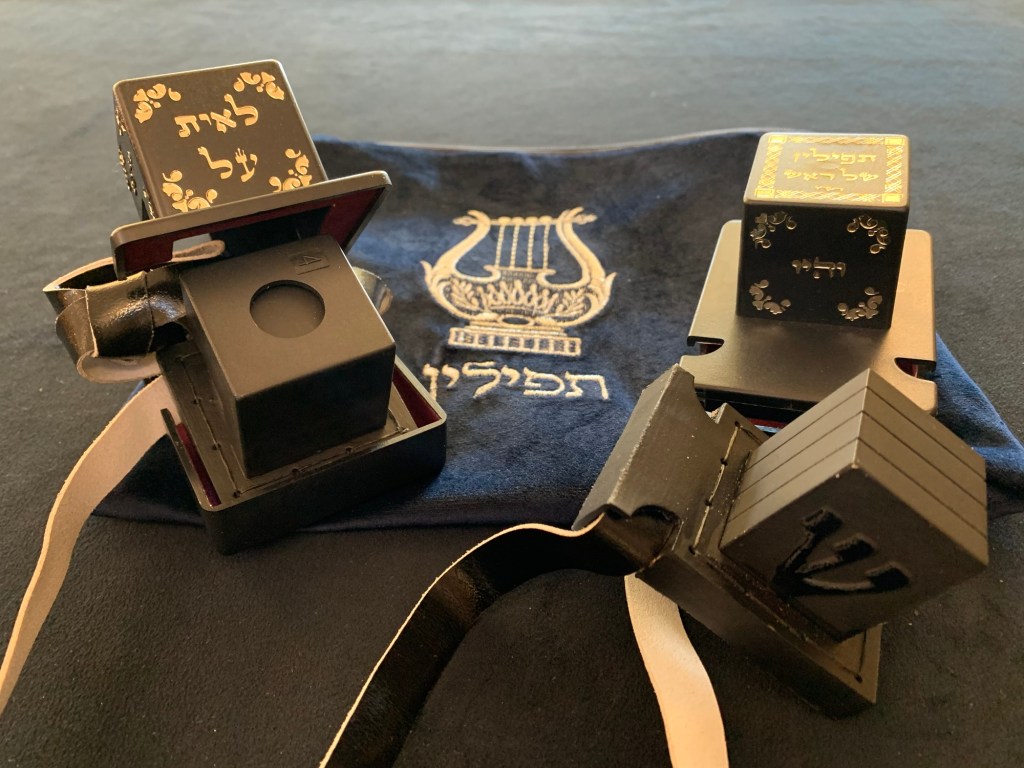
In the typological picture of the תְּפִילִּין/Tefillin, the head תְּפִילִּין/Tefillin is referred to as “the crown,” or “crown of righteousness,” a type Paul references. In the straps on the arm and hand, and on the boxes we find His name, identifying to whom we belong, and upon our hand, when we say the words from Hosea 2:21-22, we find a ring. All of this together טַלִּית/tallit and תְּפִילִּין/Tefillin is the bridal attire for those betrothed to Messiah to prepare for the Marriage Feast of the Lamb.
Finally:
Just as the Passover Seder as a remembrance is a living sermon meant to engage generations and the senses, Tefillin brings the head and the heart together in prayer. How?
1. Thought and Action
2. Creed and Deed.
3. Knowledge and Compassion.
The orthodoxy of mind, right thinking in learning, is taken a step higher through orthopraxy, doing what is right as an act of worship and prayer unto the covenant Lord.
Messiah Yeshua/Jesus teaches us: “Everyone then who hears these words of mine and does them will be like a wise man who built his house on the rock. And the rain fell, and the floods came, and the winds blew and beat on that house, but it did not fall, because it had been founded on the rock” (Matt. 7:24-25).
To hear and do the Word of Messiah, the forever settled Word of God, makes us, His disciples, a ṭoṭafot, something immovable in Him. Adorned in the garments of betrothal, no matter the plague or storm in life, we stand firmly established.
Underlying the faith life is the remembrance of deliverance as family gathering and bodily adornment. Now that we are free, how then shall we live?
Be well. Shalom.


 the mountain mensch