
Mourning in Hope

Life, whether we want to think about it or not, is walked out in a valley overshadowed by death (Ps. 23:4). How so? I do not mean this to be melancholic, but the longer you live, the more acquainted you become with death. I remember the first time that death came into my awareness when I was maybe four or five years old and I was told that my great-grandmother had passed away. I am not sure I understood what was told to me, but I remember weeping nonetheless. Now, I know why we weep, and how important it is to mourn. 
That valley can become evident suddenly, without warning; or, it may be a longer journey of goodbye. Yet, in the midst of that valley, David reminds us, “Yea, though I walk through the valley of the shadow of death, I will fear no evil: for thou art with me.” You, O Lord, are with us even when death overshadows us. 

Every week our congregation says a corporate prayer called the Mourners Kaddish, or just the Kaddish (קדיש). It is a prayer sanctifying the name of the Lord even in our times of sorrow. But more personally, when we are mourning among others, in community, there is someone beside us to say “Amen,” especially when we cannot. As Paul encourages: “Rejoice with those who rejoice, weep with those who weep” (Ro. 12:15).

In this week’s Torah portion called רְאֵה/Re’eh, Behold, we find a very short word of direction in times of mourning. In Deuteronomy 14:1-2 we read: 

“You are the sons of the Lord your God. You shall not cut yourselves or make any baldness on your foreheads for the dead. For you are a people holy to the Lord your God, and the Lord has chosen you to be a people for his treasured possession, out of all the peoples who are on the face of the earth.” 

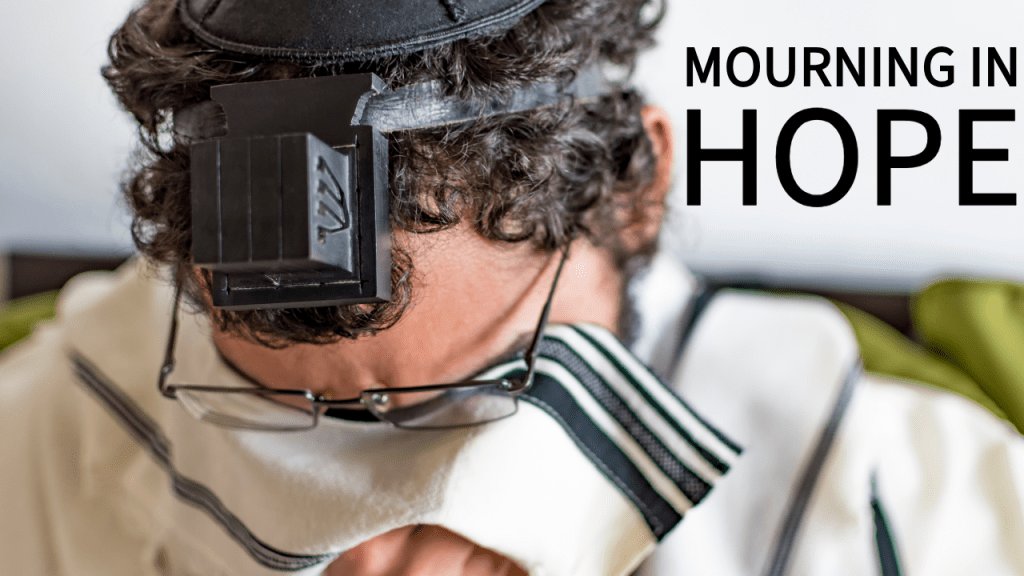
This direction in mourning is nearly unnoticeable: “you shall not make any baldness on your foreheads for the dead.” Why? Not simply to avoid the practice of other people groups, but because of what is put on the forehead, on that very spot: God’s Promises. 

Most people have seen pictures of תְּפִילִּין/Tefillin, or phylacteries, but have limited understanding of what they are for. The command for תְּפִילִּין/Tefillin is found in Exodus 13:9; 13:16; Deuteronomy 6:8; and 11:18. These four paragraphs are written on parchments inserted into the תְּפִילִּין/Tefillin. Deuteronomy 6:4-9 explains, the Word is to be applied to the head and the hand in order to demonstrate the love of God with all our heart, mind/soul, and strength. So they are placed on the arm adjacent to the heart and on the head above the brain to demonstrate that with our heart and mind we are willing to serve to the Lord.

Rather than marring the flesh while in mourning, we apply the promises of God to our life as His sons and daughters, as death for us has lost its sting.

The Apostle Paul encourages, “But we do not want you to be uninformed, brothers, about those who are asleep, that you may not grieve as others do who have no hope” (1 Thess. 4:13). In Messiah, we do not mourn as those who have no hope. We mourn, yes; but we are not without hope. Mourning is not sinful, and neither is it a symptom of weak faith. It is a time to recognize loss, and to allow others in to say “Amen.” We do not mourn as one without hope, why? Paul continues: 

“For since we believe that Jesus died and rose again, even so, through Jesus, God will bring with him those who have fallen asleep” (1 Thess. 4:14). There is the hope that we find only in Messiah, as Paul writes, “remember that you were at that time separated from Christ, alienated from the commonwealth of Israel and strangers to the covenants of promise, having no hope and without God in the world” (Eph. 2:12). 

Yeshua/Jesus, the Word and Promise of the Lord made flesh grieved, not so that we would not have to, but for us to know that we are permitted to. Still, our grief is informed by the Gospel. We do not mar the flesh in sorrow. We mourn in the sure and certain hope of the Resurrection. Mourning in hope directs us away from death, to life eternal, with His promises applied to our hearts and minds, remembering:

“He will wipe away every tear from their eyes, and death shall be no more, neither shall there be mourning, nor crying, nor pain anymore, for the former things have passed away” (Rev. 21:4). 

Maranatha. Shalom. 

Eikev: Torah 46

Tap pic for link!

In this portion, Moses reminds Israel of their miraculous provision from heaven, but then stresses, “Man shall not live by bread alone, but by every word that comes from the mouth of God.” This is a statement of not only provision, but also mission. How does this reminder inform us spiritually and supernaturally? Give a listen!

Believing the Sent One

I’ve never been so aware of my feet, my legs, my hips, my back, alright most of my body, as I’ve been since developing issues with my knees. Suddenly, those little things that I took for granted, like walking, getting dressed, sitting, standing, etc., became points of potential pain or even danger. By necessity I now carefully consider movement that was once second nature; yet, in this slowing, we might say, I have become more attentive to those “little things” overlooked before.

In this week’s Torah portion called עֵקֶב/Eikev, (Deut. 7:12-11:25) sometimes translated as because, if or wherefore, Moses calls Israel to faithfulness as they prepare to enter the Promised Land. With the difficulties before them, they need to remember the faithfulness of the covenant Lord, and in that remembrance, walk faithfully before Him regardless of the perceived obstacles along the way.

Still the word עֵקֶב/Eikev that opens the portion troubles some commentators, as we read:

וְהָיָה עֵקֶב תִּשְׁמְעוּן אֵת הַמִּשְׁפָּטִים הָאֵלֶּה וּשְׁמַרְתֶּם וַעֲשִׂיתֶם אֹתָם וְשָׁמַר יְהוָה אֱלֹהֶיךָ לְךָ אֶת־הַבְּרִית וְאֶת־הַחֶסֶד אֲשֶׁר נִשְׁבַּע לַאֲבֹתֶיךָ

“And because you listen to these rules and keep and do them, the Lord your God will keep with you the covenant and the steadfast love that he swore to your fathers” (Deut. 7:12).

The word עֵקֶב/Eikev is not often used in the Torah, or the entire Hebrew Bible for that matter, so its usage here by Moses seems deliberate. Rashi translates this first clause, “And it will be because of your listening to these ordinances …” He explains that Israel must heed even the small commandments that people often trample “with his heels” by not heeding them seriously. He is reminding the reader of the root meaning of עֵקֶב/Eikev, as “heel” or the bottom of the foot. Other rabbinic commentators, such as Ibn Ezra and Ramban, offer different or even harmonizing opinions to Rashi. Yet, Rashi seems to be pointing the reader to the first usage of the root word עָקֵב/ʿāqēḇ in the Bible, in Genesis 3:15, regarding the Seed of the woman:

  הוּא יְשׁוּפְךָ רֹאשׁ וְאַתָּה תְּשׁוּפֶנּוּ עָקֵב

 “He shall bruise your head, and you shall bruise His heel.”

The head of the נָחָשׁ/nāḥāš, the whisper/serpent, is laid low to the ground to where the promised Seed will walk. While the serpent can bruise the heel of the promised One, the promised One will trample upon his head. Moses seems to be reminding Israel to not trample underfoot the commandments of the Lord, do not trample upon His faithfulness; rather, respond faithfully. Sadly, time and again, they did. The serpent brought low those who were called to soar. It is easy to walk over or upon those “little things” that seem low or unimportant. Trampling upon, not the head of the serpent, but the Word of God, or as Messiah said, “making void the Word of God” (Mk. 7:13).

When we trample upon or mishandle God’s Word, we find ourselves in the domain of the serpent. Now, dear reader, I am not suggesting a works-based righteousness. Rather, I am asking us to be attentive. We will, even in our saved and renewed lives of imputed righteousness, make mistakes and sin. We do not glory in that, or use it as an excuse, but we remember, even in those moments, the grace by which we have been saved. We, in Messiah, are washed anew by His grace and mercy when we confess our sins (1 Jn. 1:8-10). But what happens when we identify with Christ, but continue in sin, or, heaven forbid, become dismissive of sin entirely?

The author of Hebrews explains succinctly, “How much worse punishment, do you think, will be deserved by the one who has trampled underfoot the Son of God, and has profaned the blood of the covenant by which he was sanctified, and has outraged the Spirit of grace?” (Heb. 10:29). We “trample underfoot” the Son of God, the Word made flesh (Jn. 1:14) when we fall for the schemes of the enemy (Eph. 6:11) and believe the whisper over the Word of God (Gen. 3:1).

In his commentary, Rashi was reminding his readers to pay attention to what Messiah Yeshua/Jesus calls “least of these commandments” (Matt. 5:19), the ones that to us seem unimportant, even as Yeshua does. How can we understand the “least” today? Honestly, it probably depends on the individual and their specific emphasis. This is why we must be in His Word, in community, and in discipling relationships. We need brothers and sisters who can see our blind spots, and gently restore us (Jas. 5:19-20). The promise connected to Deuteronomy 7:12 is found in verse 7:13: the promise of His love, His blessing, His increase of womb, produce, orchard, flocks, and herds, etc.

The Lord calls Israel to abide in Him, even as Messiah said, “I am the vine; you are the branches. Whoever abides in Me and I in him, he it is that bears much fruit, for apart from Me you can do nothing” (Jn.15:5; cf. Jn. 14:15; 15:8-10, 16). Let us not neglect or trample underfoot so great a salvation (Heb. 2:3). He has bruised the head of the enemy, and the Holy Spirit silences the voice of the whisper leading us along in Yeshua’s victory.

Over this past year I have been reminded daily of Jacob/יַעֲקֹב, whose name comes from the same root family of heel or עָקֵב/ʿāqēḇ words. Jacob attempted to overreach or grab the heel of Esau, and he became a schemer and subject to a schemers reward. Yet, when he trusted the Lord for his life and blessing, he overcame. The heart of all this is to believe in the One the Lord sent to bruise the head of the enemy, as Messiah said, “This is the work of God, that you believe in Him whom He sent” (Jn. 6:29); and in doing so, we will not trample upon the Word of God, rather, we bruise the schemes of the enemy doing those “least” commands for the benefit and blessing of the “least of these My brethren” (Matt. 25:40).  

Maranatha. Shalom.