
Short of Breath

“Moses said this to the people of Israel. But they wouldn’t listen to him, because they were so discouraged, and their slavery was so cruel” (Exodus 6:9).


 As Exodus 6 opens, the Lord appears to Moses and announces, יְהוָה אֲנִי, “I am the Lord.” He explains to Moses that to Abraham, Isaac, and Jacob he appeared as שַׁדָּי אֵל, “God Almighty.” In rabbinic literature, the divine, personal name of the Lord, יהוה, is recognized as a revelation of the Lord’s compassion, mercy, love and justice; while God Almighty speaks to his power and provision. It is in these opening verses (Ex. 6:2-8) that the Lord again acknowledges the plight of his covenant people, and his plan to rescue and redeem them from the hands of the Egyptians. From the land of bondage, he will deliver them to the Promised Land, where the children of Israel will dwell in the inheritance promised to the patriarchs.
 
At the Lord’s direction, Moses takes this announcement to the children of Israel, but as the Torah recounts, “they wouldn’t listen to him” (Ex. 6:9). Why would they not listen? In Exodus 5, after Moses speaks to pharaoh, the harshness of the labor of the children of Israel only intensifies, it does not diminish (Ex. 5:6-23). After witnessing such an escalation, Moses boldly goes before the Lord and says, “For ever sense I came to Pharaoh to speak in your name, he had dealt terribly with this people! And you haven’t rescued your people at all” (Ex. 5:23). The Lord then responds, “Now you will see what I am going to do to Pharaoh. With a mighty hand he will send them off; with force he will drive them from the land” (Ex. 6:1).
 
When we give close attention to the flow of the Torah narrative, we recognize that the Lord had a plan – one that involved an intensification of the pressure, before the promised relief. As they received the news of their coming deliverance, the children of Israel would not listen, in fact they could not listen, why? The Torah notes that they had become discouraged after receiving news of a deliverance that did not seem to come. Yet, the Torah gives a short visual explanation as to their hardness of ear. As the Torah says, רוּחַ מִקֹּצֶר, Israel had “shortness of spirit/breath.”
 
We can understand רוּחַ מִקֹּצֶר in two ways – 1) they were fatigued spiritually, and 2) they were fatigued physically (out of breath). It was this spiritual and physical fatigue that caused the children of Israel to not heed the words of Moses. The pressure of the bondage was so great that they gave up hope of ever being delivered.
 
The majority of the world’s population live with a daily struggle for the basic necessities of life – food, water and shelter. With the urgency of this reality ever-present, the thought of a better life, hope for a future change in circumstance, is a burden that many cannot assume. Still, the God of Abraham, Isaac, and Jacob wants to speak into that circumstance, and he desires to ease that burden by giving those trusting in him the strength of body and spirit to overcome.
 
Israel didn’t know how they were going to overcome. The Lord, however, was not expecting them to overcome in themselves, but rather, in him. Psalm 105:37 reminds us, “He brought them forth also with silver and gold: and there was not one feeble person among their tribes.” Israel was powerless to overcome, but when they trusted in the Lord, he not only enriched their lives, he healed their fatigue of breath and spirit.
 
There is an old rabbinic proverb that says, “From the greatest pressure comes the greatest treasure.” The Lord knew when he sent Moses that Israel was fatigued in body and spirit – as it was the place that he needed them to be. We are unable to deliver ourselves from the harsh realities of this life, or the spiritual bondage that ensnares humanity. When we recognize our limitations, we look for a Savior, a Deliverer. Messiah Jesus said, “Come to me, all of you who are struggling and burdened, and I will give you rest. Take my yoke upon you and learn from me, because I am gentle and humble in heart, and you will find rest for your souls. For my yoke is easy, and my burden is light” (Matt. 11:28-30).
 
In these short verses we recognize that we all have something in common with the enslaved children of Israel – struggle and burden. Christ is the shelter from the burden and struggle. He takes the stress of the yoke upon himself and gives us pause to breathe and learn from him. This is not just a rest for the body, but also our soul. How do we receive this rest? “Come to me” beckons Jesus.
 
Let us not lose hope for a different future, it is Christ who secures the future of those who believe on him. This hope from him will change how you live now, and how you experience what is to come, while we wait patiently for what will be. When you are faced with those daily struggles, stop, pray, and remember to breathe in the hope of Messiah.

Maranatha. Shalom.
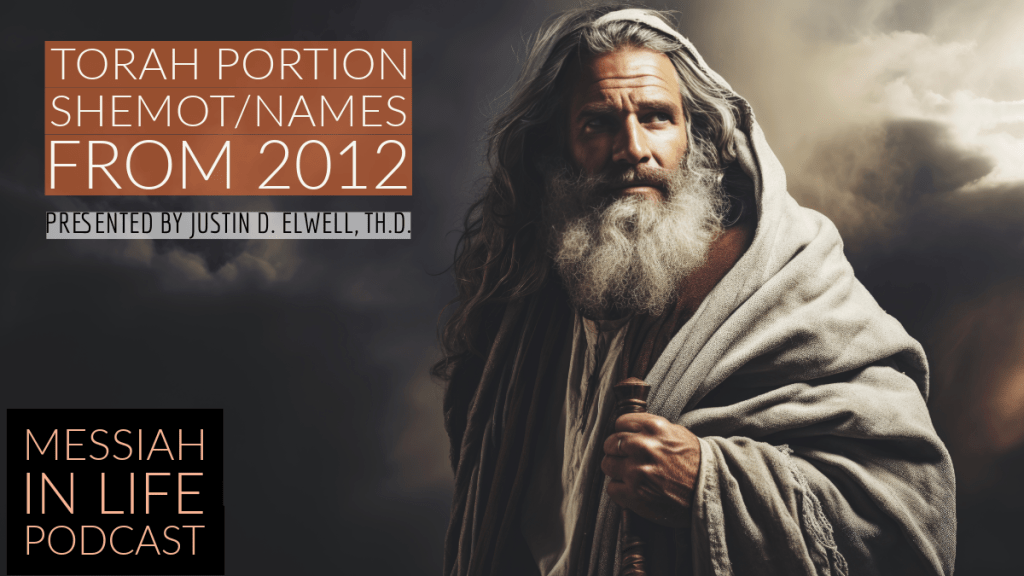
Classic Message, 2012, New Podcast Available!

Tap pic for link!

Shalom friends, as I have been under the weather this week I decided to look back into the archive and find a message to share. This message on the Torah portion of Shemot/Names is from 2012. In this message we consider the calling, refusal, but ultimately the preparation of Moses for his calling. How does this translate for today? How do we, or how have we disbelieved our calling in Messiah? Finally, how do we walk in this new life that He has graced us with? *Not the best audio, sorry. 

Hear Him

“The angel of the Lord appeared to him (Moses) in a fire blazing from the middle of a bush. He looked and saw that although the bush was flaming with fire, yet the bush was not being burned up. Moses said, ‘I’m going to go over and see this amazing sight and find out why the bush isn’t being burned up’” (Exodus 3:2-3). 

 In Exodus 3:1 the Torah reveals that Moses is on the very mountain that he will eventually lead the children of Israel. The place where the power and condescending presence of the Lord will be manifest, Mt. Horeb. Yet, as Moses tends the sheep of his father-in-law Jethro, the Lord quietly appears in a bush, with the appearance of fire. Rabbinic tradition explains that Moses had left the flock of Jethro to find one lost lamb (cf. Lk. 15:4-7), and that his care for the lost sheep indicated that he was ready to shepherd the children of Israel. Further, the Torah is careful to record that Moses “looked and saw” the burning bush, causing him to turn aside to investigate (Ex. 3:2-3). As followers of Messiah, we learn valuable lessons from this event. 

Daily life can be filled with many distractions. Whether from employment, family, or personal struggles, there always seems to be something in need of our attention. And in the turbulence of life, our ability to discern the Lord’s voice can be overcome by many other voices. 

 The Bible is filled with miraculous demonstrations of the Lord’s power. For those observing the parting of the Sea of Reeds (Red Sea), there was little doubt as to the Lord’s presence. When the sun stood still for Joshua, it confirmed that the sovereign Lord heard his prayer. When Elijah called down fire from heaven to defeat the priests of Ba’al, this also confirmed His abiding presence. The record of miraculous events continues in the New Testament with demonstrations of healing and resurrection, and the atoning work of Yeshua/Jesus. Miracles are the work of the sovereign Lord, but is this how He desires to regularly speak with His people? 

 The episode of Moses reminds us of the quiet, abiding presence of the Lord, the I Am (Ex. 3:14). The Lord did not begin his conversation with Moses by calling him to the bush, this would be moments later (Ex. 3:4). Moses had to notice the fire. Much like the remembrance of Hanukkah, the miracle at work here is subtle. The oil of the Menorah that lasted eight days burned but was not consumed. To look at the Menorah one would not notice a miracle taking place unless one first turned to give attention. The burning bush burned, but was not consumed, a strange, but subtle sight to behold (Ex 3:2). 

 Moses needed to experience the quiet voice of the Lord, the stillness of His presence, and learn to recognize it, before the chatter of the children of Israel overwhelmed him. Elijah, having defeated the priests of Ba’al in a miraculous demonstration of God’s power, fled to Horeb because of the voice of Jezebel. At Horeb Elijah did not find the Lord in the wind, earthquake, or fire; but in the, קוֹל דְּמָמָה דַקָּה, “still small voice,” or another way, the sound of sheer stillness (1 Kgs. 19:11-12). 

 While miracles are wonderful gifts from the Lord affirming His abiding presence, His desire is that His people would learn to listen to His voice, in the quiet. The episode with Moses, and even Elijah, remind us that we must give attention to life around us, beyond what is consuming our focus. God is still working among His people, in glorious ways, yet we must take the time to notice, turn, and discern what He is doing in that moment. As followers of Messiah, we must learn to hear and recognize the voice of our Shepherd before we enter the storms of life or experience the thunder and earthquakes of His condescending presence, and His miraculous manifestations. As Messiah said, “My sheep listen to my voice, I recognize them, they follow me, and I give them eternal life” (Jn. 10:27). 

 When Moses and Elijah were speaking with Messiah face to face on the Mount of Transfiguration (Matt. 17:1-5), Peter, when raising his voice presumptuously, hears the voice of the Father in heaven speaking and quieting him by saying, “This is my beloved Son, with whom I am well pleased; listen to him” (Matt. 17:5). As if to say, “Peter, hear Him. With all that will be in the years ahead, learn to hear Him now.” This is my prayer for us dear reader, that we continue to learn to hear Him, to know Him, and follow Him wherever He may lead us. 

 Maranatha. Shalom.