
In 2 Samuel 9, David inquires as to any remaining descendants of Saul’s house. David is now the anointed king. He is expanding his kingdom. And from this position of authority, he desires to show kindness, even unusual kindness: to the house of the former king.
David is told of מְפִיבֹשֶׁת/Mephibosheth, a son of his dear friend Jonathan. Mephibosheth is maimed or lame. In 2 Samuel 4, when news of the death of Saul and Jonathan came from Jezreel, his nurse picked him up and fled. In the commotion he falls and was maimed (2 Sam. 4:4). He is exiled in לּוֹ דְבָר/Lodebar, as a descendant of the former king; and as such, he has no inheritance, no future and no hope.
לּוֹ דְבָר/Lodebar, means “no pasture,” it is a picture of a wasteful place, not good for anything. It is from two Hebrew root words, no and speech/promise. It is a place distant from the promises of God, as Mephibosheth no longer has any inheritance due to the death of his grandfather Saul and father Jonathan. Yet, David, דָּוִד/Beloved will show godly kindness.
David wants to show kindness to Saul’s house (2 Sam. 9:1). So what does he do?
1. He seeks the exile: his identity and location (2 Sam. 9:3-4).
2. He calls the exile by sending word to where there is no word (2 Sam. 9:5-6).
3. He assures the exile (2 Sam. 9:6).
4. He restores the exile by drawing him near (2 Sam. 9:7).
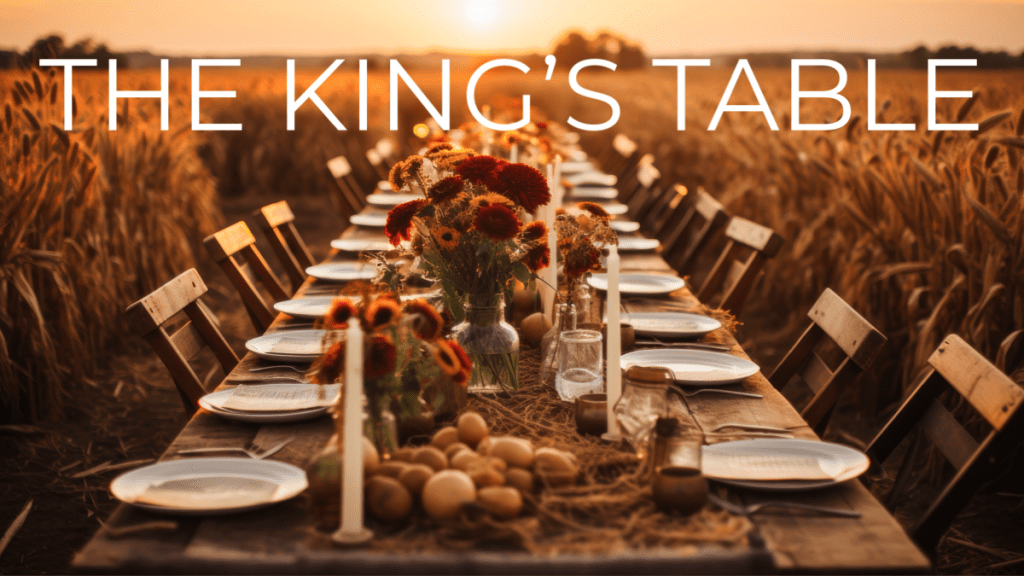
5. He sets the exile at the kings table (2 Sam. 9:7, 10).
Mephibosheth sees himself in his broken condition, a condition created by a fall, as a “dead dog,” meaning useless, as he lingers exiled in a useless, waste of a land (2 Sam. 9:8). Yet, by David’s unusual kindness, his grace, and by his word, Mephibosheth will sit at David’s table, like one of David’s own sons (II Sam. 9:11).
And while seated at that table, no one sees his lame condition; rather, only his restored condition.
מְפִיבֹשֶׁת/Mephibosheth, is restored by the word and kindness (חֶסֶד/chesed) of the king. Even so, his name, מְפִיבֹשֶׁת/Mephibosheth, seems to be prophetic, as if a result of his lame/maimed condition. מְפִיבֹשֶׁת/Mephibosheth, is rooted in two Hebrew words meaning “to blow away or scatter shame.” מְפִיבֹשֶׁת/Mephibosheth is exiled in a place where there is no wind, breath or speech, לּוֹ דְבָר/Lodebar; however, he is restored by the breath and spirit of King David.
We too have been made lame by a fall: Adam’s sin. Helpless in ourselves, we inhabit the land of לּוֹ דְבָר/Lodebar, far from God, stuck in our sin, without hope or inheritance. Yet, as the apostle Paul writes, “But thanks be to God, who gives us the victory through our Lord Yeshua/Jesus the Messiah” (1 Cor. 15:57), the greater David in whom the Father is well-pleased. Messiah has shown extraordinary kindness to those He has restored (Ro. 5:8):
1. He came to seek and save the lost: those in the waste (Lk. 19:10).
2. He chooses those who were lost (Jn. 15:16).
3. He assures the lost of His abiding presence unto fruitfulness (Jn. 15:4, 5).
4. He Restores by making new (Rev. 21:5).
5. He fulfills the promises, leaving nothing undone (2 Cor. 1:20).
6. He shows kindness as the Final Adam, not fallen, but having overcome (1 Cor 15:22; Jn. 16:33).
7. He shares the table with those having received His grace (Jn. 13:12; Lk. 22:19-20).
8. And at His table, the Table of the King, we are no longer distant, strangers, or exiles, as we are seated as sons of the King (Ro. 8:15-17).
No longer in Lodebar, a place of no promise or inheritance, our shame having been blown away, removed as far as the east is from the west (Ps. 103:12), by the breath of God (Jn. 20:22; Acts 2) the Lord in Messiah has reconciled both Jew and Gentile to Himself, as Paul writes:
“But now in Messiah Yeshua, you who once were far off have been brought near by the blood of the Messiah … And He came and proclaimed peace to you who were far away and peace to those who were near – for through Him we both have access to the Father by the same Spirit. So then you are no longer strangers and foreigners, but you are fellow citizens with God’s people and members of God’s household … In Him, you also are being built together into God’s dwelling place in the Spirit” (Eph. 2:13, 17-19, 22).
No longer are those in Messiah as Mephibosheth, maimed by the fall; but all in Him are now restored by His overcoming. The kindness of the King of kings, and Lord of lords. You dear reader, have you received of this kindness? Then I am sure you know how Mephibosheth felt. That dread feeling of worthlessness due to some challenge you face. Yet, the beauty of sitting at the table of Yeshua/Jesus is when you look around, He has recovered, healed, and restored everyone there. We did not seat ourselves, we were seated by the grace of the Living God. Now, having been brought near to the King, we have a future and a hope, no longer exiled to the wastelands of life, He has filled us with new life.
Be well. Shalom.
 the mountain mensch