
The Root of Bitterness and the Grace of Forgiveness

“The heart knows its own bitterness” (Prov. 14:10).
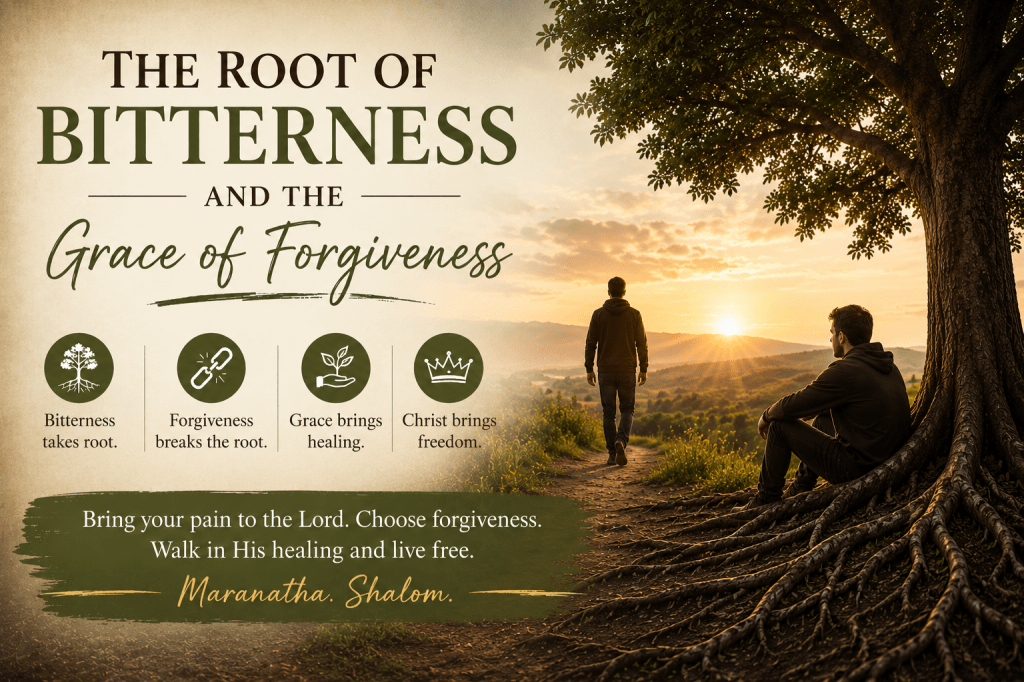
There are pains carried deep within the human heart that no other person can fully comprehend. Even those closest to us may only see the outward expression of inward sorrow. Hidden wounds, disappointments, betrayals, fears, and griefs often remain buried beneath the surface. Solomon reminds us that each heart carries its own bitterness, known fully only to the Lord.

We live in a time where bitterness easily takes root. Political strife divides families and congregations. Financial pressures create anxiety and resentment. Emotional wounds from rejection, abandonment, betrayal, or misunderstanding linger long after the moment has passed. Many carry silent pain that has never truly been brought into the healing light of the Lord’s presence.

Scripture warns us carefully about the danger of allowing bitterness to remain unchecked: “See to it that no root of bitterness springs up and causes trouble, and by it many become defiled” (Heb. 12:15). Bitterness is rarely stagnant. Like a hidden root beneath the soil, it grows quietly and spreads deeply. What begins as a wound can become resentment. Resentment can become anger. Anger can eventually poison relationships, distort judgment, and harden the heart.

The tragedy is that bitterness rarely harms only the one who carries it. It spreads outward into families, friendships, congregations, and communities. A bitter spirit often creates more pain than the original wound itself.

This is why the apostle Paul exhorts believers so strongly: “Let all bitterness and wrath and anger and clamor and slander be put away from you, along with all malice. Be kind to one another, tenderhearted, forgiving one another, as God in Christ forgave you” (Eph. 4:31–32; cf. Col. 3:13).

Forgiveness is the antidote to bitterness.

Not superficial forgiveness that simply ignores pain, but forgiveness deeply rooted in faith in Messiah. The forgiveness extended to us through Christ becomes the foundation from which we learn to release others. We forgive because we ourselves have been forgiven. We release because the Lord has released us from a far greater debt (Matt. 6:14-15, Lk. 7:47).

This does not mean wounds are unreal. Scripture never minimizes pain. Hannah is a powerful example of this truth. In 1 Samuel 1:10, she “wept bitterly” under the crushing shame and anguish of barrenness. Her pain was real. Her sorrow was deep. Yet Hannah did not surrender herself to bitterness. She brought her grief, petition, and tears before the Lord. Rather than allowing pain to harden her heart, she poured out her soul in prayer.

There is a profound difference between carrying pain to the Lord and feeding bitterness within ourselves.

This fallen world constantly presents opportunities for bitterness to take hold internally and externally, and the enemy of our soul would like nothing more than to feed a bitter root buried deep within us. Broken relationships, disappointments in ministry, injustice, false accusations, unmet expectations, and personal suffering can all become excuses for allowing bitterness to grow. But this is not what we have been redeemed for. The Lord did not call us out of darkness so that we might become prisoners of resentment.

Instead, we are called to become tenderhearted people shaped by mercy, humility, and forgiveness.

Even suffering itself can become a sanctifying instrument in the hands of the Lord. J.C. Ryle wisely wrote:

“Be patient under the bitterness of the gates of hell. It is all working together for your good. It tends to sanctify. It keeps you awake. It makes you humble. It drives you nearer to the Lord Jesus Christ. It weans you from the world. It helps to make you pray more. Above all, it makes you long for heaven, and say with heart as well as lips, ‘Come, Lord Jesus.’”

What a needed reminder. The Lord does not waste our suffering. Even bitter experiences can become means by which He draws us closer to Himself.

If bitterness has begun to take root in your heart, do not nourish it. Bring it honestly before the Lord, confess it where needed, and bring it into His marvelous light. Lay the wound before Him in prayer as Hannah did. Ask the Holy Spirit to uproot resentment before it grows deeper. Choose forgiveness, even when emotions lag behind obedience. Trust that the grace of God is sufficient not only to forgive sin, but also to heal wounded hearts.

The Lord alone fully knows the bitterness of every heart, and the same Lord alone is able to heal it, “He heals the brokenhearted and binds up their wounds” (Ps. 147:3). 

Maranatha. Shalom. 

Starving Bitterness

The children of Israel have crossed the Red Sea by the way of escape provided by the Lord. They celebrated this rescue with song and shouts of praise. Yet, three days later they began murmuring against Moses: “What shall we drink?” They had arrived at a place called Marah. The waters there, however, were undrinkable (Ex. 15:23), as they were bitter. 

 Have you ever found yourself in such a mood that even your favorite tastes seem tasteless, your favorite foods dis not satisfy, and those distracting comforts no longer distracted? It is amazing how our psychological disposition or even distress can impact how we experience so much in life. Perhaps this was at the heart of what the children of Israel were experiencing. 

Dov Ber ben Avraham, the Maggid of Mezeritch commenting on Exodus 15:23 focuses on the heart of the matter: כִּי מָרִים הֵם, “because they were bitter.” He turns our understand of Exodus 13:23 on its head, as he taught that it was not the water that was bitter, but the Israelites themselves. The taste of what they so desperately needed was embittered by their murmuring disposition after three days of no water. The bitterness bubbled up from within them, and now the Lord would address it. 

 In Exodus 15:25-26 we read, “So he cried out to the Lord, and the Lord showed him a tree. When he cast it into the waters, the waters were made sweet. There He made a statute and an ordinance for them, and there He tested them, and said, “If you diligently heed the voice of the Lord your God and do what is right in His sight, give ear to His commandments and keep all His statutes, I will put none of the diseases on you which I have brought on the Egyptians. For I am the Lord who heals you.”

 To heal the bitterness, of the water and the Israelites, the Lord shows Moses a tree. Yet, the words “showed him a tree,” according to rabbinic sources, could also be read, the Lord “taught him a tree.” What tree? The tree of life, or the written Torah. Exodus 15:26 is reminiscent to earlier words spoken to Abraham, Isaac, and Jacob. Words that promised blessing as they obediently walked before Him. In the Torah, the Lord gives promises of goodness, blessing, peace, and generational longevity that are attached to positive commandments. Amid the traditional 613 commandments of the Torah are commandments about forgiveness. Unforgiveness left unattended can send a bitter root deep into the heart. 

 The Torah teaches in Leviticus 19:18, “You shall not take vengeance or bear a grudge against the sons of your own people, but you shall love your neighbor as yourself: I am the Lord.” Bearing a grudge churns the remembrance of a hurt over and over again in our heart and mind. In Proverbs 17:9 we read, “Whoever covers an offense seeks love, but he who repeats a matter separates close friends.” That churning is a repetition of “a matter” that separates often leading to bitterness. We dwell on the matter, we talk about it to others, and ultimately, we seek vindication in the sight of man, even the one with whom we have had the issue. 

 In Exodus 15, Moses was the target of a deep-seated bitterness among the children of Israel that needed to be healed. After the tree taught to Moses was “cast into the waters,” into or applied to the bitterness, that which they desperately needed was potable again.

 What does this mean for us in messianic faith? The apostle Paul teaches us, “Let all bitterness and wrath and anger and clamor and slander be put away from you, along with all malice. Be kind to one another, tenderhearted, forgiving one another, as God in Christ forgave you” (Eph. 4:31-32). Put it away! What? All bitterness, wrath, anger, clamor, slander, and malice. How? The forgiveness we have received by Messiah Yeshua/Jesus. How do we follow His example? 

 On the Cross Messiah was offered a drink when He became thirsty, as we read, “they offered him wine to drink, mixed with gall, but when he tasted it, he would not drink it” (Matt. 27:34). The wine, a symbol of blessing and peace, was mixed with gall, a bitter substance (sometimes wormwood) used to ease pain. What did Messiah do? He refused to drink it. He would not drink the bitterness. He would not take it in. As difficult as it may seem to us, right from the start, by the Holy Spirit through prayer and faith, we must not drink in the bittering agents that sometimes come in life. We must turn to the Word, especially the Word made flesh.

 As disciples of Messiah, just as the Lord showed/taught Moses a tree of His promises in the wilderness, Messiah showed us on His tree just what it looks like to follow Him. Enduring and sharing in the sufferings of Christ, enduring the hurt and the embittering agents that seek to find their own rest in us. Walking in His grace and His forgiveness, especially when it is the most painful, will allow us to taste of the goodness of God, and starve the bitterness of the human experience before it takes root. 

 David wrote in Psalm 34:8, “Oh, taste and see that the Lord is good! Blessed is the man who takes refuge in him!” Taste and see that your healer is good. Amen. 

 Maranatha. Shalom.