Hanukkah reminds us that God is still working miracles, even silently, through messengers human and angelic.
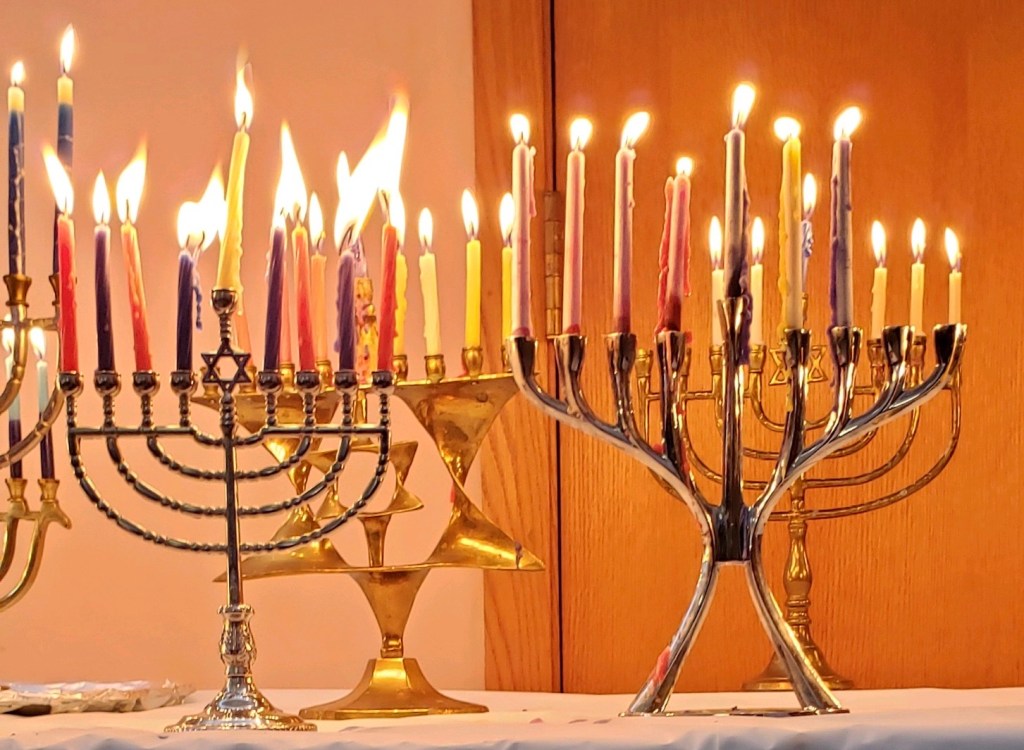
Happy Hanukkah.

Hanukkah reminds us that God is still working miracles, even silently, through messengers human and angelic.
Happy Hanukkah.
The hard circumstances, the really difficult unbearable ones, can be used as an excuse to turn away from God, or as an excuse to cling tighter to Him, and make the promise of His Word become what the circumstance says it cannot and will not be: “Yes, and Amen, in Yeshua/Jesus” (II Cor. 1:20). Victory.
The gathering of family and friends, both young and old, around a beautifully decorated blessed table, is a precious sight. Food lovingly prepared over the course of days for a single united time of feasting. Followed by the careful preparation and distribution of abundant leftovers.

All of us, I am sure, have a unique dynamic within our families that makes Thanksgiving a collection of cherished memories.
For some, it is the enjoyment of hearing what their relatives are thankful for from the previous year; for others it’s the food, or the conversation; some enjoy cooking; still for others, it’s the leftovers that always seem to taste better the second and third time around; some enjoy a parade or a football game; and for a few, very special people, the hunt for deals on Black Friday.
Of football, Scottish-born comedian Craig Ferguson said, “I like football. I find it’s an exciting strategic game. It’s a great way to avoid conversation with your family at Thanksgiving.”
Still, Thanksgiving is not just a remembrance of a bountiful feast long ago celebrated by Puritan, Pilgrim settlers in Plymouth. Thanksgiving is a very real, and present necessity for those of biblical faith: as we are to be a thankful people.
Interestingly enough, this most American of holidays is not an American invention, but an expression of gratitude that is rooted in the Bible. Leviticus 7:11-12, 15 says, “This is the law of the sacrifice of the peace offerings which he shall offer to the Lord: If he offers it for a thanksgiving, then he shall offer, with the sacrifice of thanksgiving, unleavened cakes mixed with oil, unleavened wafers anointed with oil, or cakes of blended flour mixed with oil … The flesh of the sacrifice of his peace offering for thanksgiving shall be eaten the same day it is offered. He shall not leave any of it until morning.”
The thanksgiving offering was regarded as one of the most important sacrifice in the Holy Temple, as in the thanksgiving offering all other sacrifices completed their educational mission – as it teaches the importance of gratitude.
The biblical prophets rank ingratitude as a sin that reduces man below the level of an animal; which is why we must be reminded from time to time to stop and give thanks.
The celebration that surrounded the thanksgiving offering was much like our Thanksgiving gatherings today, as Alfred Edersheim comments, “Then, after the priests had received their due, the rest (of the thanksgiving offering) was to be eaten by the offerers (and their families) themselves, either within the courts of the Temple or in Jerusalem.”
Offering thanksgiving unto the Lord is commanded throughout the Scriptures, as examples: “Offer to God thanksgiving…” and, “Enter into His gates with thanksgiving…” and, “Sing to the Lord with thanksgiving…” and as the apostle Paul wrote, “Be anxious for nothing, but in everything by prayer and supplication, with thanksgiving, let your requests be made known to God…” (Phil. 4:6).
Thanksgiving in the Hebrew, תּוֹדָה/todah, means, “extending the hands up in adoration.” It is a demonstrative action.
In Greek it is “grateful language to God;” as an expression of the heart.
This Thanksgiving, demonstrate thankfulness to the Lord with both action and words: how do you do this? Demonstrate the love that you have for family, friends, strangers, and those suffering or in need, as this is the love of Messiah. Speak words of grace, and gratitude. Be thankful for each other; be thankful for the memories.
Build moments that will be lasting memories of a thanksgiving in action.
Have a blessed, and thankful, Thanksgiving. Shalom.
 the mountain mensch