The Trouble with: AND

After the revelation on Mt. Sinai of the Ten Commandments, the next portion in the Torah cycle opens with two words: וְאֵלֶּה, הַמִּשְׁפָּטִים, “And these are the statutes.”

The Torah portion called Mishpatim/Statutes signals a drastic change from historical narrative and revelation, to chapters of legal code. Again, mishpatim itself means “statutes,” and we begin to look at statutory law in Israel, concerning the covenant community of God.

The ten commandments are apodictic, divine law; while beginning in Exodus 21:1, casuistic or case law, which is conditional in nature, is now in view. Casuistic law refers to the incidents or circumstances that emerge in life, meaning “if this” than “this.” Many of these instructions direct us in the right way to love our neighbor, stranger and even enemy as ourselves.

Yet, as is so often the case, one word can mean so much. Depending on when and where you were educated (in English grammar), you probably learned that beginning a sentence with the conjunction “and” is incorrect. And for strict grammarians it probably remains so … yes, I started that sentence ironically. Even though I am aware that it is not incorrect, I still wrestle with doing so. Thankfully, Moses did not have trouble with English rules of grammar.

The portion of Mishpatim/Statutes, opens with the conjunctive letter “ו,” which means “and.” וְאֵלֶּה, “And these…” Exodus 21:1. The conjunctive vav connects the previous subject with what follows after it.

There is an important lesson to learn from this: the casuistic law, the “if … then …” statements were revealed upon Mt. Sinai with the apodictic laws contained in the ten commandments.

I’ve often explained that the horizontal love of neighbor and stranger is an important outworking of the vertical love we have for the Lord God, the two tablets of the Law. With this tiny letter, ו/vav, a simple stroke of the scribes hand, we find how true this is.

Walking in faith is not just about our responsibility and devotion towards God, but also to our fellow, in our environment. Moses is careful to show that the sanctity of our business, civil and interpersonal relationships is as important as our relationship with the Lord. Why? We live out the reality of our vertical relationship within the framework of the horizontal communal reality.

Two Scriptures, of many, speak powerfully to this:

“Religion that is pure and undefiled before God the Father is this: to visit orphans and widows in their affliction, and to keep oneself unstained from the world” (Jas. 1:27).

“So whatever you wish that others would do to you, do also to them, for this is the Law and the Prophets” (Matt. 7:12).

So often our minds get caught up in and overwhelmed by the dense legal matter of sections such as Mishpatim/Statutes. Yet, as I’ve often taught, these detailed instructions are an elucidation of the ten commandments themselves. Now, the vertical devotion enumerated in the ten are amplified in the dozens of situations where humanity intersects with humanity in the realm of society. How does God enter that setting? The devoted actor present in the situation.

It is our devotion to the unseen God in the midst of the, often difficult, seen reality that manifests His presence, and our devotion to Him for the world around us.

The conjunctive vav not only moves our text forward, but it also connects our forward movement to the past revelation. It was not only the presence of the Living God and the ten commandments revealed on Mt. Sinai, but also those seemingly mundane “legal matters” of every day life that God gave to Moses in order for Him to be present in our business deals, in our marriages and families, our communities, and in our walking along the way.

The vav/and connects the mundane to the supernatural, and makes our spiritual lives very much part of our every day life. “And” becomes a bridge between heaven and earth in faith-obedience to the Messiah, and stakes or holds the revelation of heaven firmly upon the earth into which we have been sent (Matt. 28:18-20, the Hebrew letter ו/vav resembles a tent peg).

Be well. Shalom.

Wondrously Made

Raising children is not for the faint of heart. There are times of soaring joys, along with times of deep sorrows and concerns. I have yet to find a time when I am still not praying for my adult sons, and I am sure that many of you can relate.

There is an interesting textual oddity in Exodus 18. This slight, almost unnoticeable difference to what had come before it, speaks to the heart of how we raise children as individual lives formed by the hand of God.

In my family I am the oldest child, by many years. In my situation, there was no comparison to the successes or failures of my siblings as we grew up. Yet, for whatever reason, I was acutely aware of how much it hurt my friends when their parents, in times of correction, would compare them with their siblings: “why can’t you be more like …?” Or similar statements.

Moses and his wife Zipporah show us something remarkable as we approach our children, and how we shepherd others along in life as well. As Jethro, Zipporah’s father, returns Moses’ family to him after the exodus from Egypt, the Torah says of the two boys: שֵׁם הָאֶחָד, גֵּרְשֹׁם, “the name of one is Gershom” … וְשֵׁם הָאֶחָד, אֱלִיעֶזֶר, “and the name of one is Eliezer” (Ex. 18:3, 4, respectively).

This is a change from the usual language pattern of the Torah, which, if there is more than one son: there is one son, then the second son, and so forth. This sets the sons in order for purposes of inheritance and blessing. Yet Moses and Zipporah were careful not to follow this pattern. Why?

If you have read the Book of Genesis, you may have noticed the strife between the sons of the patriarchs regarding position, blessing, and leadership. Moses changes this ever so slightly. Gershom is the oldest, and he has a position given to him by God. Eliezer is the younger, but he is no less loved or favored. What do we learn from this?

Consider the words of David: “I praise you, for I am fearfully and wonderfully made. Wonderful are your works; my soul knows it very well” (Ps. 139:14). David says נִפְלֵיתִי, “I am wondrously made.” Another way, amplified, “I am uniquely made to be me.”

For Moses and Zipporah their sons were the only Gershom and the only Eliezer. They were unique. They were not the other. Moses and Zipporah recognized their sons uniqueness, and the Torah forever records how they loved them. In their family, they recognized each child as unique, special, gifted in their own right. Moses and Zipporah would raise them and direct them, but they would not raise them one against the other, or exactly the same. They had the presence of mind, and a depth of relationship with their sons to know how to raise them, uniquely, in the “fear and admonition of the Lord” (Eph. 6:4).

Children are not uniform. Even with the same parents and environment, they grow as their unique selves, guided, we pray, by involved godly parents. Moses and Zipporah, in these few words, encourage us to be involved with our child(ren) in such a way as to shepherd their personalities as God has formed them. Recognize their strengths and weaknesses. Respond to them in a manner that encourages their strengths, but also strengthens their points of weakness according to the wise counsel of God’s Word and faith in Christ.

You, dear reader, are also unique. There is no one else who has ever been or ever will be like you. You have been wondrously made, and I pray, even more wondrously renewed (II Cor. 5:17). As a shepherd, I must recognize the unique person that the Father is reforming before me (Ro. 8:29), and communicate in such a way as to encourage them along the way…and sometimes correct their course. Speaking to their individual strengths and weakness according to the wise counsel of God’s Word and faith in Christ, as noted above.

Moses and Zipporah honored the uniqueness of their sons, and in their uniqueness they strengthened their lives and relationships. Gershom was free to be Gershom. Eliezer was free to be Eliezer. Neither had to be the other.

We learn this lesson at the foot of Sinai, where a nation would learn to be a unique, chosen nation among nations, even with their imperfections. And what is a nation but unique people joined in covenant together, ensuring the life, safety and wellbeing of the neighbors and strangers around them, according to the Word of God.

In our parental relationships, in our shepherding relationships, and our communal relationships, let us remember that we have all been wondrously made, and supernaturally renewed by the Father, through the Son, in the power of the Holy Spirit. I am me, and you are you, but in all things, let us show forth Christ to all (I Pet. 2:9-10).

Be well. Shalom.

Adorned for Such a Time

“Unleavened bread shall be eaten for seven days; no leavened bread shall be seen with you, and no leaven shall be seen with you in all your territory. You shall tell your son on that day, ‘It is because of what the Lord did for me when I came out of Egypt.’ And it shall be to you as a sign on your hand and as a memorial between your eyes, that the law of the Lord may be in your mouth. For with a strong hand the Lord has brought you out of Egypt” (Ex. 13:7-9).

In every generation we are to regard ourselves as having been taken out of Egypt. We are to answer our children when they ask, “What’s this service about?” Not only is the exodus remembered on Passover, but it is memorialized daily. How?

‎וְהָיָה לְאוֹת עַל-יָדְכָה, וּלְטוֹטָפֹת בֵּין עֵינֶיךָ: כִּי בְּחֹזֶק יָד, הוֹצִיאָנוּ יְהוָה מִמִּצְרָיִם

“And it shall be a sign upon your hand, and as frontlets between your eyes; for by a strong hand the Lord brought us out from Egypt” (Ex. 13:16).

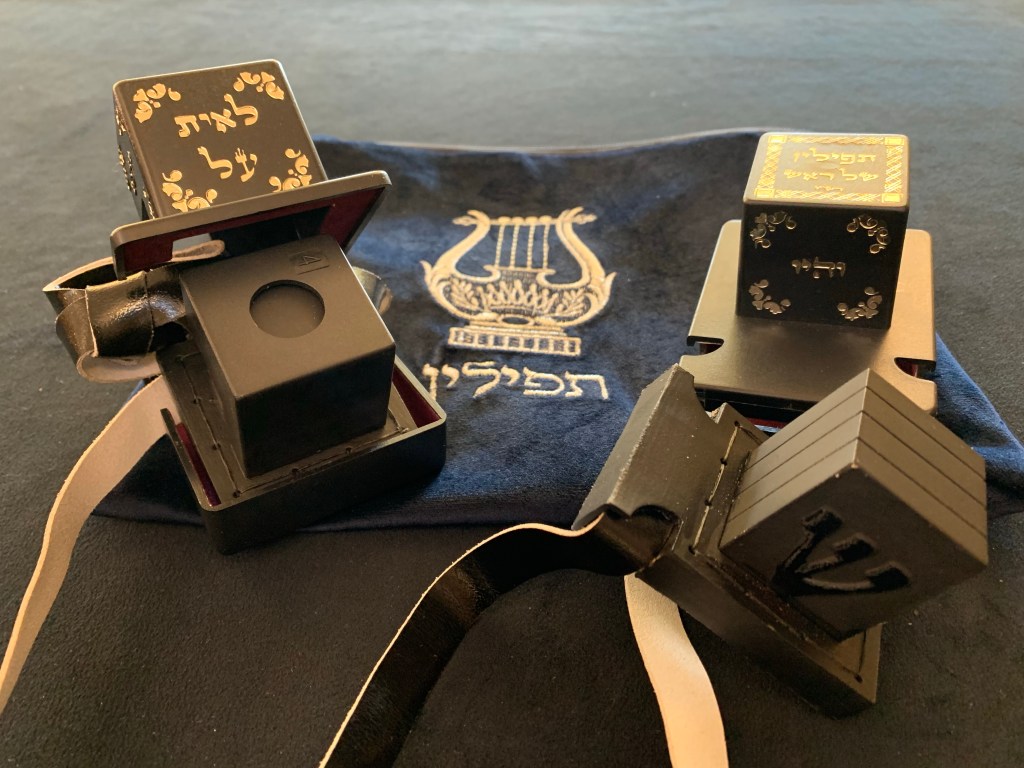
This is the practice of Tefillin, or phylacteries as they are called in the New Testament (see included pic). Tefillin are adorned every day except Shabbat and some holidays. They are a sign, for what?

There is an interesting answer in the text. The “sign upon your hand,” לְאוֹת, “sign” is in the singular. While the “frontlets between your eyes,” וּלְטוֹטָפֹת, “frontlets” is plural. Why? The Tefillin, the black boxes used during prayer, as a memorial adorning the body are incomplete without the hand and the head adorned together. In order to be a sign and as frontlets, they must be together, not separate.

The Tefillin of the hand actually rests on the bicep of the weak arm, for right handed people the left, adjacent the heart. While the Tefillin of the head rests upon the forehead, equidistant between the eyes, upon the mind.

These two, connected as memorial signs, teach us that we need to think and feel. Our intellect and our heart must be connected; and together they inform our thoughts and actions in this world.

But how are they connected?

Leather straps. The leather once used to enforce the crushing harshness of slavery in Egypt by the whip, now adorn the freed man as a sign of freedom of thought, action, and time. Freed by God to obey Him. Freed by God to do. Freed by God to live. The boxes contain four paragraphs of text from the Torah: Exodus 13:1-10, 13:11-16; Deuteronomy 6:4-9, 11:12-21, each a reminder to set this memorial, but also a reminder of our relationship to God.

“Frontlets” is an interesting word. Worn by brides, princesses and women of position, it was an adornment of beauty worn around the head. Not for labor, but for beauty signifying position and occasion. Commanded for memorial above, the וּלְטוֹטָפֹת, frontlets, bands, or marks, were to adorn the betrothed of God as a memorial of deliverance from slavery to freedom.

This memorial reminds one of deliverance. As freed people, we have the liberty to translate the meditation of our heart and mind into godly action for those bound up in sin, or to come alongside those stumbling. At times the Word upon our heart convicts the thoughts of our mind. While at other times, the Word upon our mind convicts the hardness of our heart.

Beloved friends, in messianic faith you have been adorned. You are robed in the righteousness of Messiah (II Cor. 5:21), crowned with the mind of Messiah (I Cor. 2:16), and sealed upon the heart by the Holy Spirit (Eph. 1:13). These also resulting from deliverance, from the greater and more brutalizing enslavement: to sin. Set not upon crippling weakness, but the Fathers grace, as Paul writes:

“My grace is sufficient for you, for my power is made perfect in weakness.” Therefore I will boast all the more gladly of my weaknesses, so that the power of Christ may rest upon me” (II Cor. 12:9).

Today, remember your adornment. The sign and frontlets upon you, the Word and the Spirit, as you engage the life around you. Yes, you may be laboring in the harvest field, dirtied by the trauma of life, but remember how He sees you: adorned beautifully for an approaching wedding feast (Rev. 19:9).

For such a time as this, you have been equipped in His Kingdom.

Shabbat Shalom.