Building Pressure

The Book of Leviticus, with its explicit instructions on matters of ritual purity and holiness, is often a very difficult book for Christians to approach. Where do these ideas fit into a life of faith in Messiah? In every case, even the most rigid of instructions contained in it, point us to a diminishing of self, and an increase of the Lord’s presence in our lives. From the beginning of this book, hidden in the very first word in Hebrew, Vayikra, is the key to its understanding – the diminished alef.

וַיִּקְרָא אֶל-מֹשֶׁה וַיְדַבֵּר יְהוָה אֵלָיו מֵאֹהֶל מוֹעֵד לֵאמֹר דַּבֵּר אֶל-בְּנֵי יִשְׂרָאֵל

וְאָמַרְתָּ אֲלֵהֶם אָדָם כִּי-יַקְרִיב מִכֶּם קָרְבָּן לַיהוָה–מִן-הַבְּהֵמָה מִן-הַבָּקָר וּמִן-הַצֹּאן תַּקְרִיבוּ

“Now the Lord called to Moses, and spoke to him from the tabernacle of meeting, saying, ‘Speak to the children of Israel, and say to them: When any one of you brings an offering to the Lord, you shall bring your offerings of the livestock – of the herd and of the flock” (Lev. 1:1-2).

The Lord’s instruction in Leviticus begins with sacrifice, specifically the burnt offering. This offering represented the one bringing it, “when anyone brings an offering of you,” the text says. The offering was meant to be us, the animal was the innocent substitute (II Cor. 5:21).

The burnt offering was of the best of your herd or flock, unblemished. It was sacrificed before the Altar, skinned, its blood was applied to the Altar, it’s innards washed, all before it was set loose in holiness and offered by fire to the Lord. There is no human logic to this. It is, in fact, illogical. As you approached the Lord, what good did it do to kill the best of your flock or herd and gain no benefit from it?

The answer is found in the final letter of the Hebrew word וַיִּקְרָא, and he called. In the Torah scroll, the final letter of the word וַיִּקְרָא is written approximately half it’s size. It is dimished. When you approach the Lord as He calls, your strength, your position, your esteem, represented by the א/alef, must diminish. At the heart of sacrifice is the recognition of someone greater than yourself. The recognition that everything you have comes from the Lord. In this act of sacrifice, the worshipper drew near with the עֹלָה קָרְבָּנוֹ, the elevation offering, humbled, to the Lord in order to be lifted up. David, as he was preparing to buy the threshing floor of Aravnah, who wanted to give it to him, said, “No; I insist on buying it from you at a price. I refuse to offer to the Lord my God burnt/elevation offerings that cost me nothing” (II Sam. 24:24). In order to increase, first David had to decrease.

This is still true today, but the Lord does something amazing as we are pressed in His hand.

John the Baptist was the herald of the Messiah. His ministry was one of calling Israel to repentance in preparation for the work of Yeshua/Jesus; and he did this in the spirit of Elijah.

John was a priest of Israel by birth. As such he was guaranteed support and honor among the Jewish community. He is described as a bit of a “wild man” in Matthew, “And John had a garment of camel’s hair, and a leather girdle around his waist. And his food was locusts and wild honey.”

Yet, John walks away from his birthright, and begins to announce something very different, something contrary to Altar sacrifice, repentance by water immersion. He made it clear that repentance was not simply in word, as he proclaimed, “If you have really turned from your sins to God, produce fruit that will prove it! And don’t suppose you can comfort yourselves by saying, ‘Abraham is our father!’” Repentance is the act of turning away from one direction to another. In the case of biblical repentance, it is turning from our way to Him.

John attracted so much attention that leaders from Jerusalem would come and ask him, “Are you Elijah?…Are you the Prophet?…Who are you?” He said, “I am the voice of one crying in the wilderness, ‘Make straight the way of the Lord,’ as the prophet Isaiah said.” As he gained followers, and upset the religious elite, it would certainly seem that he had measurable ministry success. But then Yeshua arrived.

In John 3:30 we read, “It is right for Him to increase, but me to decrease.” John knew that his purpose was to make straight the way for the coming of the Lord, to announce a season of repentance, literally the changing of the mind, and at the end of his season, he was to decrease, as Yeshua increased.

When the Lord enters our lives, and we become more serious about our walk with him, we feel a pressing enter our lives as well. This pressure occurs for two reasons: 1) to remove ungodliness from our lives, and 2) to give us room to grow and mature in the Lord.

As a baby chick develops in the egg, it has no way of knowing that the pressure that it begins to feel is for its own good. The pressure is a sign that it is about to break-forth. As it begins to press on the shell, and its body takes up more space within, the Lord’s design takes shape, and it consumes the last of the yoke for strength. External blood vessels that had supplied it with life dry up, the egg softens, and it begins to struggle against the shell.

The struggle is preparing it not only to break-forth, but to stand after it does. The chick does not know that the pressure was preparation to stand in the world. Unfortunately, many well-meaning people have observed this struggle and believed the chick would die from it, only to break it out to find that it lacked the vigor it needed to stand, and unprepared for life, it died.

John’s pressure was to decrease as Messiah increased, and that decrease would lead to exaltation. The Scripture says, “Humble yourselves before the Lord and in due time He will lift you up.” Dear reader, the pressure you are feeling today is the hand of the Lord tightening around you as He matures you; and the struggle is building you.

Godly pressure brings forth the greatest treasure, when we allow Him to work us through it; but we must be willing to stand before Him, offer the best we have, submit to His Word, and lay down upon the Altar in repentance: He must increase in us, and through the pressure, we shine brighter for Him (Ro. 12:1).

Be well. Shalom.
Imitating Him

“The Lord said to Moses, ‘On the first day of the first month, you are to set up the tabernacle, the tent of meeting.’” (Exodus 40:1-2).

George Bernard Shaw once said, “Imitation is not just the sincerest form of flattery – it’s the sincerest form of learning.” As the fabrication of the elements of the tabernacle were completed, the Lord instructs Moses to consecrate Aaron and his sons for their positions as priests among the children of Israel for a period of seven days (Ex. 29:35); on the eighth day they would begin their ministry (Lev. 9).

It was during this seven-day period of consecration that Aaron and his sons learned, not only the service of the tabernacle – its sacrifices and offerings – but also how the tabernacle was assembled. They learned this by observing Moses, and they would later imitate him as they matured into their ministry. The rabbis explained that over the seven days of consecration that Moses assembled and disassembled the tabernacle before the eyes of Aaron and his sons – a feat that is actually physically impossible for one man to accomplish.

The priests of Israel did not flatter Moses by imitating him, rather, they fulfilled their solemn duty and learned the pattern of ministry established in heaven. Imitation in our modern culture is often frowned upon – as it is considered “unoriginal.” Yet, in biblical faith imitation of the Lord, Yeshua/Jesus, and elders in the faith is considered a serious matter indeed; as Messiah said:

“A new commandment I give to you, that you love one another; just as I have loved you, you also are to love one another (Jn. 13:34; cf. Matt. 16:24).

To fulfill this commandment, we must consider closely just how He loved us, and how to replicate His actions of love. Additionally, we can consider these examples:

“Be imitators of me, as I am of Christ” (1 Cor. 11:1; cf. 1 Cor. 4:16; Eph. 5:1).

“For to this you have been called, because Messiah also suffered for you, leaving you an example, so that you might follow in his steps” (1 Pet. 2:21).

“Whoever says he abides in him ought to walk in the same way in which he walked” (1 Jn. 2:6).

“Brothers, join in imitating me, and keep your eyes on those who walk according to the example you have in us” (Phil. 3:17; cf. 1 Thess. 1:6).

“Therefore be imitators of God, as beloved children. And walk in love, as Messiah loved us and gave himself up for us, a fragrant offering and sacrifice to God” (Eph. 5:1-2).

“What you have learned and received and heard and seen in me – practice these things, and the God of peace will be with you” (Phil. 4:9).

When we consider the above examples from Scripture, we find the same pattern at work in the New Testament model, as we do in the Levitical model; and this for good reason, as the priesthood of Messiah was the original pattern that Moses witnessed upon Mt. Sinai. Just as Aaron and his sons watched and closely observed how to administer the ministry of reconciliation, the Body of Messiah must also closely watch, observe and pattern itself on the examples of godly faith that has preceded us.

The key is that we must, as much as possible, follow His pattern. In Exodus 40:34, when the tabernacle and its furnishing were properly set according to the pattern shown to Moses, the presence of the Living God filled the tabernacle and dwelt among his people. Following that same pattern, whenever two or more are gathered in the name of Messiah Yeshua/Jesus, He is in their midst – the fullness of his prophetic name Emmanuel: God with us, God among us, and God in us.

Be well. Shabbat Shalom.

Tending to Your Lamp

Psalm 119:105 reads:

נֵר-לְרַגְלִי דְבָרֶךָ; וְאוֹר לִנְתִיבָתִי

“Your Word is a lamp to my feet, and light to my well-worn path.”

In Proverbs 6:23we find an echoing verse:

כִּי נֵר מִצְוָה, וְתוֹרָה אוֹר

“For the commandment is a lamp, and the instruction (Torah) a light.”

The lamp, in the ancient Near-East, was either a metal or clay dish filled with oil, with a wick of some fashion set in the oil. In order for the lamp to burn properly, both the oil and the wick had to be tended: one filled, the other trimmed or replaced. It was a process that all in a household would know well; because of this familiarity, both the psalmist and Solomon make use of this imagery. Why? The days we are living in should give us a clue.

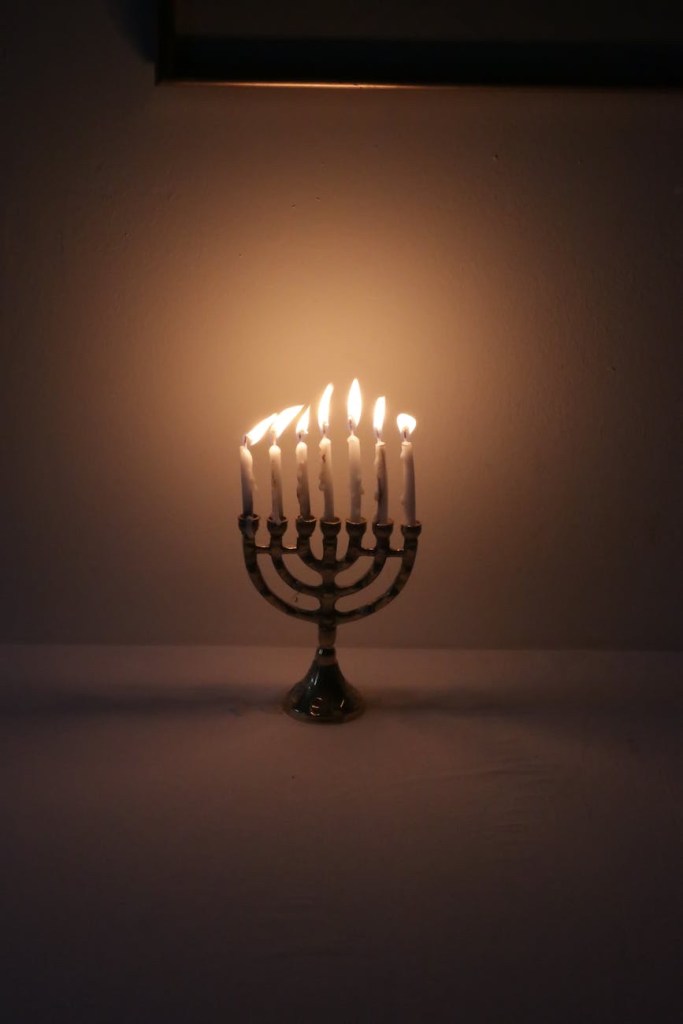
In this week’s double Torah portion of Vayakhel/Pekudei (Ex. 35:1-40:38), concluding the Book of Exodus, the Tabernacle that has been designed and described, is now constructed in painstaking detail. As this instruction unfolds, we find details regarding the Menorah: a hammered work, with cups, bulbs, flowers and branches, made in the fashion of an almond tree. The Menorah had seven lights in all. Located in the holy place, the inner chamber, it was the only source of light in the Tabernacle. Like smaller household lamps, the Menorah must be tended to: the oil filled and the wicks trimmed and replaced.

The Menorah symbolized: His Presence, His stirring presence, light overcoming darkness, His enduring Word, and His people.

Almonds?

In the Middle East, the Almond tree is the first tree to awake after winter, quick to respond to changing conditions. The word almond comes from the root שָׁקַד, meaning: to be alert, on the lookout, sleepless, watchful; and in the image of the Menorah, the almond branches, cups and flowers speak to His watchfulness, and the quickening of life and His Word. Aaron’s rod/staff was an almond branch – it springing to life (resurrection) signified the Lord’s choice of High Priest – the Almond Branch of Resurrection – by a sleepless branch.

When Titus sacked the Temple in Jerusalem, he took with him the furnishings of the Temple – a scene famously depicted in Rome (see included picture). When he carried away the Menorah, he believed he was taking away, not only the light, but also the Word and hope of God’s people. The enemy attempted to steal the symbol of light and hope. Why? What are many peope facing today? Fear and hopelessness.

To the point.

In Jeremiah chapter 1, as the Lord calls him, He explains that the words given to Jeremiah will either bring judgment or blessing, and the Lord confirms this in an unusual way:

וַיְהִי דְבַר-יְהוָה אֵלַי לֵאמֹר, מָה-אַתָּה רֹאֶה יִרְמְיָהוּ; וָאֹמַר, מַקֵּל שָׁקֵד אֲנִי רֹאֶה

“And it happened that the Word of the Lord came to me saying, ‘What do you see Jeremiah?’ And I said, ‘I see a rod of an almond tree.’”

וַיֹּאמֶר יְהוָה אֵלַי, הֵיטַבְתָּ לִרְאוֹת: כִּי-שֹׁקֵד אֲנִי עַל-דְּבָרִי, לַעֲשֹׂתוֹ

“And the Lord said to me, ‘You have seen well, for I watch over My Word do to it.”

The word “almond” and “watch” come from the same root: שָׁקַד, to be alert, on the lookout, sleepless, watchful. The Lord is watching over His Word, to do it: either judgment or blessing. We need to walk in it, and as we do we are quickened in life.

Applying Psalm 119 and Proverbs 6

The Word/commandment is the lamp, needing to be tended to in us. They are a lamp to our life/walk, they inform the way we should go. Usually, Psalm 119:105, the second clause, is translated “and a light to my path,” yet, the Hebrew speaks of the well-worn way that others in faith have gone before: patterns of faith to follow.

The light, the lamp illuminated and set in place informing our walk becomes our worldview – directing us to avoid the same circumstances that once ensnared us. The instruction of the Father aids our walk: look both ways before you cross the street.

The scene of Psalm 119:105 is obviously in darkness, at nighttime, a place of fear. Dear reader, it’s past time to light our lamps: to see and avoid the old trap of fear. As He has commanded, by His Word, He is also watching over it to fulfill it. He is not sleeping or slumbering, and He does not take time off. Therefore, we can take steps with confidence (Heb. 11:1). How so?

Coming together.

The Word, the light, the Resurrected One, the Branch, has not only come, but has joined us to Himself, and sent us the Holy Spirit. Do not let the enemy to carry away your light and hope, extinguishing it.

Now is the time to walk in what we have been studying for, praying about, and rejoicing in; that He: will not leave us, nor forsake us, He is with us always, even to the end of the age, He will be in us. The apostle John writes, “Greater is He that is in me, than he who is in the world” (I Jn. 4:4); and, “There is no fear in love, but perfect love casts out all fear” (I Jn. 4:18).

The Word must be the way we view the world around us, not just when things are well, but when everything is falling to pieces. This is the Word of Jeremiah: “I am still doing My Word.” And as we abide in Him, we can rest in this promise, “Forever, O Lord, Your Word is settled in heaven” (Ps. 119:89).

Meditation: Matthew 25:1-13

Be well. Shalom.