It is usually only in hindsight of challenges overcome or when sorrow turns to joy that we recognize how the working of faith has changed us. The often painful process of transformation, the growing pains of maturity, unfolds as the hand of the Lord works in areas of our lives that few people ever see. Having gone a mile or two in this race, I can assure you: He is faithful.
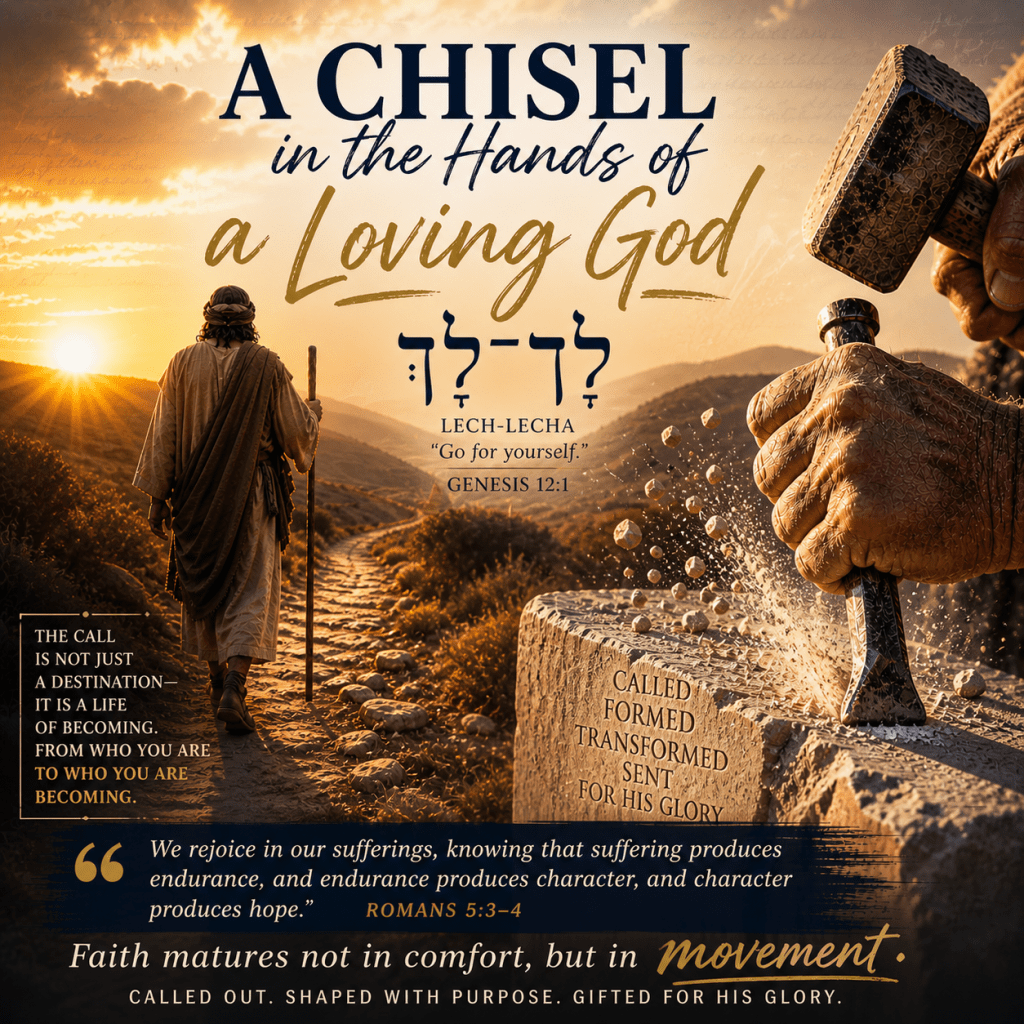
Still, there is something both humbling and instructive in the fact that Abraham was seventy-five years old when the Lord called him out from his father’s house (Gen. 12:4), and yet he was still only at the beginning of his faith formation. The initial call of the Lord did not signal completion; it marked commencement. Too often we assume that calling implies readiness, but in the economy of God, calling initiates a journey of becoming. Abraham stepped out in obedience, but he did not yet fully walk as the man the promise required him to be. His life would be shaped in the tension between trial and triumph, moments of faith alongside moments of faltering, each one serving as a chisel in the hand of God.
The journey to the place the Lord promises is never just about arriving at a destination; it is about being transformed into the kind of person who can dwell there faithfully. The land was real, but so was the inner work. Abraham was not only traveling to a land; he was becoming the man who could inhabit it in covenant with the Lord. Every delay, every test, every apparent contradiction between promise and reality became part of his formation. The famine that drove him to Egypt, the waiting for a son, the testing of his trust, these were not detours but instruments. In the mystery of God’s faithfulness, both trial and triumph serve the same end: maturity.
This is the pattern for all who walk in the path of faith. The call of Messiah Yeshua does not only lead us somewhere new; it leads us into someone new. We are called out, as Abraham was, from what has shaped us, but we are also called into a process that reshapes us. The unknown spaces of obedience are not empty; they are filled with the Lord’s intention. What feels like delay is often preparation. What feels like struggle is often refinement. The promise requires a corresponding formation, because He is not only interested in giving us an inheritance; He is committed to forming in us the character that can carry it.
So the question is not simply whether we have heard the call, but whether we are allowing the journey to do its work within us. Faith matures not in comfort, but in movement, through surrender, through testing, through perseverance, as the apostle Paul writes, “Not only that, but we rejoice in our sufferings, knowing that suffering produces endurance, and endurance produces character, and character produces hope” (Ro. 5:3-4). Like Abraham, we may begin with obedience, but we are invited into something deeper: trust that endures, identity that is reshaped, and a life that reflects the faithfulness of the One who called us. In this way, the journey itself becomes a gift of grace, for through it we are formed into people who can dwell in the promises of the covenant Lord, not merely visit them.
Many years ago, when I purchased a new iPhone, I seem to recall it being the iPhone X in 2017, I was surprised to discover that it would not sync with my Mac. The new operating system was not backwards compatible. It struck me that, in the faith life, we can face a similar tension. We must be “backwards compatible.” We honor what the Lord has done, remembering His faithfulness, and recognizing the growth rings of our formation (Ps. 77:11), but we must never become “backwards controllable” (Isa. 43:18-19).
This tension is vividly on display in Numbers 11. Israel, though physically free from Egypt, was not yet spiritually or psychologically free. They were no longer following Pharaoh, but neither were they truly following Moses. Instead, they were following their memories. “We remember the fish we ate in Egypt that cost nothing, the cucumbers, the melons, the leeks, the onions, and the garlic” (Num. 11:5) they said, longing not for the Lord’s promise, but for their past comforts. Their desires had rooted them in memory, anchoring them to what the Lord had already called them out of. But they were not being shaped by His presence or the leadership of Moses; they were being hardened by what they refused to release. They had left Egypt, but Egypt had not yet left them.
This reveals something essential about the life of faith, or life in general: we are always being formed by something. The question is not whether we are being shaped, but by what, and by whom.
When Messiah says, “Come, follow Me,” He is not offering a casual invitation to observe Him, but a call to imitate Him. Discipleship is not just the transfer of information; it is the transformation of life. This is why Paul can say, “Imitate me,” (Phil. 3:17) and again, “Imitate me as I imitate Christ,” (1 Cor. 11:1). The disciple does not simply learn the teachings of the rabbi; he adopts his way of life. He walks as his teacher walks. He becomes, in time, a living expression of what he has received: a “living epistle,” read by all (2 Cor. 3:2-3).
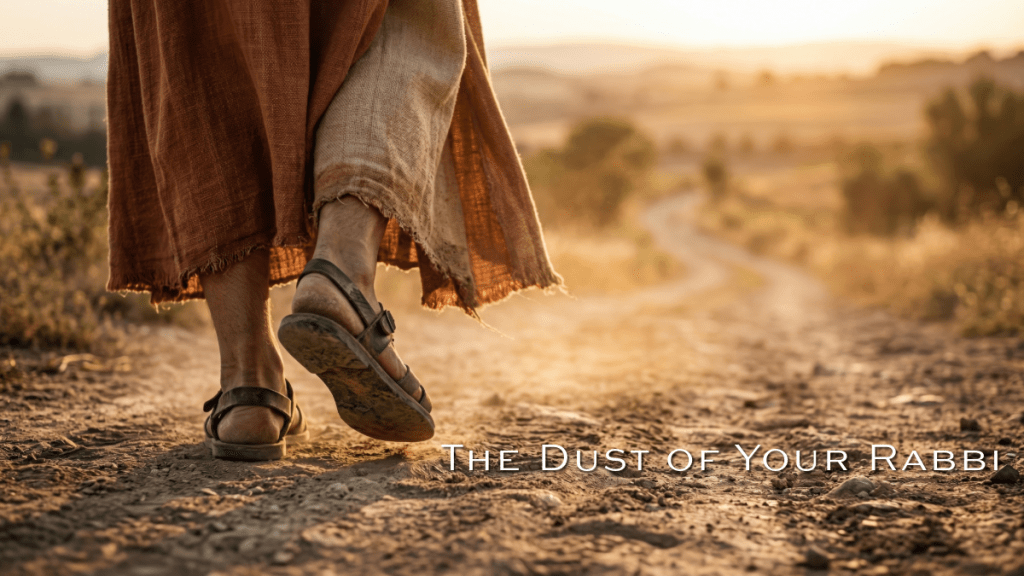
In the ancient Jewish world, this idea was captured in a powerful image: to be a disciple was to be “covered in the dust of your rabbi.” This was no small concept. The sages taught, “cover yourself in the dust of their feet,” a call to walk so closely with your teacher that his life settles upon you (Pirkei Avot 1:4; cf. Lk. 10:39; Acts 4:35; 22:3). In a land of dry, unpaved roads, this was not metaphor alone; it was lived reality. As the rabbi walked, his disciples followed close behind, the dust rising from his steps settled upon them. To be covered in that dust was a sign of proximity, devotion, and formation. You were not simply near your teacher; you were being shaped by him.
This image brings clarity to the warning found in Matthew 10:14, where Yeshua instructs His disciples to shake the dust off their feet when leaving a place that rejects them and their message. In Jewish practice, devout Israelites would sometimes shake the dust from their feet when leaving Gentile lands, a symbolic act of separation from what was considered unclean. Yeshua draws on this imagery, not to cultivate pride, but to teach discernment – not everyone we walk with, nor everything we walk through, should be permitted to have formational influence on us. Influence is never neutral. One must not carry the “dust” of every place into the life of discipleship. The issue is not withdrawal from the world, but awareness of what is shaping us as we move through it.
So the questions must be asked: What dust is covering you? And whose voice is still directing your steps?
For Israel, it was the dust of Egypt: the residue of a life they had physically left but inwardly preserved. For us, it may be the dust of our past, the weight of former identities, the pull of cultural expectations, social convention, or even the subtle influence of misdirected orthodoxy. It is possible to walk with the Lord outwardly while still being inwardly shaped by something or someone else entirely.
This is why discipleship must be intentional. In Hebraic thought, learning is never an end in itself. The root ל-מ-ד (lamad) connects learning and teaching. One learns in order to live, and lives in order to teach. Likewise, the concept of avodah (ע-ב-ד), encompassing both work and worship, reminds us that what we do is inseparable from how we serve the Lord. This is not passive discipleship, but intentional, lived obedience before Him. It is a life lived in response to the One we follow.
This balance is beautifully illustrated in the account of Mary and Martha (Lk. 10:38-42). Too often, they are set against one another: Mary as the spiritual ideal, Martha as a cautionary example of distraction. But this is an unnecessary dichotomy. Martha’s service was an expression of devotion, offered within the cultural framework she understood. Mary, however, stepped beyond those expectations, sitting at the feet of Yeshua, taking the posture of a disciple. Remarkably, Yeshua affirmed her.
The lesson is not that one must choose between being Mary or Martha, but that discipleship requires both. But first we are called to sit at His feet, to be formed, instructed, and covered in His dust, Mary’s “good portion,” and then to rise and serve with lives shaped by that formation. Service without formation becomes hollow; formation without service becomes stagnant: “Martha, Martha, you are anxious and troubled about many things.” But when the two are joined, the result is a life that truly reflects our Rabbi, “You will drink my cup…” (Matt. 20:23).
Israel’s failure in the wilderness was not simply disobedience; it was misdirected formation. They did not walk closely enough with their shepherd to be shaped by him. Instead, they clung to the dust they already carried—they remained “backward controllable.” And so they longed for what the Lord had delivered them from. The voice – and dust – of Pharaoh still directed their steps. We must not make the same mistake.
To follow Messiah is to walk so closely with Him that His life shapes ours as we are covered in His dust (Ro. 8:28-29). It is to allow His words, His ways, and His character to permeate our thinking, our desires, and our actions. It is to be transformed, not by the residue of where we have been, but by the presence of the One we now follow.
The winds of life will always carry dust. Influence is unavoidable. Formation is inevitable. The only question is whether we will be shaped by the dust of our past, or by the dust of our Rabbi.
So walk with Him. Stay near. And let His dust, not the dust of your past, be what forms you.
Having led and walked with many through the season of Passover, I have often reflected on how redemption is not only something we recall, it is something that leaves its mark upon us.
In Exodus 13:9, the Lord commands that the remembrance of deliverance from Egypt shall be “as a sign on your hand and as a memorial between your eyes.” This is no casual metaphor. Redemption is to be bound to the body, to shape thought, action, and speech. It is to be carried.
Over time, this command found tangible expression in the practice of tefillin, or phylacteries, the binding of small leather boxes upon the arm and forehead by religious Jews during prayer. Within them are the very words of Torah, including the account of redemption (Ex. 13:1-10; 13:11-16; Deut. 6:4-9; 11:13-21). The people of Israel quite literally bind the memory of the exodus upon themselves.
And yet, later rabbinic reflection adds a striking layer to this image. Some sages taught that the leather straps of the tefillin, wrapped around the arm and hand, had undergone a symbolic transformation: what once symbolized the whips of Egyptian slavery is now reshaped into the cords of covenantal devotion. The instruments of oppression become the instruments of remembrance and dedication. This is a profound reversal.
What once bound Israel in suffering now binds them in obedience. What once marked them as slaves now marks them as redeemed. Redemption does not erase the past; it redeems it.
The straps that encircle the bicep and arm, traditionally wound down toward the hand and fingers, mirror both memory and mission. The arm: strength, action. The hand: deed, obedience. The head: thought, intention. The whole person is claimed. The whole person is marked. But the story does not end there.
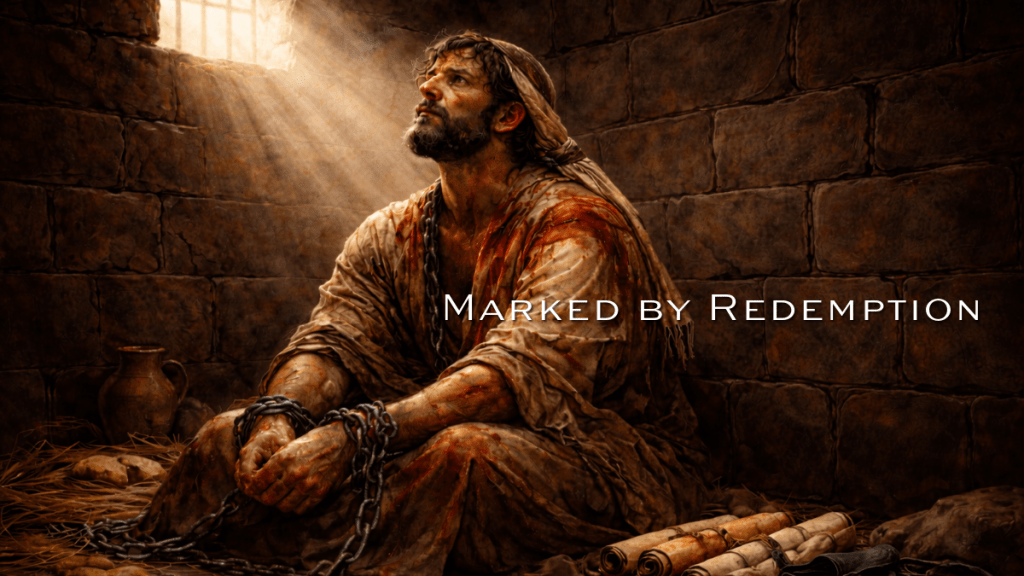
When we turn to Galatians 6:17, we encounter a man who also speaks of being marked. The Apostle Paul writes, “I bear in my body the marks of Jesus.” These are not ritual bindings. These are scars. The risen Messiah still bears His wounds, and those who belong to Him should not be surprised if redemption leaves its mark upon them as well. Beatings. Stonings. Imprisonments. The cost of following and proclaiming Messiah Yeshua.
Paul does not bind straps upon himself as a remembrance of redemption; his very body has become the testimony. If Israel bore the sign of deliverance through commanded symbols, Paul bears the sign of redemption through suffering. And yet, both speak the same truth: redemption leaves a mark. It is here that the imagery converges in a powerful way.
The rabbis saw in the leather straps of tefillin a transformation of the whips of Egypt. Paul, too, knew the lash. He knew the rod. He knew the weight of affliction laid upon his body. But in Messiah, even these marks are transformed. What was intended for harm becomes a testimony of belonging, for a man who once rejected the very Messiah he now clings to. What once would have silenced him instead proclaims that he is not his own. The straps and the scars tell the same story.
Both declare: I belong to the One who redeemed me.
In Exodus, the marking is commanded, an act of faithful remembrance. In Galatians, the marking is endured, an act of faithful witness. One is taken up willingly in obedience; the other received through the cost of discipleship. Yet both are bound together by covenant. This invites a searching question. What marks us?
Not just what do we profess, but what do we carry? What has redemption done in us that can be seen, felt, known? For some, the mark may indeed be visible suffering, the cost of faithfulness in a world that resists the claims of Messiah. For others, it may be the quiet but no less real transformation of life: habits reshaped, desires reordered, words redeemed, actions aligned with the will of God. But make no mistake, redemption is never without imprint.
At Passover, we remember that Israel did not leave Egypt unchanged. The blood of the lamb marked their doorposts. The journey marked their identity. The covenant marked their lives. And in Messiah, we, who have been redeemed by a greater deliverance, are likewise marked, not by the absence of hardship, but by the presence of belonging. The question is not whether we are marked. The question is whose mark we bear.
Israel bound the remembrance of redemption upon their minds and arms Paul bore the cost of redemption in his very flesh. And we, too, are called to live as those upon whom the mark of God rests, not superficially, not symbolically alone, but truly and wholly. For those redeemed by the Lamb are never left untouched.
 the mountain mensch