
Something Immovable

In the midst of the plague narrative of Exodus, the Lord gives the children of Israel a continual remembrance even as He commands a yearly remembrance. How are the two, applying a physical reminder and Passover, related?

In Exodus 13:9, 16 we read, “And it shall be to you as a sign on your hand and as a memorial between your eyes, that the law of the Lord may be in your mouth. For with a strong hand the Lord has brought you out of Egypt … It shall be as a mark on your hand or frontlets between your eyes, for by a strong hand the Lord brought us out of Egypt.”

The rabbis understand this literally: a physical application of the words above upon the body. The practice of laying Tefillin, defined below, endured through Israel’s long history, to the time of Yeshua/Jesus, even to today. Perhaps some background will aid our understanding.

The word תְּפִילִּין/Tefillin is the plural of Tefillah, meaning to pray. The word “tefillin” is not found in the Bible; rather, the Torah refers to Tefillin as: ot, zikaron, or ṭoṭafot, sign, remembrance and something immovable, respectively.

When the Jewish translators of the Septuagint were searching the Greek language to translate, וְהָיוּ לְטטָפת בֵּין עֵינֶיךָ, “they shall be as frontlets between your eyes,” they settled on φυλακτήριον/phylaktērion, phylacteries, meaning: guarded post, safeguard, or security; as the Word of God is to guard, protect, and keep the people of God, something, as noted above, that is immovable. Why?

The command for תְּפִילִּין/Tefillin is found in Exodus 13:9, 13:16; Deuteronomy 6:8 and 11:18.

These four paragraphs are written on parchments inserted into the תְּפִילִּין/Tefillin – one compartment in the hand tefillin, and four compartments in the head tefillin. There is one parchment in the hand תְּפִילִּין/Tefillin, and four in the head תְּפִילִּין/Tefillin, from the singular and plural language found in the text of the Torah. As Deuteronomy 6:4-9 commands, the Word is to be applied to the head and the hand in order to demonstrate the love of God with all our heart, mind/soul and strength, more on this below.

Going a little deeper. The תְּפִילִּין/Tefillin are made from the skin, hair and sinew of kosher animals. The rabbis explain this demonstrates that the “animal nature” of man must be submitted to the will of God, or in Christian parlance: “the flesh/sin nature.”

Numbers play a symbolic role in the Tefillin as well. The boxes are each sealed with 12 stitches: for 12 months of the year. The number seven is found in the windings on the arm, as well as the Hebrew letter ש/shin found on two sides of the head תְּפִילִּין/Tefillin. The seven stems found on the two ש/shin letters may represent the patriarchs and matriarchs (7 total), the week of creation, or the perfect plan of God. The number seven in Hebrew is שָׁבַע, meaning to “to bind oneself by seven things,” also means to “make covenant,” the covenant partner being the one we are bound to. In Revelation 1:4, the Bride of Messiah, is represented by seven, as in the seven letters.

The two straps hanging from the head תְּפִילִּין/Tefillin represent love and judgment – love on the right, and judgment on the left, reaching down to creation. The three windings on the middle finger of the weaker hand represent betrothal.

As you apply the תְּפִילִּין/Tefillin, the following blessings are recited:

בָּרוּךְ אַתָּה ה’. אֱלהֵינוּ מֶלֶךְ הָעולָם. אֲשֶׁר קִדְּשָׁנוּ בְּמִצְותָיו. וְצִוָּנוּ לְהָנִיחַ תְּפִלִּין

“Blessed are you, Lord our God, Ruler of the Universe, who sanctified us with God’s commandments and commanded us to place the tefillin.”

בָּרוּךְ אַתָּה ה’ אֱלהֵינוּ מֶלֶךְ הָעולָם. אֲשֶׁר קִדְּשָׁנוּ בְּמִצְותָיו וְצִוָּנוּ עַל מִצְוַת תְּפִלִּין

“Blessed are you, Lord our God, Ruler of the Universe, who sanctified us with God’s commandments and commanded us regarding the mitzvah of tefillin.”

בָּרוּךְ שֵׁם כְּבוד מַלְכוּתו לְעולָם וָעֶד

“Blessed is the name of the Glory of God’s Kingdom forever.”

As the hand is wrapped:

וְאֵרַשְׂתִּיךְ לִי, לְעוֹלָם

וְאֵרַשתִּיךְ לִי בְּצֶדֶק וּבְמִשְׁפָּט וּבְחֶסֶד וּבְרַחֲמִים

‘וְאֵרַשתִּיךְ לִי בֶּאֱמוּנָה. וְיָדַעְתְּ אֶת ה

“I betroth you to me forever. I betroth you to me in righteousness, justice, lovingkindness, and mercy. I betroth you to me in faithfulness, and you shall know the Lord” (Hosea 2:21-22).

The verses from Hosea 2:21-22 brings the picture together. The donning of the טַלִּית/tallit, the Jewish prayer shawl, and the laying of the תְּפִילִּין/Tefillin is a picture of a bride preparing: a bride in identifying attire. In Hebrew bride and betrothed is כַּלָּה/kallah, from the root כָּלַל/kalal, meaning to make perfect or complete: to put a crown upon.
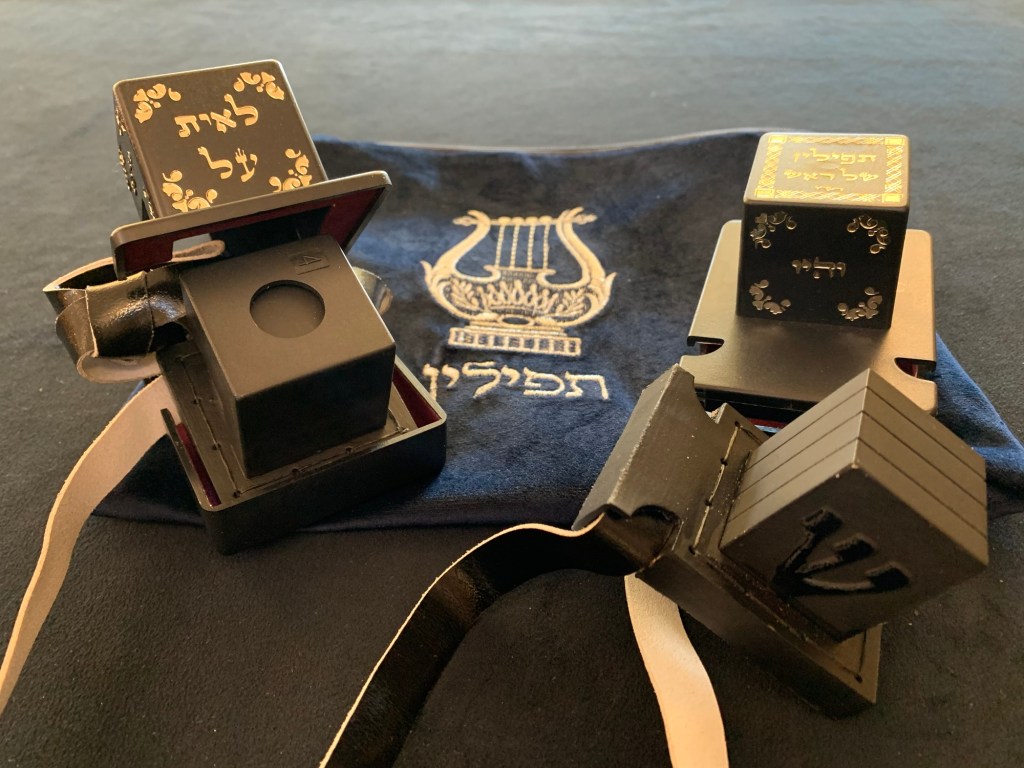
In the typological picture of the תְּפִילִּין/Tefillin, the head תְּפִילִּין/Tefillin is referred to as “the crown,” or “crown of righteousness,” a type Paul references. In the straps on the arm and hand, and on the boxes we find His name, identifying to whom we belong, and upon our hand, when we say the words from Hosea 2:21-22, we find a ring. All of this together טַלִּית/tallit and תְּפִילִּין/Tefillin is the bridal attire for those betrothed to Messiah to prepare for the Marriage Feast of the Lamb.

Finally:

Just as the Passover Seder as a remembrance is a living sermon meant to engage generations and the senses, Tefillin brings the head and the heart together in prayer. How?

1. Thought and Action

2. Creed and Deed.

3. Knowledge and Compassion.

The orthodoxy of mind, right thinking in learning, is taken a step higher through orthopraxy, doing what is right as an act of worship and prayer unto the covenant Lord.

Messiah Yeshua/Jesus teaches us: “Everyone then who hears these words of mine and does them will be like a wise man who built his house on the rock. And the rain fell, and the floods came, and the winds blew and beat on that house, but it did not fall, because it had been founded on the rock” (Matt. 7:24-25).

To hear and do the Word of Messiah, the forever settled Word of God, makes us, His disciples, a ṭoṭafot, something immovable in Him. Adorned in the garments of betrothal, no matter the plague or storm in life, we stand firmly established.

Underlying the faith life is the remembrance of deliverance as family gathering and bodily adornment. Now that we are free, how then shall we live?

Be well. Shalom.

We Need Each Other

When called by God, there is a risk that we may believe we are autonomous in vocation, this is a dangerous disposition indeed.

The Torah portion וָאֵרָא/Va’era, meaning “I appeared,” provides an interesting lesson in growth and leadership. Moses, as we know from the Torah, the Apostolic Scriptures and Jewish tradition is highly respected, and rightly so. Yet, often overlooked is the importance of his relationship with his brother, Aaron.

In Exodus 7:1 the Lord says to Moses:

וַיֹּאמֶר יְהוָה אֶל-מֹשֶׁה, רְאֵה נְתַתִּיךָ אֱלֹהִים לְפַרְעֹה

וְאַהֲרֹן אָחִיךָ, יִהְיֶה נְבִיאֶךָ

“And the Lord said to Moses, ‘Look, I am appointing you as a man of authority before pharaoh, and Aaron your brother will be your spokesman.’”

When Moses was called by God, he did not have a very good opinion of himself. In fact, he used this perception as the basis for his argument to disqualify himself from service to the Lord. When Moses says, “I am not eloquent … I am slow of speech and of tongue …” (Ex. 4:10), the Lord says, “Who has made mans mouth?”

Still, knowing that Moses was yet fragile, he calls someone to come alongside Moses to be his voice: Aaron. Yet, Aaron is not just a mouthpiece, he is a support that allows Moses to grow into his calling. Even though Moses was called to lead Israel at age 80, he was effectively discipled into this position by his older brother Aaron. Read to the words of the Lord:

“Then the anger of the Lord was kindled against Moses and he said, “Is there not Aaron, your brother, the Levite? I know that he can speak well. Behold, he is coming out to meet you, and when he sees you, he will be glad in his heart. You shall speak to him and put the words in his mouth, and I will be with your mouth and with his mouth and will teach you both what to do. He shall speak for you to the people, and he shall be your mouth, and you shall be as God to him. And take in your hand this staff, with which you shall do the signs” (Ex. 4:14-17).

When Aaron saw Moses, his heart was glad. He would become a support for Moses. Aaron would speak the words Moses was told, and the Lord would “teach you both what to do.” Aaron became a facilitator for Moses, but not to his own detriment. As Moses fulfilled his calling, in the unfolding history of Israel, Aaron would also be fulfilled in his calling.

With Aaron’s support, even mentoring, Moses was enabled to become who God called him to be: the real Moses, not the disqualified Moses. Still, as much as Moses needed Aaron’s help, Aaron needed Moses as well.

In Exodus 6, the Torah records the genealogy of Moses and Aaron, concluding with “These are the Aaron and Moses to whom the Lord said, “Bring out the people of Israel from the land of Egypt by their hosts” (Ex. 6:26). Here Aaron is listed first, but then in Exodus 6:27 we read, “It was they who spoke to Pharaoh king of Egypt about bringing out the people of Israel from Egypt, this Moses and this Aaron.” The rabbis find this to be an indication of their equality, as one was not greater than the other.

By the end of their lives Moses and Aaron would be the men God called them to be: the real Moses and the real Aaron. Moses, having benefited from the support of Aaron, would then support Aaron as he was called to serve as the anointed High Priest of Israel. Moses the “slow of speech” prophet and leader of Israel, by his brothers support, would anoint Aaron, the compromising sculpture of the Golden Calf, to be the uncompromising High Priest of God’s righteous standard before the Brazen Altar.

What facilitated this change? They were supported in their time of growth by someone that God had sent into their life.

I do not often insert myself into these devotional writings, but for the sake of my point, I will. As a “pastoring teacher” or rabbi, (Eph. 4:11) my job description is simple, but continuous, as Paul writes regarding the gift ministries that Messiah gave to His congregation; they are: “to equip the saints for the work of ministry, for building up the body of Messiah, until we all attain to the unity of the faith and the knowledge of the Son of God, to mature manhood, to the measure of the stature of the fullness of Messiah, so that we may no longer be children, tossed to and fro by the waves and carried about by every wind of doctrine, by human cunning, by craftiness in deceitful schemes” (Eph. 4:12-14; cf. 4:15-16).

How am I able to do this, as inept as I am, O Lord? The Lord sent older brothers into my life, as pastors and teachers, fathers in the faith, to come alongside and support me as the Lord matured, and continues to mature, me. Men like Dr. John Looper, Dr. Karl Coke, Dr. Michael Lake, the late Bishop Daniel Herzog, and the elders of Messiah Congregation. As the Lord has sent me to support and edify those He has entrusted to my care as a bishop in their lives, He has provided the same for me, just as He had done for those who mentored me.

Why is this important? The saints of God in Messiah have been commissioned as part of the Great Commission. We all have shortcomings that we magnify in our minds, but as God told Moses, paraphrased, “Who made you?” As we grow in faith, matured by study, prayer and process in tribulation, we have support, principally from the promised Holy Spirit, but then visibly by our Aaron, or by our Moses.

Dear reader, you are not disqualified because you are “slow of speech.” He knows your limp, and He is the support for your limp; and He sends brothers and sisters into your life to help you limp and live by faith in the One Who is conforming you to the image of Messiah (Ro. 8:28-29), as you walk in your calling.

We do, in fact, need each other.

Be well. Shalom.

Name Above All Names

The Gospel of Exodus opens with the portion of Shemot, meaning names. As it says:

וְאֵלֶּה שְׁמוֹת בְּנֵי יִשְׂרָאֵל הַבָּאִים מִצְרָיְמָה אֵת יַעֲקֹב אִישׁ וּבֵיתוֹ בָּאוּ

“And these are the names of the children of Israel which entered Egypt with Jacob, each man with his household” (Ex. 1:1).

The portion of Names also records the birth of the future leader and deliverer of the people of Israel, Moses; but there is something unusual in his brother announcement:

“Now a man from the house of Levi went and took as his wife a Levite woman. The woman conceived and bore a son, and when she saw that he was a fine child, she hid him three months” (Ex. 2:1-2).

What is unusual? Neither Moses, nor his parents are named. Moses is named by Pharaohs daughter only a few verses later, and the Torah later provides the names of the parents of Aaron, Miriam, and Moses: Amram and Jochebed (Ex. 6:20). Why are they absent here?

In the eyes of the Pharaoh and his court, Israel is a nameless, faceless hoard. Perhaps this was how the Egyptians themselves related to them: a mass of people who have overrun their country. It is not until the daughter of Pharaoh adopts Moses that he is given a name: מֹשֶׁה/Moses, from the verb, to pull or draw out.

What do we learn from this?

Moses was not chosen because he was born to the most important tribe, as the Levites were yet attached to the Tabernacle. He was not born of a great house. He was not wealthy and free; rather, he was born under and then hidden from a death decree. He only survived because his mother was willing to send him down the Nile in a bulrush basket. She let him go, and the Lord lifted him up.

To serve the Lord you need not be born of a great house, family name or of prominent parents. Too many today disqualify themselves because of past sin or present circumstance. Yet, in Christ you are born-again into the greatest house, into His name, and now you call the Lord of heaven, Abba, Father, by the Spirit of Adoption (Ro. 8:15).

Moses faced the challenge of his upbringing as well. Yes, he was born nameless, faceless, and in peril; but, he was raised in the house of the Pharaoh. When the Lord called Moses, and ultimately established him as the leader of Israel, do we think there would not have been whispers about Moses? This “Hebrew” Egyptian “now leading us”? We see this now for the second time, as an earlier deliverer, Joseph, the one the Pharaoh of Exodus 1 forgot, was also a Hebrew “Egyptian.”

The Lord used the experience of both Joseph and Moses to rescue His people, but not in their own name.

When Moses went into the court of Pharaoh, he did so in the name of the Lord: the Name above all names. It was not the name of Moses or even Joseph that rescued, but the name of the Lord God.

When Paul is correcting the Corinthians about the divisions among them, he says so powerfully:

“For it has been reported to me by Chloe’s people that there is quarreling among you, my brothers. What I mean is that each one of you says, “I follow Paul,” or “I follow Apollos,” or “I follow Cephas,” or “I follow Christ.” Is Christ divided? Was Paul crucified for you? Or were you baptized in the name of Paul? (1 Cor. 1:11-13).

Baptized and then resurrected in the name of Messiah Yeshua/Jesus. Not that of any earl they house or position. Why does this matter? You, dear reader, are not called to serve, go out, or even build up your own name, but His.

Just as Joseph and Moses were raised to the house of Pharaoh, you may graduate from the most prominent university or from the school of hard knocks, but that matters not. What matters is the calling in His name. For it is by His name that we are saved, sent out, and ultimately harvested into His glorious presence.

Do not focus on your apparent lack, but on the Name of the Father, the Son and the Holy Spirit. Moses was a nobody of a dying house, but in God’s name, he is remembered as a man of God.

Hear Paul’s doxology:

“Let this mind be in you which was also in Christ Jesus, who, being in the form of God, did not consider it robbery to be equal with God, but made Himself of no reputation, taking the form of a bondservant, and coming in the likeness of men. And being found in appearance as a man, He humbled Himself and became obedient to the point of death, even the death of the cross. Therefore God also has highly exalted Him and given Him the name which is above every name, that at the name of Jesus every knee should bow, of those in heaven, and of those on earth, and of those under the earth, and that every tongue should confess that Jesus Christ is Lord, to the glory of God the Father” (Phil. 2:5-11).

The Name above all names has called you by a new name, one from His House. Remember who you are in Him, and He will position you according to His will.

Be well. Shalom. And Happy New Year.