Song: From the Heart to the Heart

The portion of Mishpatim/judgments opens in Exodus 21:

וְאֵלֶּה הַמִּשְׁפָּטִים אֲשֶׁר תָּשִׂים לִפְנֵיהֶֽם

“And these are the judgments/ordinances that you are to put before them.”

This is the beginning of the legal code, understood to be a continuation of the Sinai revelation. This portion contains twenty-three (23) positive commandments, and thirty (30) prohibitions. Most of these are formulated as casuistic statements, case law, or: “if … then” conditionals. In the previous portion of Yitro/Jethro, the ten commandments were formulated as apodictic commandments.

Considering these together, apodictic commandments, such as “you shall not murder,” gives a general prohibition, but does not address accidental death, or manslaughter. Casuistic laws give general circumstances from which a determination can be made in a specific situation.

In Exodus 21:22, we find an example of a casuistic law that deals with the harm done to an unborn child. This law protects the life of the unborn, and defines a pattern of justice for harm done. In this case, the Law of Talion, “eye for eye” and so on. The Law of Talion is understood to be concerned primarily with monetary damages for bodily harm, except in the case of murder, when it was life for life. It is not, as Mr. Gandhi suggested, a law of mutilation.

It is important to study, reflect on, and rightly apply the Word of God to life and community, particularly in these days of popularized relative morality, and a feel good ethic. The Word of God is forever, unchanging, and contains the eternal ethical norm of the Living God (Ps. 119:89). While not everything in the law, or the Torah, is literally normative for us today, by the Lord’s design, it remains His will, as a revelation of His heart and character.

When we consider portions like Mishpatim, filled with legal code that allows me to rattle off $5 words, and an occasional $10 word dealing with the technical issues of the Torah, it is difficult to inspire the next generation, or even our current generation, if we sermonized the legal code of the Torah in public exposition. How then, do we transmit the principles of our biblical faith from one generation to the next, to include this dense ethical matter? This portion illustrates for us the importance of ethical, social and religious norms, but we must remember in our exposition that the Lord desires to speak to the heart as well as the mind.

The apostle Paul aids us in our consideration here, as he writes, “And do not get drunk with wine, for that is debauchery, but be filled with the Spirit, addressing one another in psalms and hymns and spiritual songs, singing and making melody to the Lord with your heart, giving thanks always and for everything to God the Father in the name of our Lord Yeshua/Jesus the Messiah,” (Eph. 5:18-20).

Song. Song penetrates the heart, especially spirit-filled song. Paul encourages us to “pluck the heart” as an instrument, and to sing from the heart. There is a rabbinic expression that says, “words spoken from the heart enter the heart.” If this is true, then it stands to reason that words sung from heart enter the heart as well.

Song is vitally important in Scripture. Consider some examples:

Revelation 15:3: we find the redeemed of the Lord singing the Song of Moses, and the Song of the Lamb. Revelation 14:3: the 144,000 stand before the Throne and sing a new song to the Lord. Matthew 26:30: before departing for the Mt. of Olives, Messiah and the disciples sing the Hallel of the Passover Seder.

One of the greatest poems of love is called the Song of Songs/Solomon. Further, many of the Psalms open with: מִזְמוֹר לְדָוִד, “this is a song/melody of David.” In Exodus 15:1, after the crossing of the Red Sea, it was not a great sermon that the children of Israel listened to, it was a song they sang.

The entire Hebrew Bible, Old Testament, is, in fact, one long melody … even the legal bits.

Song permeates the life of my home congregation, Messiah Congregation. As the congregational rabbi and song leader, I love song in communal life, songs about the Lord. Whether before, during, or after a service, or during the week, you will hear song echoing through our congregational building.

In Deuteronomy 31:19, when speaking of the Torah, the Lord speaks of it as a song: “Now therefore write this song and teach it to the people of Israel …” When we approach the Torah, whether we study, memorize, or read in the congregation, the Lord says, “write this song for yourselves … learn it by heart.”

The Lord likens the Torah to a song, and it is sung from week to week with a melody all its own. Here we return to a connection to the next generation.

The rabbis find in Deuteronomy 31:19 a command that the Israelite must write a copy of the Torah for himself. Yet, not everyone has the skill to do so. A later tradition developed that as a scribe wrote the final lines of a Torah scroll, he would simply outline the final letters, not filling them in. As the scroll of the Torah is being completed, each letter in the final lines are filled in by different people to fulfill the words of Deuteronomy 31:19; and a joyous celebration called סיום/Siyyum (completion) is held. In this celebration, we find the generations present in joy and song.

See our songs of faith, hope, love, and even theology become the outline of the letters of the Torah. At this point the Torah can still be read, but they must be filled in. We help fill in the letters of the next generation by teaching their meaning, and being examples of their meaning in life. The letters are filled by the renewed heart in faith. Intellect wrote the letters, but the heart fills them with life.

Song, praise, and psalms are not only important in worship of the Living God, they help to transmit the substance of the dense theological matter contained in these more difficult passages. For one generation, the letters have been filled with meaning, to the next, the outline is being drawn: with the heart, and to the heart in song.

From generation to generation, the song of the Word continues, even as the Lord Himself “rejoices over you with singing” (Zeph. 3:17).

Be well. Shalom.

At the King’s Table

In 2 Samuel 9, David inquires as to any remaining descendants of Saul’s house. David is now the anointed king. He is expanding his kingdom. And from this position of authority, he desires to show kindness, even unusual kindness: to the house of the former king.

David is told of מְפִיבֹשֶׁת/Mephibosheth, a son of his dear friend Jonathan. Mephibosheth is maimed or lame. In 2 Samuel 4, when news of the death of Saul and Jonathan came from Jezreel, his nurse picked him up and fled. In the commotion he falls and was maimed (2 Sam. 4:4). He is exiled in לּוֹ דְבָר/Lodebar, as a descendant of the former king; and as such, he has no inheritance, no future and no hope.

לּוֹ דְבָר/Lodebar, means “no pasture,” it is a picture of a wasteful place, not good for anything. It is from two Hebrew root words, no and speech/promise. It is a place distant from the promises of God, as Mephibosheth no longer has any inheritance due to the death of his grandfather Saul and father Jonathan. Yet, David, דָּוִד‎/Beloved will show godly kindness.

David wants to show kindness to Saul’s house (2 Sam. 9:1). So what does he do?

1. He seeks the exile: his identity and location (2 Sam. 9:3-4).

2. He calls the exile by sending word to where there is no word (2 Sam. 9:5-6).

3. He assures the exile (2 Sam. 9:6).

4. He restores the exile by drawing him near (2 Sam. 9:7).

5. He sets the exile at the kings table (2 Sam. 9:7, 10).

Mephibosheth sees himself in his broken condition, a condition created by a fall, as a “dead dog,” meaning useless, as he lingers exiled in a useless, waste of a land (2 Sam. 9:8). Yet, by David’s unusual kindness, his grace, and by his word, Mephibosheth will sit at David’s table, like one of David’s own sons (II Sam. 9:11).

And while seated at that table, no one sees his lame condition; rather, only his restored condition.

מְפִיבֹשֶׁת/Mephibosheth, is restored by the word and kindness (חֶסֶד/chesed) of the king. Even so, his name, מְפִיבֹשֶׁת/Mephibosheth, seems to be prophetic, as if a result of his lame/maimed condition. מְפִיבֹשֶׁת/Mephibosheth, is rooted in two Hebrew words meaning “to blow away or scatter shame.” מְפִיבֹשֶׁת/Mephibosheth is exiled in a place where there is no wind, breath or speech, לּוֹ דְבָר/Lodebar; however, he is restored by the breath and spirit of King David.

We too have been made lame by a fall: Adam’s sin. Helpless in ourselves, we inhabit the land of לּוֹ דְבָר/Lodebar, far from God, stuck in our sin, without hope or inheritance. Yet, as the apostle Paul writes, “But thanks be to God, who gives us the victory through our Lord Yeshua/Jesus the Messiah” (1 Cor. 15:57), the greater David in whom the Father is well-pleased. Messiah has shown extraordinary kindness to those He has restored (Ro. 5:8):

1. He came to seek and save the lost: those in the waste (Lk. 19:10).

2. He chooses those who were lost (Jn. 15:16).

3. He assures the lost of His abiding presence unto fruitfulness (Jn. 15:4, 5).

4. He Restores by making new (Rev. 21:5).

5. He fulfills the promises, leaving nothing undone (2 Cor. 1:20).

6. He shows kindness as the Final Adam, not fallen, but having overcome (1 Cor 15:22; Jn. 16:33).

7. He shares the table with those having received His grace (Jn. 13:12; Lk. 22:19-20).

8. And at His table, the Table of the King, we are no longer distant, strangers, or exiles, as we are seated as sons of the King (Ro. 8:15-17).

No longer in Lodebar, a place of no promise or inheritance, our shame having been blown away, removed as far as the east is from the west (Ps. 103:12), by the breath of God (Jn. 20:22; Acts 2) the Lord in Messiah has reconciled both Jew and Gentile to Himself, as Paul writes:

“But now in Messiah Yeshua, you who once were far off have been brought near by the blood of the Messiah … And He came and proclaimed peace to you who were far away and peace to those who were near – for through Him we both have access to the Father by the same Spirit. So then you are no longer strangers and foreigners, but you are fellow citizens with God’s people and members of God’s household … In Him, you also are being built together into God’s dwelling place in the Spirit” (Eph. 2:13, 17-19, 22).

No longer are those in Messiah as Mephibosheth, maimed by the fall; but all in Him are now restored by His overcoming. The kindness of the King of kings, and Lord of lords. You dear reader, have you received of this kindness? Then I am sure you know how Mephibosheth felt. That dread feeling of worthlessness due to some challenge you face. Yet, the beauty of sitting at the table of Yeshua/Jesus is when you look around, He has recovered, healed, and restored everyone there. We did not seat ourselves, we were seated by the grace of the Living God. Now, having been brought near to the King, we have a future and a hope, no longer exiled to the wastelands of life, He has filled us with new life.

Be well. Shalom.

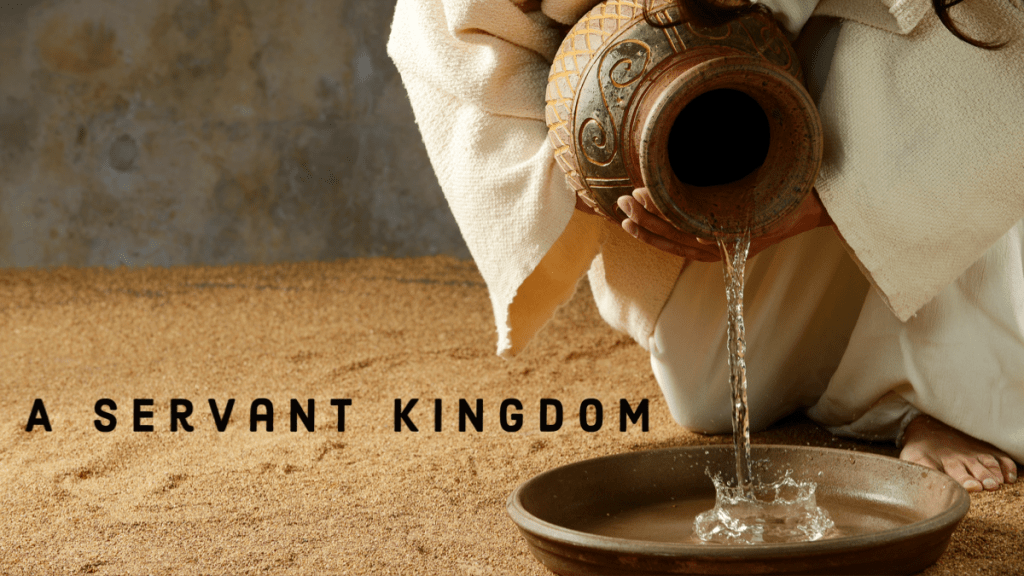
A Servant Kingdom

In Exodus 19:1-6, the children of Israel travel from Rephidim and encamp in the wilderness of Sinai, just before the mountain of God. As the Lord recounts the majestic and swift salvation of the “house of Jacob” upon “eagles’ wings,” He calls Israel to their purpose:

וְאַתֶּם תִּהְיוּ-לִי מַמְלֶכֶת כֹּהֲנִים, וְגוֹי קָדוֹשׁ

“And you will be to Me a kingdom of priests/servants, and a holy nation” (Ex. 19:6).

When people think of priest, we imagine someone in an exalted position, wearing robes of office and esteem. There is esteem, dignity and exaltation in the priestly calling, but the heart of the call is service.

Israel, standing before Mt. Sinai will prepare for three days in order to receive the revelation. The people are tended to, not only by Moses and the eldership of Israel, but also a priesthood (Ex. 19:22). This is often a point of confusion, as when people read of Israel’s priesthood, they think of Aaron and his sons; however, they were not yet installed. So who are these “priests”?

The Hebrew word priest, or כֹּהֵן/cohen, simply means “one who serves” or a “servant.” The priesthood or servants referenced in Exodus 19 were people, not anointed into the Levitical office, but those presumably chosen by Moses or the elders to serve the people as they prepared to meet the Lord. These “types,” often overlooked, are important to our understanding of who we are in Messiah.

The apostle Peter directly quotes nearly half of Exodus 19:5-6 in 1 Peter 2:9 when he speaks of the Body of Messiah as a “chosen race, a royal priesthood, a holy people, a people for a possession…” Further, the apostle John writes in Revelation 1:6 that the Lord has made those in Messiah “a kingdom, priests to his God and Father … (ESV).” Some scholars suggest that it could be rendered: “a kingdom of priests to His God and Father…”

Still, what does this mean? Consider three points:

1. A kingdom of priests, or servants, is not concerned with their own fame, but with helping others, by their care, to thrive.

2. Glorify Him in all you do (1 Cor. 10:31).

3. A holy nation, literally a “set-apart people,” are called by God to be unafraid of being unique, or different, from the surrounding society, because of who He has made us to be, as Paul writes, “and if children, then heirs—heirs of God and fellow heirs with Christ, provided we suffer with him in order that we may also be glorified with him” (Ro. 8:17).

This is the calling of those covenanted to the Lord through the Blood of the Lamb, to: serve others, glorify Him in all they do, and be different. At its heart, the calling of God to those He has saved, is a calling to humility in service, even as a son or daughter of the Living God.

In Philippians 2:3 Paul writes, “Do nothing out of selfishness or conceit, but with humility consider others as more important than yourselves.” From what example? That of Christ, as Paul continues, “Who, though he was in the form of God, did not count equality with God a thing to be grasped, but emptied himself, by taking the form of a servant, being born in the likeness of men. And being found in human form, he humbled himself by becoming obedient to the point of death, even death on a cross” (Phil. 2:6-8).

CS Lewis wrote, “True humility is not thinking less of yourself; it is thinking of yourself less.” Paul, in referencing the humbled example of the Messiah, stresses that He could have advanced His importance and position as a means exemption from humbled, even humiliating service, but He did not. In this we find a stark difference with other world religions. Of all the religions of the world, the Messianic faith is the only one that makes its central event – the crucifixion of Messiah – the humiliation of its Lord and Savior. Why?

Hebrews 4:15 says that our High Priest is able to empathize with us, His people. He experienced the brokenness of humanity, and was moved in His heart to tears, as the shortest verse in the English Bible says, “Jesus wept.” He had compassion on the sick, on the downcast, even on the dead; and in that compassion He served them, healed them, and restored them. His compassion did not consider His own importance. He considered, just as Paul directs us, “others as more important than yourselves.”

What does this require us to do?

We must stop looking into the mirror of our-self, upon our beauty and importance, thereby laying aside our self-judgment, criticism, self-importance, or feelings of superiority. As Lewis encourages, “think of yourself less.” We are called in Messiah to be priests and a holy people, therefore we serve and seemingly become odd, different, unique in how we engage the human other in the eyes of the broader culture.

The priests of Exodus 19 served, unnamed, only recognized in a word from the Lord that they too must prepare themselves, even while serving others. It matters not if your name is forgotten here on earth, as it has already been written in heaven, therefore: “rejoice” (Lk. 10:20). In an era when everyone is a celebrity, the new fame is found in godly anonymity. That He knows you, is more than enough.

Be well. Shalom.