Shepherds After God’s Own Heart

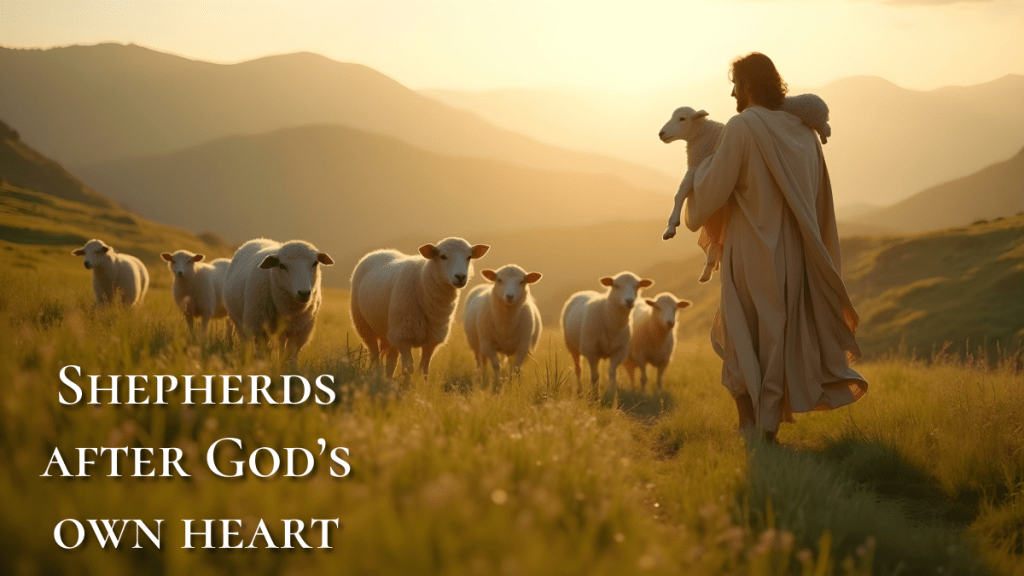
Pastoral ministry is not a profession, it is a vocation, even a sacred trust. The apostle Paul, in his farewell to the Ephesian elders, reminds us that the flock we tend was purchased at the highest cost: the precious blood of Messiah. This truth alone should fill every pastor’s heart with trembling reverence and holy resolve.
“Take heed to yourselves and to all the flock, among which the Holy Spirit has made you overseers, to shepherd the church of God which He purchased with His own blood” (Acts 20:28).

Our vocation comes by the calling of Christ. Our training by the study of God’s Word, taught by the Holy Spirit, at the feet of proven, elder ministers and teachers. Our principal study is the Word of God, with our mission the tending to and salvation of souls. Keeping always before us this high calling cuts through distractions and vain ambitions. Faithfulness in prayer, worship and devotion will continually draw us back to the two pillars of pastoral vocation: the Word and the care of the soul. 

The Anglican Bishop JC Ryle wrote:

 “Like the sower, the preacher must sow good seed if he wants to see fruit. He must sow the pure Word of God, and not the traditions of the church or the doctrines of men. Without this, his labor will be vain. He may go to and fro, and seem to say much, and to work much in his weekly round of ministerial duty, but there will be no harvest of souls for heaven, no living results, and no conversions.

Like the sower, the preacher must be diligent. He must spare no pains; he must use every possible means to make his work prosper; he must patiently sow beside all waters, and sow in hope. He must “instant in season and out of season,” he must not be deterred by difficulties and discouragements; “he that observeth the wind shall not sow.” No doubt his success does not entirely depend upon his labor and diligence, but without labor and diligence success will not be obtained (Isa. 32:30; 2 Tim. 4:2; Ecc. 11:4). 

Like the sower, the preacher cannot give life. He can scatter the seed committed to his charge, but he cannot command it to grow: he may offer the word of truth to a people, but he cannot make them receive it and bear fruit. To give life is God’s solemn prerogative: “It is the Spirit that quickenth.” God alone can “give the increase” (Jn. 6:63; 1 Cor. 3:7). 

Let these things sink down into our hearts. It is no light thing to be a real minister of God’s Word. To be an idle, formal workman in the church is an easy business; to be a faithful sower is very hard. Preachers ought to be specially remembered in our prayers.”

Rabbi Jonathan Sacks, reflecting on leadership, said, “A leader is one who takes responsibility.” In the pastoral context, this means bearing the burdens of the people with compassion, while lifting their eyes to the greatness of God. We are not CEOs or entertainers, we are under-shepherds of the Good Shepherd, entrusted with the care of eternal souls.

Paul’s exhortation in Acts 20 is both sobering and empowering. “The Holy Spirit has made you overseers,” you did not appoint yourself. You were chosen, anointed, and sent. This divine commissioning is not a burden to bear alone, but a grace we walk in daily with the Holy Spirit.

Dear shepherd of God’s people, when the weight of ministry feels heavy, remember: you are not alone. The Chief Shepherd walks with you. The Word you preach is living and active. The people you serve are beloved of God. Your labor is not in vain.

Let your study of Scripture be a sanctuary. Let your care for souls be your joy. Let your leadership be marked by humility, courage, and love. You are doing holy work. You are laboring in His harvest field. You are, and you should prayerfully be, a shepherd after God’s own heart.

Lord, strengthen every pastor who reads this. Renew their vision, restore their joy, and remind them of the sacredness of their calling. May they teach Your Word with clarity, care for Your people with compassion, and lead with wisdom born of a deep relationship with Jesus. Let them feel Your pleasure in daily walk and work. Protect and encourage their families. Give them strength to labor, and wisdom to rest. And may all they do be for Your glory. Amen.

Be encouraged, the Lord knows your heart and commitment. 

Maranatha. Shalom. 

Broken and Poured Out

“She has done a beautiful thing to Me”(Mk. 14:6). 

During my morning devotional reading yesterday, this act of devotion shown to Yeshua/Jesus spoke to me deeply. In Bethany, a woman enters the house of Simon the leper, who was likely healed by Jesus, and breaks an alabaster jar of costly perfume, pure nard, pouring it over Jesus’ head. Some rebuke her for the apparent waste, suggesting the perfume could have been sold and the money given to the poor. But Yeshua defends her, declaring her act as preparation for His burial, and promising that her story will be told wherever the gospel is preached; and here, two millennia later, we still tell her story of devotion.

This moment is more than an act of generosity, it is a prophetic gesture of honor and insight. The woman, unnamed in Mark’s account, perceives something the disciples have missed: that Jesus is headed toward death. Her worship is not calculated or reserved, it is extravagant, costly, and timely.

The alabaster jar was likely worth a year’s wages. It was an item of value and extravagance. She did not measure her offering, she broke it. True worship often involves loss, and in this case, breaking something: pride, reputation, agency. While others see her loss, Jesus recognizes what she has gained.

Jesus says, “She has anointed My body beforehand for burial.” Her act aligns with heaven’s prophetic timing. In a room full of people, she alone responds to the prompting of the Holy Spirit with urgency and precision.

Her act of devotion and worship is criticized. Even the well-meaning among us can misinterpret Spirit-led devotion; but Yeshua calls it beautiful. He sees the heart behind the act, and knows the Spirts prompting leading this moment of poured out anointing. 

The act of this woman caused me to consider, over the course of my day, what am I holding back that should be broken and poured out before the Resurrected Lord? Do I value honoring Him above the preservation of my reputation and resources? Have I tended to a prayer life that keeps me sensitive to the Spirit’s prompting and timing, with a willingness to act even when others don’t understand?

With the pressure, trials and busyness of our lives, it can be easy to lose sight of this, but He graciously invites us back to the heart of worship time and again. 

Maranatha. Shalom. 

“Who Has Ascended…and Descended? A Devotional on Proverbs 30:4 

“Who has ascended into heaven and descended? Who has gathered the wind in His fists? Who has wrapped the waters in His garment? Who has established all the ends of the earth? What is His name or His Son’s name? Surely you know!”

מִי עָלָה־שָׁמַיִם וַיֵּרַד מִי אָסַף־רוּחַ בְּחָפְנָיו מִי צָרַר־מַיִם בַּשִּׂמְלָה מִי הֵקִים כָּל־אַפְסֵי־אָרֶץ מַה־שְּׁמוֹ וּמַה־שֶּׁם־בְּנוֹ כִּי תֵדָע

Have you ever tried to chase the wind? Maybe you have tried to grab it, take hold of it, get ahead of it, or even command it. Were you successful? 

Proverbs 30:4 is considered a riddle of sorts in the biblical canon. Who, but God, could do anything asked in these questions? And what about this Son? Surely this is metaphorical, yes? If the author was being rhetorical, then there is no need to answer. If he was posing a riddle, then perhaps he was being intentionally ambiguous, leaving the answer open-ended. It is my contention, however, that he was writing prophetically. The answer written into the text of the New Testament. 

Agur the son of Jakeh asks a series of questions echoed in motifs found in later rabbinic literature, especially regarding the heavenly ascent of a mysterious figure. Midrash Tanchuma (Va’etchanan 6) speaks of Moses ascending to heaven to receive the Torah/Law. Yet, even Moses is portrayed as a servant, not the sovereign of heaven and earth (Heb. 3:5). Pirkei DeRabbi Eliezer 35 describes Enoch and Elijah ascending, but never descending with authority over creation.

In contrast to this, Proverbs 30:4 reveals a figure who not only ascends but descends. This divine revelation aligns with the Messianic understanding of the incarnation of Messiah Yeshua/Jesus. “Who has ascended into heaven and descended?” Agur asks. This verse is echoed in John 3:13, as Yeshua/Jesus says: “No one has ascended into heaven except He who descended from heaven: the Son of Man.”

Here we find the fulfillment of Agur’s mysterious statement: Yeshua. It is Yeshua who bridges the gap between heaven and earth (Jn. 1:51), not as a prophet or sage, but as the incarnate Son of the Father in Heaven, with authority over creation itself, the Messiah. 

Agur’s imagery of wind and water evokes Genesis 1 and the Spirit of God hovering over the deep. Rabbinic texts often associate control over the elements with divine prerogative. Berakhot 59a (in the Talmud) attributes thunder and wind to God’s majesty, reinforcing the idea that only the Lord commands such forces. Midrash Tehillim 104:3 describes God “clothing Himself with light” (cf. Ps. 104:2) and “walking on the wings of the wind.” This language is mirrored in the poetic awe of Proverbs 30:4.

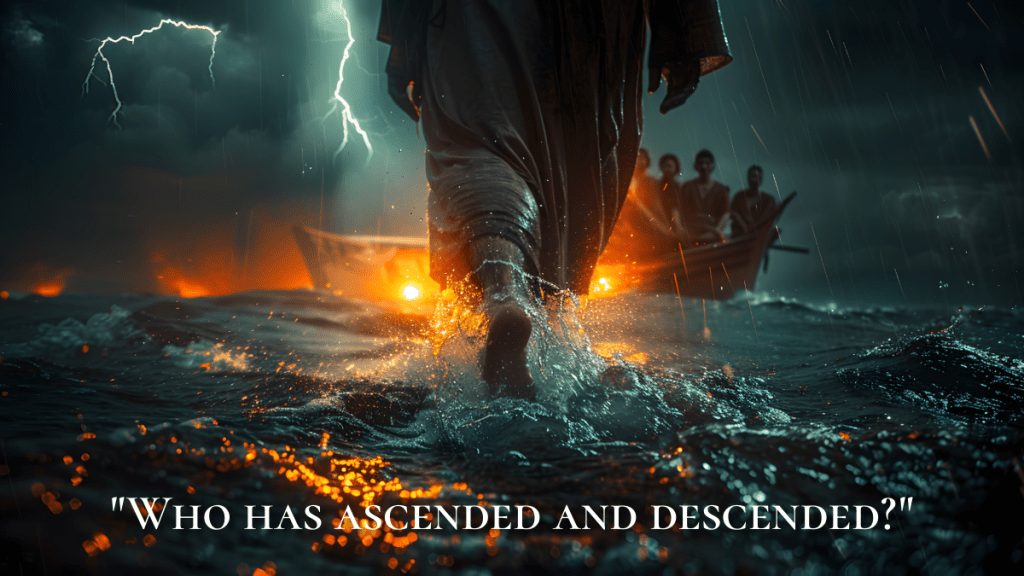
When Jesus calmed the storm Mark 4:39, it was not just a miracle, it was a Messianic signpost. The One who wraps the waters in His garment walked upon it, and has walked among us. The One “Who has gathered the wind in His fists?” is the One who rebuked the wind and calmed the sea, prompting the disciples to ask: “Who then is this, that even the wind and the sea obey Him?” (Mk. 4:31).

This miracle draws our attention back to the imagery in Proverbs 30:4, portraying Yeshua/Jesus as the One who commands nature, an authority attributed to God alone in biblical text and rabbinic tradition. Still: מַה־שְּׁמוֹ וּמַה־שֶּׁם־בְּנוֹ כִּי תֵדָע, “What is His name, what is His Son’s name, if you know?” 

This verse is provocative indeed. Rabbinic tradition wrestles with divine names, emphasizing their mystery and sanctity. Shemot Rabbah 3:6 teaches that God has many names, each reflecting a different aspect of His interaction and relationship with creation, the nations and His covenant people. Sanhedrin 38b discusses the concept of the “Son of Man,” suggesting that the name of the Messiah was known before creation, hinting at the preexistence of the Messiah even in their commentary. 

A later Jewish text, Zohar (Vol. III, 152a; 13th-century Spain), even hints at a hidden “Son” who shares in divine glory, a concept that, while more esoteric, resonates with the revelation of Yeshua as the Son who bears the Name. As the Apostle Paul wrote, “Therefore God has highly exalted him and bestowed on him the name that is above every name, so that at the name of Jesus every knee should bow, in heaven and on earth and under the earth, and every tongue confess that Jesus Christ is Lord, to the glory of God the Father.” (Phil. 2:9–11). 

In Matthew 3:17, at Yeshua’s immersion, the voice of the Father from heaven declares: “This is My beloved Son, in whom I am well pleased.” The New Testament reveals the Son’s name, Yeshua, as the embodiment of divine grace and truth (Jn. 1:14), answering the mystery found in Proverbs 30:4. 

Proverbs 30:4 is not just poetic, it is prophetic. Rabbinic tradition affirms the mystery of divine ascent, the authority over creation, and the sanctity of the Name. The Apostles reveal the fulfillment in the Gospels, the Epistles and the Apocalypse: Yeshua, the Son who descended, commanded and calmed the chaotic wind and water, and ascended again to intercede on our behalf (Heb. 7:25). Surely we now know His name: Yeshua. 

In messianic faith, our lives are no longer folly, a chasing after the wind, they are purposeful because we have been chosen, called, redeemed and commissioned to His harvest field. 

Maranatha. Shalom.