
Hanukkah: Renewal Miracle

The reference to Hanukkah – or the Feast of Dedication – in John 10:22 is one of the oldest references in to it, and the only one found in the Bible. In brief, Hanukkah remembers the defeat of Antiochus Epiphanies by a ragtag army of priests and pious Jews under the leadership of Mattitayhu (Mattathias) Maccabee, and after his death, his son Judah Maccabee.
Antiochus IV Epiphanies outlawed Jewish life, tradition, and the Torah. In 186 BCE he desecrated the Temple after he found no image of a god set in the Holy of Holies, erecting a statue of Zeus with his own face carved into the statue, and sacrificed a pig upon the Altar of God. Yet, even against insurmountable odds, the Jewish people rose up, and ultimately defeated the most powerful army on earth at the time.

Mattatyahu (Mattathias) Maccabee believed with the same faith of Abraham. He acted in faith when he could not look to the Temple, as it was desecrated. His faith would inspire his sons, particularly Judah, as he would help lead this revolt for three years. Where did they find their strength? They knew that the Lord was with them, as He had promised to never leave them nor forsake them (Deut. 31:6). The war was won, except for the battle.

The “Maccabees” acted upon the hope that the Temple would be rededicated, and against all human odds, when the Jewish people regained control of the Temple, it was once again dedicated to His service. As you might imagine, the Temple was a mess, not only spiritually, but physically. In order to rededicate the Temple they needed holy oil, but it had been destroyed. Or had it? They looked, and they found. I wonder, why did they look for sealed holy oil beneath the debris of the broken containers? Can you imagine the mess left behind by this army of desecration? I would not imagine that they carefully broke the sealed containers of holy oil.

Their search shows the hope they were acting in, as I’ve oft said: hope takes hold, and faith holds on. They took hold of the hope that set the Temple back in their hands, and in that hope the Lord provided a miracle: eight days and nights of light. The oil burned but was not consumed until that final day, when the new oil was prepared, and the miracle faded.

Hanukkah comes from the verb root חָנַך, meaning “to initiate, to discipline, dedicate and train up.” Proverbs 22:6 says, “Train up (dedicate) a child in the way he should go, and even when he is old he turns not away from it.” This definition of חָנַך, is secondary to the primary meaning of חָנַך, meaning “to narrow.” From the time a child is born until their adulthood, we as parents are to raise them, train them, discipline them in order to prepare them for the years ahead; metaphorically, we are narrowing them, removing what is unnecessary, and refining what is necessary.

This is the same process we undergo as disciples of Messiah. He narrows us, along the narrow way, as we read, “Enter through the narrow gate; for the gate is wide and the way broad that leads to destruction, and those who enter through it are many. How narrow is the gate and difficult the way that leads to life, and those who find it are few” (Matt. 7:13-14).

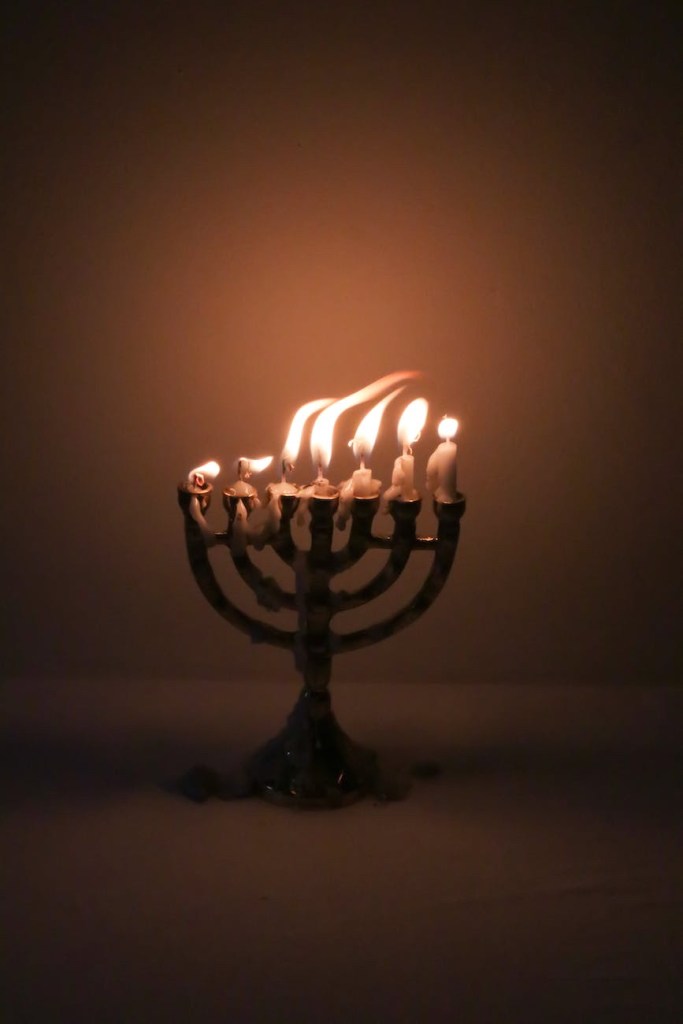
There are two traditions regarding the kindling of the Hanukkiah. One of the house of Hillel, still followed today, the other from the house of Shammai. Hillel said that for each night of the miracle, we should increase light in the world. Shammai said that for each night of the miracle, we should decrease light. The kindling of the Hanukkiah is a visible, public event: light going out. Hillel believed that the light shown in the public square should increase. Shammai, concerned with a disappearance of the Jewish people, believed the light should retract into one, representing the relationship between the Lord and the Jewish people. In a sense, both are right. The light of heaven should increase, but the unique relationship between the Lord and His people should remain intact. What is the answer?

The Festival of Hanukkah is the beautiful history of the victory of light over darkness. Hanukkah has deep roots in the Torah, the idea of spiritual dedication to the Lord, and the kindling of the lights of the Menorah in the Tabernacle. Yet, there is a profound, and wondrous connection between the celebration of Hanukkah, and light itself. At the beginning of creation, when the world is:

וְהָאָרֶץ, הָיְתָה תֹהוּ וָבֹהוּ, וְחֹשֶׁךְ, עַל-פְּנֵי תְהוֹם

“And the earth formless and empty, and darkness was on the face of the deep.”

The Lord declares: “let there be light.” This is not an act of creating, but of revelation. From the beginning light overcame darkness, by the spoken Word of God. Hanukkah, the Festival of Light, begins every year on the 25th of Hebrew month of Kislev. To see how the Lord foreshadowed this victory of light over darkness remembered at Hanukkah, one would simply count to the 25th word of the Torah scroll – אוֹר/ohr, light – and see that from the beginning light has always been triumphant.

At Hanukkah we kindle light, fire, and increase light in the world, recognizing the exclusive relationship that we have with the Lord. The author of Hebrews explains in 1:7, “And of the angels indeed He says, ‘Who is making His angels spirits, and His servants a flame of fire.’” λειτουργός/leitourgos, servants here meaning minister, priest, one busy with holy things, servants of the king. The Lord sees you as a flame of fire, light overcoming the darkness in Messiah Yeshua/Jesus, who stands in our midst (Rev. 1:12-13), as we minister to those who are suffering as in darkness, formless, and feeling empty.

As the Messiah dedicates us, refining and narrowing, His light increases as we decrease; becoming, even a living representation of both rabbinic opinions cited above. We shine in the public spaces, but we must never be overcome by the influence of darkness. We are a flame of fire on the holy Menorah, dedicated to overcoming the darkness, through the fire of the Holy Spirit, to the glory of God by His Son. As we are kindled, and rekindled, year after year, the miracle does not fade, it is continually renewed. Amen.

Be well. Shalom. And Hanukkah Sameach!

The Cleft, and Hanukkah

At the season of Hanukkah, Judean leaders approach Messiah Yeshua at the Holy Temple in Jerusalem, and ask Him plainly whether or not He is the Messiah: “Then came Hanukkah (Feast of Dedication), it was winter in Jerusalem. Yeshua/Jesus was walking in the Temple around Solomon’s Colonnade. Then the Judean leaders surrounded Him, saying, ‘How long will You hold us in suspense? If you are the Messiah, tell us outright!” (Jn. 10:22-24).

His answer reveals their problem, “I have already told you, but you don’t trust me.” Hanukkah memorializes several miracles: 1) the military victory of the Jewish people over the Greeks; 2) the renewal of covenant faith; 3) the rededication of the Temple (the very one that Messiah is standing in); 4) the miracle of the oil. Three of the four miracles are outwardly recognizable. One miracle requires pause, and close attention. The Judean leaders were not focused on a subtle miracle. They wanted a military miracle, as they wanted a military leader. This was the focus of their question. It was as if they were saying, “If you are the Messiah, lead us to victory.” Yeshua was telling them to stop, and look closer.

The miracle of the oil is that the supply did not diminish until the eighth day. It is as if the oil was suspended in time: burning, yet not being consumed. The miracle, נס, was that the oil was elevated above regular time, until they were ready for the new beginning on the eighth day, as the fresh, kosher oil had been prepared.

Why then did Messiah desire that they look closer? The victory is found in the relationship, and the miracle of Hanukkah sounds very similar to an earlier miracle.

I would like to briefly turn your attention to two past leaders of Israel, and the relational revelations that the Lord gives us, through them.

Moses, in Exodus 3:1-7, is shepherding the sheep of His father in law on the mountain of God, when he turns, and notices a burning bush that is not being consumed. The miracle here is subtle, and the sages suggest that if Moses had not turned to see, he would have passed it by, and the Lord would not have called him at that time. Yet, he turned and walked toward, and the Lord spoke to him, revealing Moses’ calling, and in whose name the mission will be.

Years later, Moses, who has spent a tremendous amount of time in the Presence of the Lord, asks to see His glory, a deeper revelation of who He is. He has seen signs, wonders and miracles, but he desires closeness. In Exodus 33:17-23, the Lord agrees with one condition – He will place Moses in the “cleft of the rock,” because no one can see the face of God the Father and live (Ex 33:22). Then the glory passes before him, while he is tucked away safely in the cleft of the rock.

Years later, another leader of Israel, called the “troubler of Israel” (I Kgs. 18:17), will demonstrate and take part in tremendous miracles, signs, and wonders, but will flee at the voice of a woman. Elijah was a prophet. He defeated the priests of Ba’al by an outpouring of the power of God – yet he flees, and not only flees, he quits ministry all together. The text in I Kings 19:3 provides a clue, when it records that “he left his servant there.” As a prophet, he had a servant to tend to his needs, and eventually take his place. Later Elisha will be servant and successor to Elijah.

He fled to the Lord, to a place called Horeb, is confronted by the Lord with a question, “What are you doing here Elijah?” His answer is a tale of woe. But where is Elijah? Elijah actually fled from the Promised Land to Mt. Horeb, also called Mt. Sinai. He fled there, into a cave, and had a revelation of God. Still, this was not just any cave.

The cave in I Kings 19:9, is identified as a cleft in Exodus 33:22. Some commentators, and rabbinic authorities, agree that Elijah fled to the very place where Moses once stood on the Mt. of God. The Lord then sends wind, an earthquake, and fire, but He is in none of those. He is in the “still small voice.”

While Elijah is in the cleft, the Rock takes the damage of the wind, earthquake and fire. The typological meaning of the “cleft of the Rock” is simple: Messiah. Moses has spoken face to face with the Lord (Ex. 33:11), but it is only in the “cleft” that he can experience the glory of God.

Elijah experiences, not the glory of God, but the protection of God in the form of personal relationship, as He speaks to him. The wind, earthquake, and fire were sent by the Father, but the Father was not in them. Moses is first placed in the “cleft of the Rock”; and under great pressure for his life, Elijah flees to the very place where he knows Moses was safe: the “cleft.”

Generations later, Messiah will bring Moses and Elijah down from heaven (Matt. 17:1-9), as He is transformed before their eyes. The disciples Peter, James and John watch from a short distance away; but are frightened by the glory that descends, and the voice of the Father from heaven. Moses and Elijah are at peace, as this time they are with the cleft of the rock: Yeshua/Jesus.

Peter, James and John have not yet been hidden in the cleft of the Rock, Yeshua; as Paul writes, “For you have died, and your life is hidden with the Messiah in God” (Col. 3:3). In each of these events, and many others like them, the power of God was demonstrated, but relationship was desired.

In Greek the word miracle is δύναμις/dynamis, meaning power, might, strength, or miraculous power, “For I am not ashamed of the Gospel, for it is the miraculous power of God unto salvation to everyone who believes, to the Jew first, but also the Greeks” (Ro. 1:16). It is the power to change you.

In Hebrew a word rich in meaning at this season of Hanukkah is: נֵס/nas; meaning raised up, or elevated, elevated or elevating event, banner, pole, sign. Two beautiful expressions of remembrance are often spoken: נס גדול היה שם, “a great miracle happened there,” meaning there, in Israel; and נס גדול היה פה, spoken from the perspective of standing in Israel, “a great miracle happened here.”

The greatest miracle you will ever experience is His transformative power working in you that raises you up as His sign that He is still working in this world. Messiah’s answer to the Judean leaders diverted them away from a military leader, to the relationship of the Shepherd to His sheep.

He explains that His sheep do not have to worry about such things, as He says, “My sheep hear my voice, and I know them, and they follow me. I give them eternal life, and they will never perish, and no one will snatch them out of my hand. My Father, who has given them to me,is greater than all, and no one is able to snatch them out of the Father’s hand. I and the Father are one” (Jn. 10:27-30).

Dear reader, when you are His, you are hidden away in the cleft of the Rock, in the hands of Yeshua, where no one can steal you away. In Him your supply will endure, burning yet not being consumed, in a time outside of time, until the new beginning, the eighth day has been prepared.

Be well. Shalom.