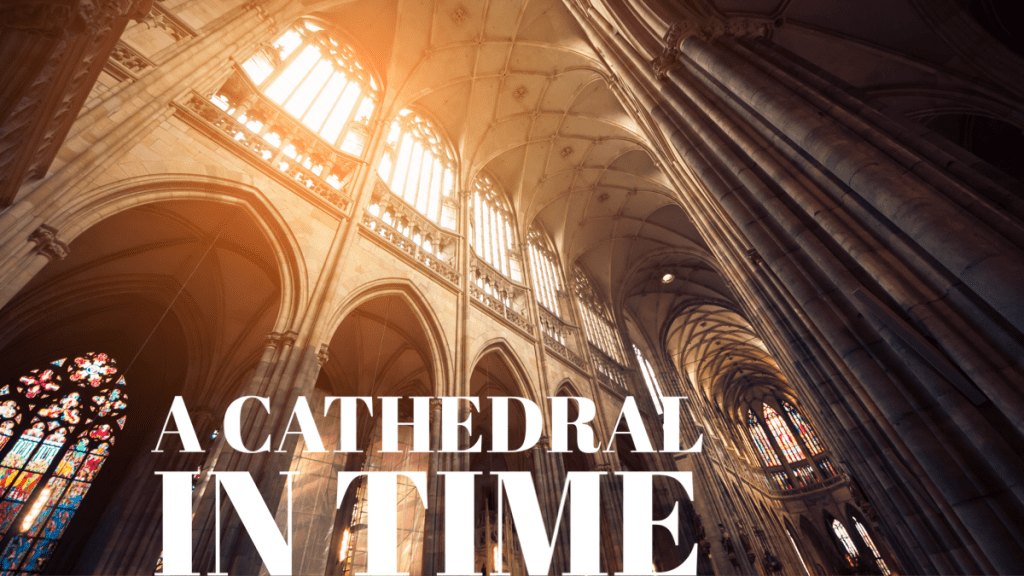
Today as I worked at the Messiah Congregation building, I was struck by how much has changed in that space over the years. Not only the space itself, but the people. The building may not be a stadium or a gothic cathedral, but the people who grow there, together, are tabernacles of incomparable beauty to the structures of man’s imagination.
I am not so concerned with building a cathedral in space, as I am in time, in presence, in sanctity, and eternity, together.
Rabbi Dr Abraham Joshua Heschel wrote, “The sabbath is to time what the temple and tabernacle are to space. The sabbath is a cathedral in time. On the seventh day we experience in time what the tabernacle and temple represented as spaces which is eternal life, God in the complete creation.”
This cathedral in time, the Shabbat, is a raptured experience of stepping out of our hurried time, into the holiness of His time. The physical worship of the Living God in rest, refreshment, and communion. Leaving behind the restrictions of the harried schedule, and stepping into the cathedral in time where He and we are present.
Voices lifted, arms raised, hearts open, and adoration of the Risen Lord mirrored in the face of the other. Who sits enthroned in this cathedral in time? But the Lord of the Sabbath Himself: Messiah Yeshua/ Jesus. As He taught, “For the Son of Man is lord of the Sabbath” (Matt. 12:18).
It matters not, the opulence of the space, but the presence of the Sabbath Lord. He reigns in His majestic cathedral fabricated not by brick and mortar, but heart and soul knit together by the Holy Spirit (Eph. 4:16).
Step out, and step in, and in Him you will find rest for your soul (Matt. 11:28-30). You are a renewed body in space, experiencing a timeless, abiding rest in King Messiah.
The Torah portion called תְּרוּמָה/terumah, meaning offering or contribution, reveals a cure provided before an illness. The illness, in this case, is the sin of the Golden Calf. Some rabbinic commentators see the construction of the Tabernacle, beginning in Exodus 25, as the remedy for the sin recorded in Exodus 32: the Golden Calf. Why did Moses choose to record one event before the other?
The sin of the Golden Calf was a national catastrophe. This newly formed nation of holy priests (Ex. 19:5-6) quickly descends into sin. Moses, in his wisdom, gives future generations hope. The way of reconciliation was provided before the sin: the cure before the illness.
“Speak to the children of Israel, that they take for Me a contribution. From every man whose heart moves him you shall receive the contribution for Me” (Ex. 25:2).
While it would appear that this is the first mention of a contribution associated with the construction of the Tabernacle, or the Ark, we do find allusions to it previously, as well as the “testimony” or more specifically the tablets of the yet to be given law (Torah) from Sinai.
After the Lord miraculously provides bread from heaven (Ex. 16:4), He commands Moses and Aaron to collect an “omer” of manna in a צִנְצֶנֶת/ṣinṣeneṯ, meaning a jar, pot or vessel of some unknown type. From the daily miracle of manna, the Lord takes a memorial portion to be a remembrance throughout the generations (Ex. 16:32) of His provision. The memorial portion was to be set לִפְנֵי הָעֵדֻת לְמִשְׁמָרֶת, “before the testimony to be kept (safe).” The testimony is a reference to the yet given tablets of the law (Torah), which will be set in the yet constructed, or even commanded, Ark (Ex. 40:20; cf. Heb. 9:4). This command seems to stand in sharp contrast to the expected expiration of the manna itself, as it could not be kept overnight (Ex. 16:19-21). Here is another miracle, one relating to the enduring nature of God’s provision and promise.
The manna, provision from the heart of God, as a memorial “before the testimony” becomes the first “contribution” for the yet to be constructed wilderness Tabernacle. Why?
As the instruction for the Tabernacle is given, it seems that Moses begins with what should be accounted for last: the Ark. Would it not have been better to start with the outer posts and curtains? Even the coverings of the Tabernacle itself? Why the Ark?
The Ark is not only the heart of the Tabernacle, it is also the cornerstone of it, as everything else is built out from the set Ark. The presence of the Lord rests upon the Ark, with His voice speaking from between the two covering angels. The ministry of the Tabernacle flows from the Ark, and back to the Ark. Still, the heart of the Ark itself is what it contains. The Tablets of the Torah from Sinai, but what is לִפְנֵי הָעֵדֻת לְמִשְׁמָרֶת, “before the testimony to be kept (safe)?” The manna.
Before the Ark receives the Tablets, it receives a jar; an enduring omer of memorial bread from heaven. As I have written and taught previously, the Lord provides the manna before the mandate (tablets). Then, as the priests set the items in the Ark (Ex. 40:20), they place the tablets of the law inside, but set immediately “before” the tablets, the jar of manna: the Lord’s memorial testimony. The manna is the testimony before the testimony. Yet, the physical memorial and testimony are fading, but, as they fade, the eternal shines.
As those in messianic faith know, Messiah Yeshua/Jesus is the “Word made flesh” (Jn. 1:1-3, 14). Moreover, in John 6:41 He says of Himself, “I am the bread (manna) that came down from heaven.” In Messiah we see the “tented” living Word, but also, the living bread from heaven (Jn. 6:51). In the person of Yeshua/Jesus we have the fullness of the bread and the testimony set in the Ark as a witness in the heart of the Tabernacle as it cornerstone. Yeshua is the provision before the need, the cure before the illness, the forever settled Word, and the atoning blood (Heb. 9:12); and in His face, we behold the glory of God (2 Cor. 4:6; cf. Ex. 40:34). The unfading, unchanging eternal Savior.
The apostle Paul explains, we in faith have been “built on the foundation of the apostles and prophets, Christ Jesus himself being the cornerstone” (Eph. 2:20). By faith, the redeemed and exodused of the Lord are made into a living tabernacles of His presence (1 Cor. 3:16). We are being formed and fitted, covered by His righteousness becoming a type of the pot of manna.
As Paul explains, “But we have this treasure in jars of clay, to show that the surpassing power belongs to God and not to us” (2 Cor. 4:7). What is this treasure? As Paul wrote in 2 Corinthians 4:6, “For God, who said, “Let light shine out of darkness,” has shone in our hearts to give the light of the knowledge of the glory of God in the face of Yeshua Messiah.” Or, elsewhere, “Christ in you, the hope of glory” (Col. 1:27).
For those written in the Lamb’s Book of Life, from before the foundation of the world (Rev. 13:8), the Lord provides, by His grace and mercy, real food, the living manna from heaven, Christ, and His Word that is “forever settled.” This is the “glory of God in the face of Yeshua Messiah” that is in you, dear reader, as the covered tabernacle of His presence whose heart is filled with living bread and eternal testimony, illuminated by His marvelous light so that as you go out on the Great Commission (Matt. 28:18-20), you will be His testimony before the testimony.
He contributed you, as a gift to His Son, and now you are a living memorial of His faithfulness in the earthen vessel that is you. Amen.
“And these are the judgments/ordinances that you are to put before them.”
This is the beginning of the legal code, understood to be a continuation of the Sinai revelation. This portion contains twenty-three (23) positive commandments, and thirty (30) prohibitions. Most of these are formulated as casuistic statements, case law, or: “if … then” conditionals. In the previous portion of Yitro/Jethro, the ten commandments were formulated as apodictic commandments.
Considering these together, apodictic commandments, such as “you shall not murder,” gives a general prohibition, but does not address accidental death, or manslaughter. Casuistic laws give general circumstances from which a determination can be made in a specific situation.
In Exodus 21:22, we find an example of a casuistic law that deals with the harm done to an unborn child. This law protects the life of the unborn, and defines a pattern of justice for harm done. In this case, the Law of Talion, “eye for eye” and so on. The Law of Talion is understood to be concerned primarily with monetary damages for bodily harm, except in the case of murder, when it was life for life. It is not, as Mr. Gandhi suggested, a law of mutilation.
It is important to study, reflect on, and rightly apply the Word of God to life and community, particularly in these days of popularized relative morality, and a feel good ethic. The Word of God is forever, unchanging, and contains the eternal ethical norm of the Living God (Ps. 119:89). While not everything in the law, or the Torah, is literally normative for us today, by the Lord’s design, it remains His will, as a revelation of His heart and character.
When we consider portions like Mishpatim, filled with legal code that allows me to rattle off $5 words, and an occasional $10 word dealing with the technical issues of the Torah, it is difficult to inspire the next generation, or even our current generation, if we sermonized the legal code of the Torah in public exposition. How then, do we transmit the principles of our biblical faith from one generation to the next, to include this dense ethical matter? This portion illustrates for us the importance of ethical, social and religious norms, but we must remember in our exposition that the Lord desires to speak to the heart as well as the mind.
The apostle Paul aids us in our consideration here, as he writes, “And do not get drunk with wine, for that is debauchery, but be filled with the Spirit, addressing one another in psalms and hymns and spiritual songs, singing and making melody to the Lord with your heart, giving thanks always and for everything to God the Father in the name of our Lord Yeshua/Jesus the Messiah,” (Eph. 5:18-20).
Song. Song penetrates the heart, especially spirit-filled song. Paul encourages us to “pluck the heart” as an instrument, and to sing from the heart. There is a rabbinic expression that says, “words spoken from the heart enter the heart.” If this is true, then it stands to reason that words sung from heart enter the heart as well.
Song is vitally important in Scripture. Consider some examples:
Revelation 15:3: we find the redeemed of the Lord singing the Song of Moses, and the Song of the Lamb. Revelation 14:3: the 144,000 stand before the Throne and sing a new song to the Lord. Matthew 26:30: before departing for the Mt. of Olives, Messiah and the disciples sing the Hallel of the Passover Seder.
One of the greatest poems of love is called the Song of Songs/Solomon. Further, many of the Psalms open with: מִזְמוֹר לְדָוִד, “this is a song/melody of David.” In Exodus 15:1, after the crossing of the Red Sea, it was not a great sermon that the children of Israel listened to, it was a song they sang.
The entire Hebrew Bible, Old Testament, is, in fact, one long melody … even the legal bits.
Song permeates the life of my home congregation, Messiah Congregation. As the congregational rabbi and song leader, I love song in communal life, songs about the Lord. Whether before, during, or after a service, or during the week, you will hear song echoing through our congregational building.
In Deuteronomy 31:19, when speaking of the Torah, the Lord speaks of it as a song: “Now therefore write this song and teach it to the people of Israel …” When we approach the Torah, whether we study, memorize, or read in the congregation, the Lord says, “write this song for yourselves … learn it by heart.”
The Lord likens the Torah to a song, and it is sung from week to week with a melody all its own. Here we return to a connection to the next generation.
The rabbis find in Deuteronomy 31:19 a command that the Israelite must write a copy of the Torah for himself. Yet, not everyone has the skill to do so. A later tradition developed that as a scribe wrote the final lines of a Torah scroll, he would simply outline the final letters, not filling them in. As the scroll of the Torah is being completed, each letter in the final lines are filled in by different people to fulfill the words of Deuteronomy 31:19; and a joyous celebration called סיום/Siyyum (completion) is held. In this celebration, we find the generations present in joy and song.
See our songs of faith, hope, love, and even theology become the outline of the letters of the Torah. At this point the Torah can still be read, but they must be filled in. We help fill in the letters of the next generation by teaching their meaning, and being examples of their meaning in life. The letters are filled by the renewed heart in faith. Intellect wrote the letters, but the heart fills them with life.
Song, praise, and psalms are not only important in worship of the Living God, they help to transmit the substance of the dense theological matter contained in these more difficult passages. For one generation, the letters have been filled with meaning, to the next, the outline is being drawn: with the heart, and to the heart in song.
From generation to generation, the song of the Word continues, even as the Lord Himself “rejoices over you with singing” (Zeph. 3:17).



 the mountain mensch