
I once again find myself in a bed of recovery. While I am suffering from an intentional affliction at the hands of a skilled surgeon, the pain is still very real, very present, and loud, in a manner of speaking. This, like any affliction, can be transformative if we keep our eyes on the One who transforms us.
Over the past several days the words of the Apostle Paul have come to mind:
“Indeed, I count everything as loss because of the surpassing worth of knowing Christ Jesus my Lord. For his sake I have suffered the loss of all things and count them as rubbish, in order that I may gain Christ and be found in him, not having a righteousness of my own that comes from the law, but that which comes through faith in Christ, the righteousness from God that depends on faith, that I may know him and the power of his resurrection, and may share his sufferings, becoming like him in his death” (Phil. 3:8–10).
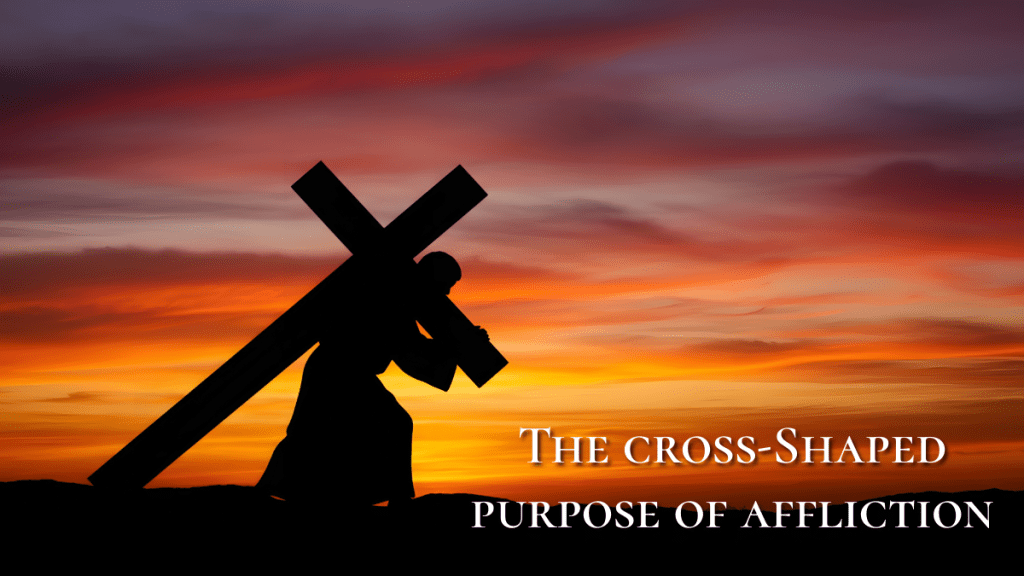
Paul the Apostle was not only a leader; he was a follower. To follow Messiah is to walk the path He walked. His is a path marked not only by glory but also by affliction (Isa. 53:1-12). Paul’s words in Philippians 3 reveal a profound mystery: suffering is not a detour from discipleship. Suffering and affliction can be a doorway into deeper intimacy with Yeshua/Jesus. The Cross is not only the means of our salvation; by faith, it becomes the shape of our life.
Again, Paul writes, “Now I rejoice in my sufferings for your sake, and in my flesh I am filling up what is lacking in Christ’s afflictions for the sake of his body, that is, the church” (Col. 1:24). Paul is not a claim that Messiah’s atonement was incomplete, heaven forbid! But that the visible witness of His suffering continues through His disciples as we share and live out the gospel. We become living testimonies of His sacrificial love.
Still, we must remember that affliction is not punitive, but it can be formative, if we keep our eyes on Him. In Romans 5:3–5, Paul teaches that suffering produces perseverance, character, and hope that does not lead to shame. The Cross-shaped life is one where affliction chisels away self-reliance and forms the likeness of Messiah within us. Again to the words of Paul, “Always carrying in the body the death of Jesus, so that the life of Jesus also may be manifested in our bodies. For we who live are always being given over to death for Jesus’ sake, so that the life of Jesus also may be manifested in our mortal flesh” (2 Cor. 4:10-11).
This paradox, of death bringing life, is the essence of discipleship in Messiah. The Cross is not just the end of sin; it ushers in resurrection power. Yet, as Paul writes, “For it has been granted to you that for the sake of Messiah you should not only believe in Him but also suffer for His sake” (Phil. 1:29). Suffering is a gift, a very holy one indeed. When we endure affliction with faith, as we bear witness to the world that Messiah is worthy even in our affliction. Our scars then become sermons.
Peters exhorts us, “Rejoice insofar as you share Messiah’s sufferings, that you may also rejoice and be glad when His glory is revealed” (1 Pet. 4:13). The Cross-shaped life is not one of despair, but of hope. Hope that our sufferings will be used for His glory. In this way, the Cross is not just a symbol, it becomes a way of life in faith.
Messiah: “Whoever does not bear his own cross and come after me cannot be my disciple” (Lk. 4:27).
Maranatha. Shalom.

 the mountain mensch