Sharing snippets of life with those who happen by. Husband, father, bishop, scholar, hiker, and homesteader. Attempting to build a natural bridge between today and ancient faith-style living. If you didn’t enjoy today’s post, stop back, there’s always something new tomorrow.
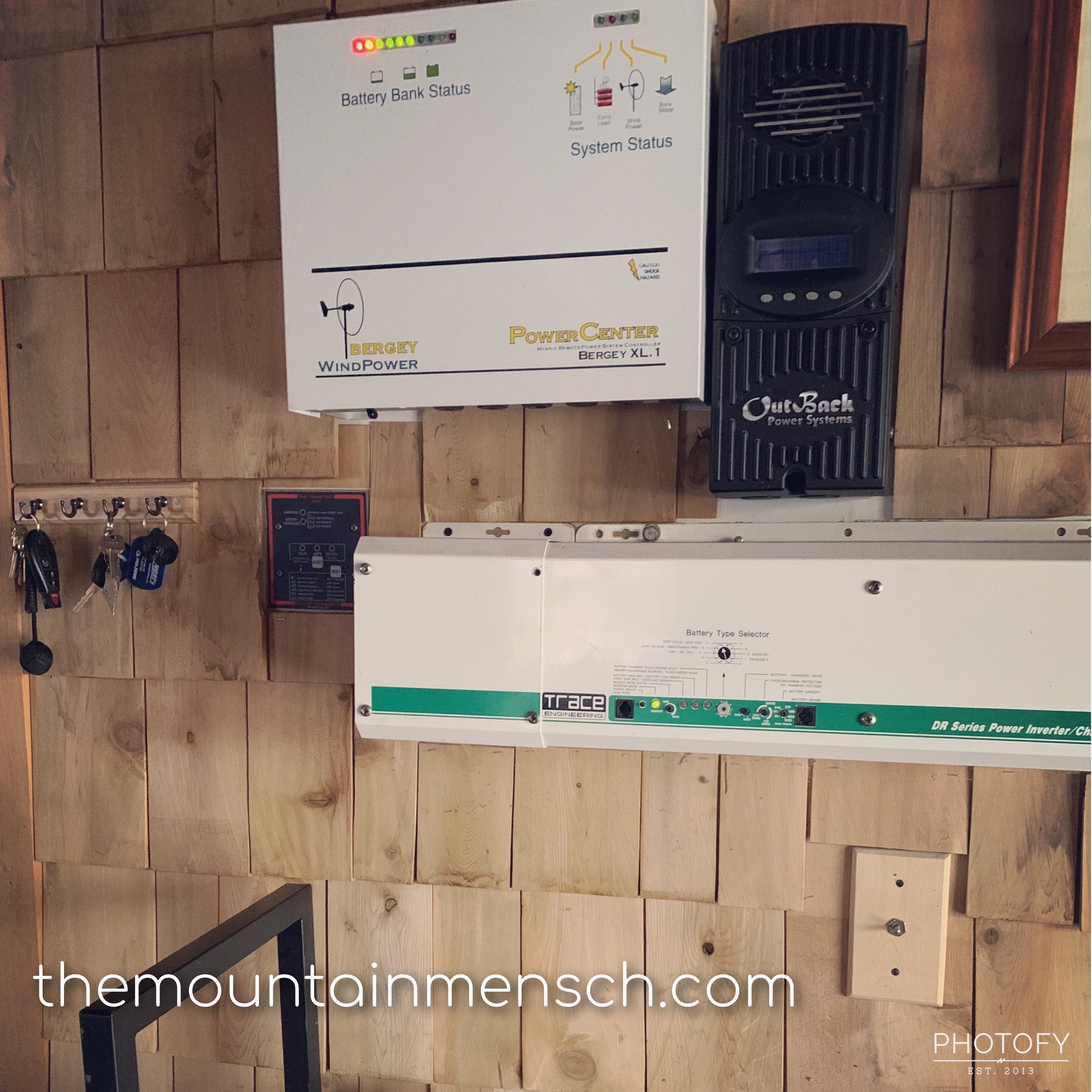
Pictured – the power control center of the house. The long white rectangle with the green strip is the power inverter – it takes the DC power stored in our batteries behind the wall, and coverts it to AC power for most of our appliances. Next is the small black square to the left of the inverter, this is a Trimetric battery monitor, kind of not necessary for us at this point, as all the info we need is in the charge controller. The big white square is the charge controller for the 1000w windmill. Finally, the black rectangle is our Outback solar power charge controller. The toggle switch below the inverter adjusts our 1200w solar array. Vertical for winter months, and nearly horizontal for summer months. And adjusted as needed between seasons.
In an off-Grid solar/wind power house the battery bank is the heart of the operation. They require monitoring for daily voltage levels, and in our case, the water in the batteries needs to be checked and filled as necessary.
For the past several months I had been noticing that our battery bank wasn’t holding the charge it once had. I was needing to run our backup generator more often, mainly on little or no sun days.
As I have mentioned, we have been in our off-Grid home for 21 years. This past Monday we had our third set of 8 6v deep cycle batteries installed. We are averaging about 10 years with each set of batteries – about their expected life for this application.
We have always used Trojan T105 6v deep cycle batteries. But this time our go to solar guy recommended Crown CR 235 deep cycle batteries. I took his advise. Time will tell, but he has had good results in other systems, so I am not expecting any issues.
The CR 235’s cost about $160 per-battery. Although I know how to do the install, time, once again, is a factor for me – so installation adds to the overall cost.
Solar and wind systems are not the cheap alternative to life on the grid. It’s a lifestyle choice and you do pay for it. The nice aspect of it is that it’s modular – you can add to a basic system as need and money allow – and that’s exactly what we have always done.
Planning is always good. And setting aside a little bit of money each month will help tremendously when you need to update part of your system or have something repaired. You know your budget, but think of a small amount per-month: $50 – $100.
What do we power? I’ll write more on this in the weeks ahead, but: lights, TV’s, computers, cellphones, other USB devices, well-pump, and a refrigerator. We are all so used to this lifestyle that it’s second nature, but we are still attentive about usage.
A change in habit and lifestyle is key to off-Grid, solar powered success – Turn off the lights when not using them! Don’t leave things running! Become familiar with the power requirements for every day items. Plan to charge devices when the sun is shining if possible! You get the picture. Comment below if you have specific questions.
New battery day is part of this lifestyle, and it is a welcomed day when the low voltage alarm has been going off at 6:00am as of late!
As we meander through the Sermon on the Mount, we must ask ourselves some serious questions: How can I turn the other cheek? How can I pray for my enemy? How can I keep myself from lustful thoughts? How can I not worry? How can I pray when it seems to not be working?
All of these are serious questions. The answer lay in the Beatitudes. As I’ve written previously, Yeshua/Jesus, as the multitudes begin to follow Him, describes in great detail the price of following Him, the cost of discipleship, in order that serious consideration be given to what it means to be a follower of the Messiah. As the great Christian theologian Dietrich Bonhoeffer wrote, “When Christ calls a man, he bids him come and die.” To follow Messiah is to be diminished, to be in last place; to not be exalted in the flesh, but to be lifted up in the spirit.
The Beatitudes describe the inner condition of a disciple, a learner of Messiah – the remainder of the Sermon on the Mount describes what that inner reality looks like in everyday life.
Practicum:
Have you ever wondered how a follower of Messiah can be slapped and not return the favor sevenfold? Have you ever wondered how followers of Messiah around the world can endure persecution and torture, and not renounce their faith in Him? The answer, again, is in the Beatitudes. The answer is actually being a follower of Messiah, yielding our life to His will as revealed in His Word, and as much as depends on us, walking it out in our daily lives faithfully.
As noted previously, it is important to recognize the sequence of the Beatitudes, as one prompts the next – each one working together in us from the recognition of our poverty, our brokenness, of spirit that causes us to mourn our condition, to the promise of comfort in that condition. It is also a mourning for others, their condition, in the hope that they will turn to Messiah and be comforted as well. And as we are being comforted by the Holy Spirit, meekness will become a work of the Spirit in us, mirroring the meekness of Yeshua, as He said, “Take My yoke upon you and learn from Me, for I am meek and lowly in heart, and you will find rest for your souls” (Matt. 11:29). What does it mean to be meek?
Let’s examine:
“Blessed are the meek, for they shall inherit the earth.”
Godly meekness then is not natural to the human condition – it is not one’s ability to be polite, or to be weak in character; but rather: God’s righteousness in place of self-righteousness; humility displacing arrogance; gentleness replacing smugness; sweetness for defensiveness; and the grace to be self-effacing. It is unpretentious, when pretentiousness would seem fitting. Meekness is able to endure criticism, whether deserved or undeserved, without sulking or offering a defense. It is, the opposite of who we naturally are in most cases.
Meekness, however, is not an indication of weakness, rather a strength enduing well past natural endurance. It is strength found in submitting our trials and circumstances to the will of God who is working for our good. It is a reliance on grace received, and the extending of grace in gentleness to the human other. Dr. Alison Bucklin explains, “Meekness is strength tamed through self-knowledge and submission to God. And it is not a natural quality. A person who finds it natural or easy to submit will not have the strength to stand up for God’s truth, to persevere against opposition, to fight the good fight or finish the race.”
Meekness, therefore, is the opposite of what is expected in this world. How many meek politicians do we know? Today we are encouraged to state, openly, our personal virtues – to vocalize our self-affirmations for public consumption.
Meekness is illusive and when we recognize it in ourselves it slips away, as it is a grace of God that allows us to live in this world without being defeated by it. It is walked out in daily life by keeping Yeshua before us, and subjecting the ego to His authority. People are too often attempting to “find themselves” without addressing the fundamental sense of deficiency that looms over them.
If anyone had cause for boasting it most certainly was Yeshua, the Son of God, Savior of humanity, healer of the sick, victor over the devil, death and the grave – but He made Himself, as Paul wrote, “of no reputation” (Phil. 2:7). He had not appearance that we would desire Him. He stripped Himself of glory, and died in apparent weakness on a cross. Yeshua had nothing to prove and in this, we find the liberty of meekness.
The reward?
Still, the meek shall inherit the earth – they shall receive a reward – a reward of the whole world, as co-heirs with Messiah. Many times in the New Covenant Scriptures, we are promised an inheritance, a gift from God the Father, as an example, “Do not be afraid, little flock, for your Father has been pleased to give you the Kingdom.”
Still, meekness is not without pain.
Meekness is painful, because it flies in the face of self-preservation; but it demonstrates that the Holy Spirit has come alongside of us to comfort us, even when we are being buffeted by circumstances around us.
It is cultivated and developed in our lives as the Lord leads, but in this we find the difficulty. As the Lord leads us over the mountains and through the valleys, along the ebb and flow of life, we experience the breaking of our pride, our self-sufficiency, as the Good Shepherd humbles us by rod and staff (Ps. 23). We realize that we are not always the victor in our trials, at least not as we would recognize victory. It is a process of grooming: shearing, trimming and worming. Until at last we resemble more of Him and less of ourselves (Ro. 8:28-29).
This humbling by the Lord is revealed by the Hebrew word for meek, עָנָו, meaning “poor, afflicted, humble and meek.” As the Lord directs it, this is part of our spiritual growth and maturity. Meekness is easy to give lip service to, but so difficult to live. As theologian John Stott said, “I am quite happy to recite the Gospel Confession in church and call myself a miserable sinner, but let somebody else come up to me after church and call me a miserable sinner, I want to punch him on the nose.”
Thanks be to God, that our growth in meekness runs parallel to our maturity in faith and growth in Messiah – our Good Shepherd.
As poverty of spirit, mourning for our condition and that of humanity, ushered us into a condition of meekness in Messiah, meekness then catapults us to a hunger and thirst for righteousness that will be satisfied. Israel stood at the base of Mt. Sinai impoverished in spirit, mourning their circumstance and anxious to hear God. Yet, as we know, the hunger and thirst for fleshly satisfaction all too often overruled their appetite for heavenly manna. More on this soon.
We heat our cordwood home with wood, ironic yes, and have done so for twenty-one years. For many years I cut, blocked and split our firewood myself; mainly supplied from blowdowns and standing deadwood on our property. Seasons in life change, and I no longer have the necessary time to do the bulk of this work – except the stacking. We now buy our firewood from a local supplier.
Storage and drying of firewood can be tricky. You want enough space, obviously; but you also want plenty of airflow. For years I did the tarp and pallet thing, and then the “upgrade” to the instant tarp garage thing – which actually lasted ten years – so well worth the $300 I paid for it. Then, after a windstorm finished the tarp garage off, I decided to build a structure that suited my needs.
The wood storage building pictured above measures 8’x16’, 6’ high on the backside and 8’ high at the front. I settled on this dimension based on the usual footprint of stacked firewood in years past.
It is a very simple building, and anyone could put it up.
Foundation: the gravel pad was put in twelve years ago, and only settled 1/2 inch over 20 feet. Excellent. I used 6 deck blocks as the foundation, as I had little concern with settling at this point. With a level grade, it only took a few minutes to square the blocks.
Timber framing: I used three 4x4x8 pressure treated posts for the front wall, and three 4x4x6 pressure treated posts for the back wall. These were “tied” together by 1x6x8 and 1x6x16 pressure treated boards. On three sides, between each 8’ section is a 2x4x8, hammered in at an angle, to give the walls rigidity, that worked great and locked the entire structure together. The roof is 2x6x10’ lumber, with 4×8 plywood sheathing, roofing felt and shingles.
Time: it took about 7 hours to build. By using dimensional lumber in full lengths, cutting was kept to a minimum, which also saved time.
Cost: using all new materials, about $600. If someone had time to find recycled materials that price point would drop considerably.
What to do differently? I would have used 2x6x12 for the roof and given myself more overhang in the front. As it is, even with two extra rows of firewood in front, the wood is covered well enough.
The rows: the wood is stacked on repurposed 2×4’s, nothing fancy. But they keep the wood off the ground.
How has it worked? Great. From time to time snow blows in during a storm, but that hasn’t caused any problems. The wood is very dry, and stays clean.
I used this same idea for a four wheeler, utility shed which I will share later on, after I dress it up a bit. That has worked great for keeping ice/snow/rain off the vehicle, as I use it for plowing, and my utility trailer is accessible. Plenty of room for the snowblower as well.
Simple design, easy to build, strong and functional. Not winning any design awards, but does the job!



 the mountain mensch