
Matthew 28:16–20
“And behold, I am with you always, to the end of the age” (Matt. 28:20).
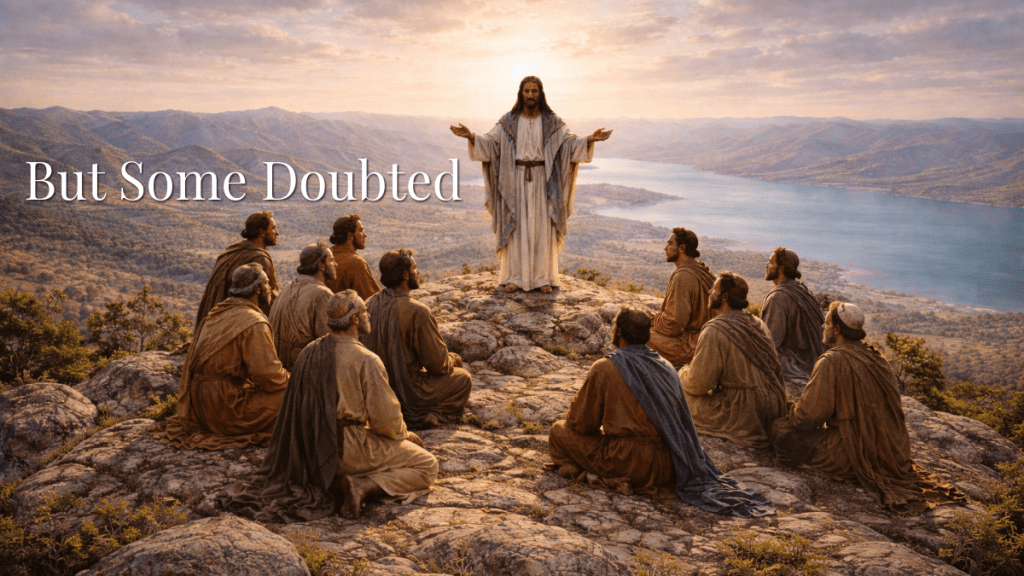
The final scene in Matthew’s Gospel does not unfold in Jerusalem—the city of power, the city of God—but in Galilee, the place where it all began. The eleven disciples go to the mountain that Yeshua had appointed for them. The text does not name it, yet it does not need to. They know the place. It is a place of prior encounter, of calling, and of revelation. Throughout Scripture, mountains are spaces where heaven and earth seem to meet—Sinai, Carmel, Zion. Now, this unnamed mountain becomes the setting for a new covenant charge.
This is not a geographical note in Matthew’s Gospel; it is theology. The One who began His ministry in Galilee of the Nations (Matt. 4:15; cf. Isa. 9:1) now, within Matthew’s narrative framework, completes it there, signaling that the mission will extend far beyond Jerusalem into the nations.
“When they saw Him, they worshiped Him—but some doubted” (Matt. 28:17).
Matthew’s honesty is striking. The disciples bow in worship, yet some waver. Why include this detail—especially about the Eleven? The Greek term distázō does not necessarily imply hardened unbelief, but hesitation—an inner tension between recognition and incomprehension. They are standing before the risen Messiah, yet still grappling with the magnitude of what they see.
Matthew includes this detail because it tells the truth about discipleship. Faith is not always the absence of hesitation; it is often the act of bowing even while trembling. Notably, Matthew records no correction and no rebuke from Yeshua directed at their wavering. Instead, something even more profound occurs: Jesus commissions them anyway.
“All authority in heaven and on earth has been given to Me. Go therefore…”
The authority of the risen Messiah is the foundation of the mission. The command to “go” is not rooted in the disciples’ certainty, but in His sovereignty. Their wavering does not disqualify them; His authority overrides their inadequacy—then, even as it does our own now.
This is a crucial theological truth: God’s mission is not entrusted to the flawless, but to the faithful (cf. 2 Cor. 4; 1 Cor. 1). The Great Commission is not a reward for perfect faith—it is a calling extended in the midst of imperfect faith.
Matthew intentionally places the Great Commission alongside another account: the report of the guards (Matt. 28:11–15). While the disciples are sent as witnesses of the resurrection, Matthew presents the religious leaders as constructing a false narrative, claiming the body was stolen. Two testimonies emerge:
- A false witness, sustained by fear, money, and suppression of truth.
- A faithful witness, carried by those who have seen the risen Lord.
The contrast is deliberate. The world will always generate counter-narratives to the truth of the resurrection. From the very beginning, the proclamation of Messiah’s victory is contested. Thus, the Great Commission is not merely about evangelism—it is about bearing true witness in the presence of competing claims.
“And behold, I am with you always, to the end of the age.”
This promise echoes deeply within the story of Israel. Just as the Lord was present with His people in the wilderness—guiding by cloud and fire and dwelling among them in the tabernacle—so now Messiah promises His abiding presence with His people, the ecclesia, even as it was announced that Emmanuel would be with His people at the birth of Christ (Matt. 1:23).
There is, however, a profound shift: from covenantally localized presence in the wilderness to universally mediated presence in Messiah.
As the disciples are sent into all nations, they do not go alone. The mission is not sustained by strategy, but by presence. The same One who commands the mission accompanies those sent on it.
The Great Commission unfolds in three movements:
- Go — The mission is outward, not static.
- Make disciples — Not just converts, but formed followers.
- Baptize and teach — Bringing people into covenant identity and ongoing obedience.
This is not solely a call to proclamation, but to formation—a lifelong shaping into the image of Messiah according to the Word of God (Rom. 8:28–29).
Still, the tension of that mountain remains with us. We, too, live between worship and wavering. We confess Christ, yet at times wrestle with doubt. We affirm His authority, yet feel our inadequacy. And still, the commission stands.
You do not need perfect clarity to be faithful. You do not need unshakable confidence to bear witness. You do not need complete understanding to obey. The call is not: “When you are ready, go.” The call is: “Because I am Lord, go.” And the promise remains unchanged: “I am with you.”
In a global culture filled with competing truths, the ecclesia is summoned to be a faithful witness—not through coercion, but through embodied testimony; not through certainty alone, but through persevering trust.
The same Messiah who met His disciples on that Galilean mountain meets His people still—sending them, sustaining them, and remaining with them—until the end of the age. And with that promise, we can turn the world upside down (Acts 17:6).
Maranatha. Shalom.
 the mountain mensch