
“So they took counsel and bought with them the potter’s field as a burial place for strangers” (Matt. 27:7; cf. 27:3-10).
One of Scripture’s most enduring metaphors is the potter and the clay. The Lord is the potter; we are the clay upon the wheel. His hands press, shape, and steady us against the spinning forces of life, forming from yielding earth a vessel fit for His purpose. It is an image of tenderness – pressure applied not to destroy, but to beautify.
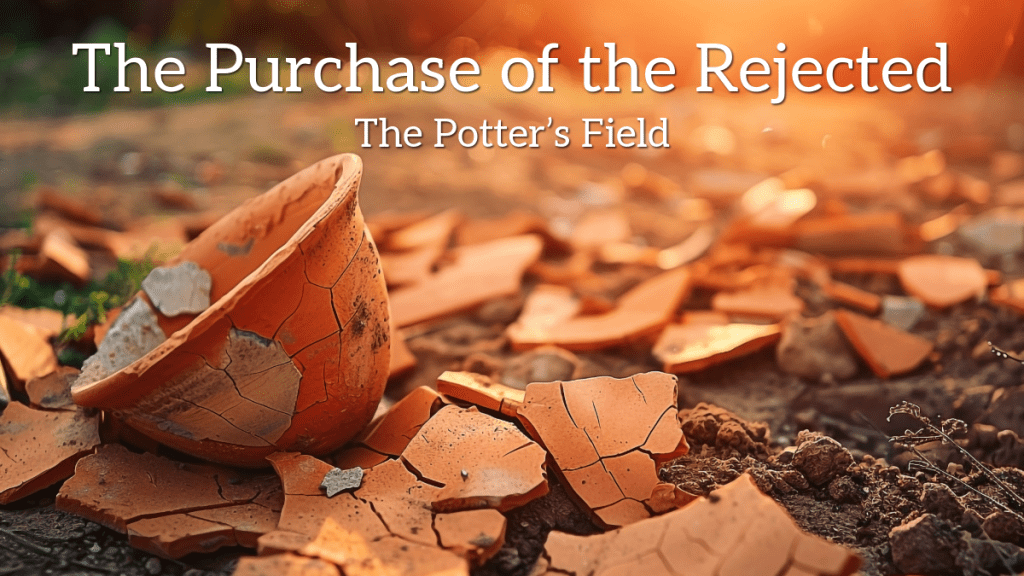
Yet near the potter’s house in the ancient world there was often another sight: a refuse area sometimes called a potter’s field. There lay the discarded fragments—vessels cracked in the kiln, misshapen in design, brittle and unusable. The land itself, exhausted of workable clay and unsuitable for agriculture, became an ideal place to cast aside broken wares. Exposed to weather and trampling feet, they slowly returned to dust. What could not serve the potter’s intended purpose was cast aside.
In time, the phrase “potter’s field” came to signify something even more sobering: a burial ground for the poor, the unclaimed, the stranger, those without name, honor, or family to lay them to rest. It became a place for the forgotten.
It is no accident, then, that during the final hours before the crucifixion of Jesus, the chief priests used the money Judas returned, thirty pieces of silver, the price of betrayal, to purchase “the potter’s field, to bury strangers in” (Matt. 27:7). In the mysterious providence of God, blood money bought a field of brokenness.
The irony is piercing. The silver used to reject the Righteous One secured a resting place for the rejected of society. What was meant for treachery became, under His sovereign hand, a testimony. Messiah’s betrayal resulted in the purchase of ground associated with discarded fragments and forgotten people. The rejected Messiah was providentially bound to a field of rejects.
This scene in Matthew 27 is more than historical detail; it is theological proclamation. The field stands as a symbol of humanity estranged, cracked by sin, distorted by pride, shattered by the weight of our own striving for acceptance. In our pursuit of belonging, we craft flexible standards of righteousness, adjusting them according to the crowd we wish to please. Yet such self-fashioned acceptance never quiets the human heart. It simply reshapes our anxieties.
The message of the potter’s field is for the misshapen and the overlooked, for the stranger and the sinner, for all who feel consigned to anonymity. It speaks to those who believe they have not met the standard, God’s or man’s.
But it also exposes a deeper, unsettling truth: Christ Himself was rejected. He was the outsider, the nonconforming righteous One whose holiness unsettled the world, “He came to His own, and His own did not receive Him” (Jn. 1:10-11). The fullness of God stood among us, and we deemed Him unworthy of our acceptance. We measured Him by our standards, and found Him wanting.
Yet in His rejection lies our redemption.
When we see beyond our wounded pride and exhausted efforts at self-justification, we behold not a discarded Savior, but the risen Lord seated in glory, inviting the weary to come. Rejection has driven us to labor for peace in all the wrong places. We carry sin like a weight, striving for affirmation that never satisfies. But Messiah calls us to rest.
He does not reject those who come to Him in faith. He renews them. The potter who might have cast aside the flawed vessel instead takes it again in His hands and reshapes it according to His grace and mercy. The field of broken shards becomes, in the gospel, a testimony of purchased hope.
The potter’s field declares that God has already acted. Before we arrived in our brokenness, before we named our shame, the price had been paid. Christ did not merely die for our sins; He died bearing the full weight of our alienation, our rejection of heaven’s righteousness, our resistance to the Father’s will. It was not God who ultimately rejected us; it was we who rejected Him. And still, He loved, as Paul writes, “but God shows his love for us in that while we were still sinners, Christ died for us” (Ro. 5:8). The Apostle John explains, “We love because he first loved us” (1 Jn. 4:19).
When we cease striving for the approval of a broken society, something remarkable happens. The tyranny of rejection loosens its grip. We no longer define ourselves by who excludes us, nor do we spurn the love extended to us in Christ. Acceptance is no longer earned; it is received. Again Paul writes, “Therefore welcome one another as Christ has welcomed you, for the glory of God” (Ro. 15:7).
Once we were fragments in a field of dust. Now, in Him, we are vessels of mercy, bearing treasure not our own. The rejected Christ has purchased the ground of our rejection and transformed it into a testimony of grace. “If anyone is in Christ, he is a new creation; old things have passed away; behold, all things have become new” (2 Cor. 5:17). In the hands of the Potter, even the field of brokenness becomes the beginning of glory.
Maranatha. Shalom.
 the mountain mensch