
“And after six days Jesus took with him Peter and James, and John his brother, and led them up a high mountain by themselves. And he was transfigured before them, and his face shone like the sun, and his clothes became white as light” (Matt. 17:1-2; cf. 17:1-9).
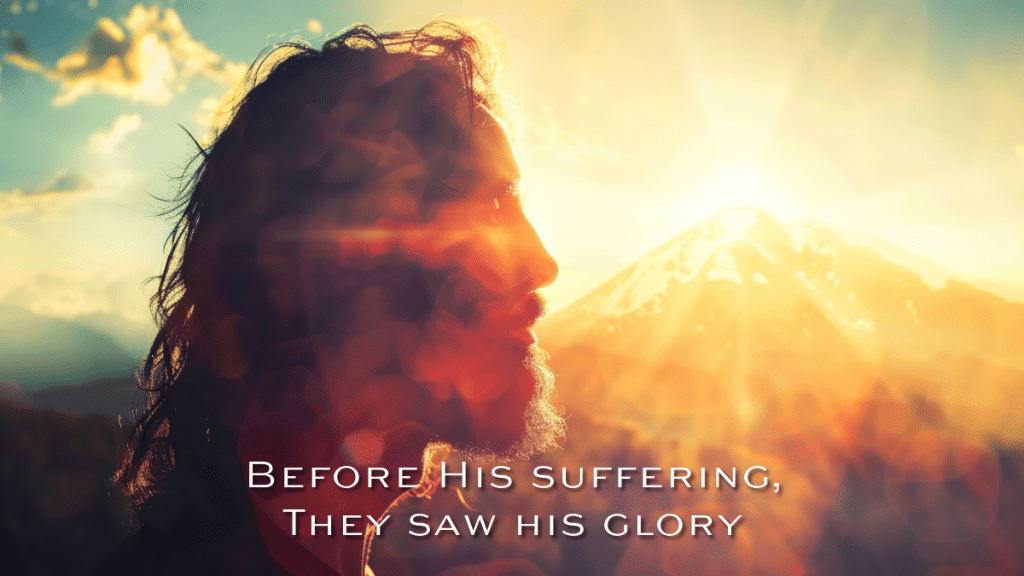
There are moments in Scripture when heaven peels back the veil and let us glimpse the glory that has always been. The Transfiguration of Messiah Yeshua/Jesus is one of those moments. The many times I’ve taught on this event, the focus was on the revelation of who Yeshua is; but it is also a revelation of why He chose these three disciples to witness it.
Matthew tells us that “after six days, Yeshua/Jesus took Peter, James, and John his brother, and led them up a high mountain by themselves.” What happened next was not an accident. It was intentional revelation of the fullness of the Godhead bodily that would also be formational and preparatory for Peter, James and John.
Peter, James, and John formed Yeshua’s inner circle. This does not mean that they were more loved as compared to the others, but they were entrusted with greater responsibility. Before they could carry the weight of leadership after Jesus’ ascension, they needed a revelation of who He truly is.
On the mountain, they saw: His face shining like the sun. His garments gleaming with heavenly light. Moses and Elijah speaking with Him. The Father’s voice declaring, “This is My beloved Son … listen to Him.”
This was not a mystical experience reserved for the most spiritual among the disciples. It was preparation. Leaders cannot shepherd others into a glory they themselves have never seen. Yeshua was forming them for the future: Pentecost, persecution, and the birth of a global Messianic community.
Yeshua’s choices are never random. Each disciple carried a unique weakness that required a unique encounter. Peter, bold but unstable, needed a revelation that would anchor him when his own failures came. James, destined to be the first apostolic martyr, needed courage rooted in the certainty of Messiah’s glory. John, the disciple of love, needed a vision that would shape his lifelong unshakable testimony of Yeshua’s divinity in the face of proto-Gnostic infiltration into the messianic community.
The Transfiguration was not only about Yeshua being revealed; it was about these men being transformed.
Yeshua “led them up a high mountain.” Revelation often requires ascent. Not because God hides Himself on a high mountain, but because “the climb” refines and purifies our attention. The mountains of life become a place where distractions fall away, and only the voice of the Father remains.
Peter, James, and John followed Yeshua upward, in this case physically, but also spiritually, and prophetically. The glory they witnessed was not for the crowds, but for the mission that Jesus would send Peter, James and John on. It was not a mission that would remain on the mountain nestled between three tabernacles, He would lead them through some deep, dark valleys.
Soon these three would see Jesus sweating blood in Gethsemane (Matt. 26:37). They would see Him arrested, beaten, and crucified. They would believe that the messianic hope had ended. Nevertheless, the Transfiguration was heaven’s antidote to despair.
Before they saw Jesus in weakness, they saw Him in glory. Before they saw Him on the cross, they saw Him crowned with light. Before they saw Him die, they saw Him standing with Moses and Elijah, the Law and the Prophets bowing to the One who fulfills them. This moment was a prophetic anchor: the suffering Servant is also the radiant King.
The cloud overshadowed them, and the Father spoke: “This is My beloved Son, with whom I am well pleased; listen to Him.” This was not a suggestion. It was appointing. The Father was redirecting their ears, their loyalties, and their expectations. Moses and Elijah fade. The bright cloud lifts. And then, only Yeshua remains.
This is discipleship in its purest form: when all else fades, only the Messiah stands before us.
Yeshua still invites His disciples up the mountain. Our mountains are not always the same. The way up can be exhausting, but when we reach the top, He reveals Himself in ways that prepare them for the unexpected valleys down below.
The Transfiguration teaches us that His glory precedes our calling, His revelation precedes responsibility, and intimacy with Him precedes our godly impact on others. Yeshua takes us higher so that when life and ministry bring us lower, we remember the One whose face shines like the sun. When the apostle John was isolated on the isle of Patmos, as the revelation opens, he sees that same glorified face, as he writes, “and His face was like the sun shining in full strength” (Rev. 1:16). What a comfort that must have been, just before he received the revelation of the end, and the renewal of all things. Amen.
Maranatha. Shalom.
 the mountain mensch