The imagery of this portion reminds us of the Shepherding Lord leading His flock to their promised pasture. What does the Psalm 23 teach us about the relationship between Shepherd and sheep, pleasant pastures and overshadowed valleys, spiritual drought and refreshing? This song of David has some deep insight into our nature as sheep, and members of the redeemed household of the Lord. Give a listen.
Life, whether we want to think about it or not, is walked out in a valley overshadowed by death (Ps. 23:4). How so? I do not mean this to be melancholic, but the longer you live, the more acquainted you become with death. I remember the first time that death came into my awareness when I was maybe four or five years old and I was told that my great-grandmother had passed away. I am not sure I understood what was told to me, but I remember weeping nonetheless. Now, I know why we weep, and how important it is to mourn.
That valley can become evident suddenly, without warning; or, it may be a longer journey of goodbye. Yet, in the midst of that valley, David reminds us, “Yea, though I walk through the valley of the shadow of death, I will fear no evil: for thou art with me.” You, O Lord, are with us even when death overshadows us.
Every week our congregation says a corporate prayer called the Mourners Kaddish, or just the Kaddish (קדיש). It is a prayer sanctifying the name of the Lord even in our times of sorrow. But more personally, when we are mourning among others, in community, there is someone beside us to say “Amen,” especially when we cannot. As Paul encourages: “Rejoice with those who rejoice, weep with those who weep” (Ro. 12:15).
In this week’s Torah portion called רְאֵה/Re’eh, Behold, we find a very short word of direction in times of mourning. In Deuteronomy 14:1-2 we read:
“You are the sons of the Lord your God. You shall not cut yourselves or make any baldness on your foreheads for the dead. For you are a people holy to the Lord your God, and the Lord has chosen you to be a people for his treasured possession, out of all the peoples who are on the face of the earth.”
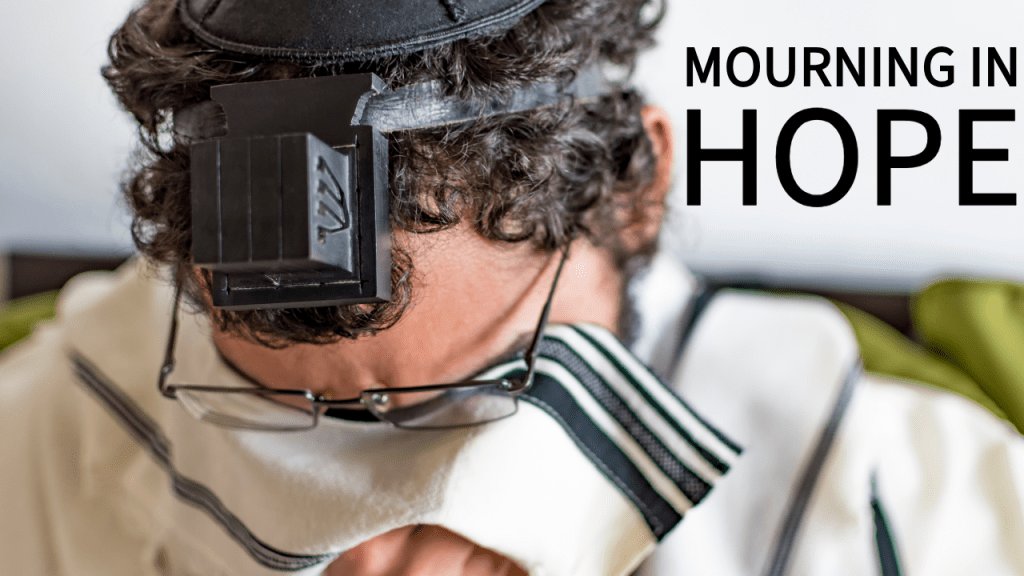
This direction in mourning is nearly unnoticeable: “you shall not make any baldness on your foreheads for the dead.” Why? Not simply to avoid the practice of other people groups, but because of what is put on the forehead, on that very spot: God’s Promises.
Most people have seen pictures of תְּפִילִּין/Tefillin, or phylacteries, but have limited understanding of what they are for. The command for תְּפִילִּין/Tefillin is found in Exodus 13:9; 13:16; Deuteronomy 6:8; and 11:18. These four paragraphs are written on parchments inserted into the תְּפִילִּין/Tefillin. Deuteronomy 6:4-9 explains, the Word is to be applied to the head and the hand in order to demonstrate the love of God with all our heart, mind/soul, and strength. So they are placed on the arm adjacent to the heart and on the head above the brain to demonstrate that with our heart and mind we are willing to serve to the Lord.
Rather than marring the flesh while in mourning, we apply the promises of God to our life as His sons and daughters, as death for us has lost its sting.
The Apostle Paul encourages, “But we do not want you to be uninformed, brothers, about those who are asleep, that you may not grieve as others do who have no hope” (1 Thess. 4:13). In Messiah, we do not mourn as those who have no hope. We mourn, yes; but we are not without hope. Mourning is not sinful, and neither is it a symptom of weak faith. It is a time to recognize loss, and to allow others in to say “Amen.” We do not mourn as one without hope, why? Paul continues:
“For since we believe that Jesus died and rose again, even so, through Jesus, God will bring with him those who have fallen asleep” (1 Thess. 4:14). There is the hope that we find only in Messiah, as Paul writes, “remember that you were at that time separated from Christ, alienated from the commonwealth of Israel and strangers to the covenants of promise, having no hope and without God in the world” (Eph. 2:12).
Yeshua/Jesus, the Word and Promise of the Lord made flesh grieved, not so that we would not have to, but for us to know that we are permitted to. Still, our grief is informed by the Gospel. We do not mar the flesh in sorrow. We mourn in the sure and certain hope of the Resurrection. Mourning in hope directs us away from death, to life eternal, with His promises applied to our hearts and minds, remembering:
“He will wipe away every tear from their eyes, and death shall be no more, neither shall there be mourning, nor crying, nor pain anymore, for the former things have passed away” (Rev. 21:4).
In this portion, Moses reminds Israel of their miraculous provision from heaven, but then stresses, “Man shall not live by bread alone, but by every word that comes from the mouth of God.” This is a statement of not only provision, but also mission. How does this reminder inform us spiritually and supernaturally? Give a listen!


 the mountain mensch