
What’s wrong with leftovers? I like leftovers. Do you? Well, there is an issue with leftovers concerning certain sacrifices. What lesson do we learn from the leftovers, or lack thereof? Is there a life lesson for us in this today? Give a listen!

What’s wrong with leftovers? I like leftovers. Do you? Well, there is an issue with leftovers concerning certain sacrifices. What lesson do we learn from the leftovers, or lack thereof? Is there a life lesson for us in this today? Give a listen!
There are times in the Torah cycle when it seems like deja vu. In last week’s portion of Vayikra, “And He called,” we read of the sacrifices repeated in the portion called צַו/tzav, “command.” Yet, just after the law of the offerings (Lev. 7:37-38), Moses writes of the consecration of Aaron and his sons (Lev. 8:1-36). There is a rather touching, and prophetic moment, when Moses wraps Aaron in his high priestly vestments.
In Leviticus 8:6 the Torah records: וַיַּקְרֵב מֹשֶׁה אֶת־אַהֲרֹן וְאֶת־בָּנָיו, “And Moses brought Aaron and his sons …” To begin this process, Moses washes Aaron and his sons. Still, there is language here that is sacrificial in nature, which can be easily missed: וַיַּקְרֵב/vayakreiv, translated “brought.” We are familiar with the root of וַיַּקְרֵב/vayakreiv, קָרַב/qāraḇ, meaning to bring near, offer or present. It is the root of קָרְבָּן/qārbān, offering or sacrifice.
The Torah is telling us that Aaron and his sons become the first sacrifice of the Tabernacle, as they were prepared before the first sacrifices were given. The language of dressing Aaron is also reminiscent of Abraham binding Isaac (Gen. 22:9), as Aaron and his sons are brought near as living sacrifices unto the Lord (Ro. 12:1). When Aaron is wrapped and bound in his garments he is a living sacrifice unto the Lord. He belongs entirely to the Lord, and the ministry of service in the Tabernacle. He and his sons will have no inheritance in the Promised Land, save for the Lord Himself.
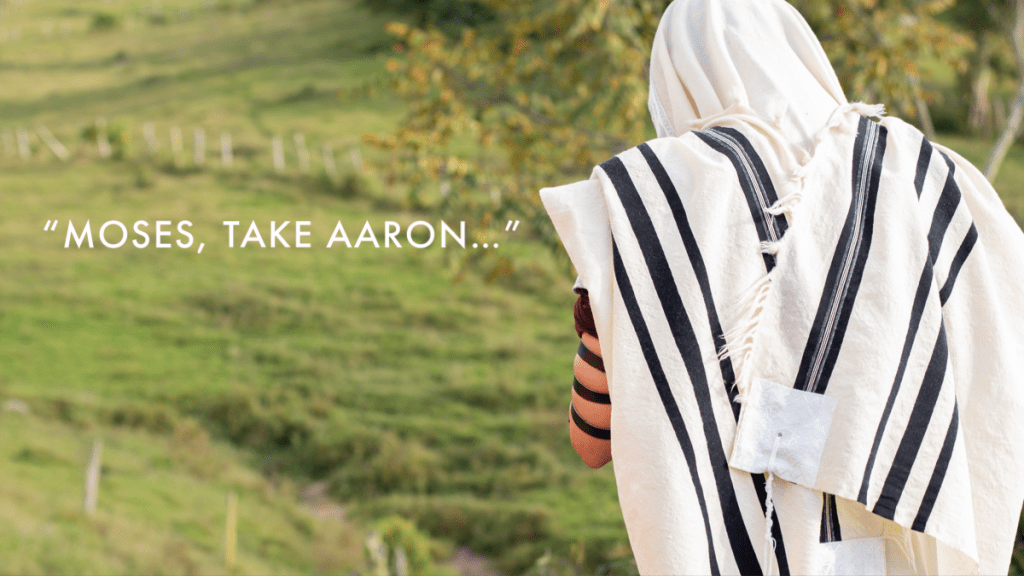
When the Lord commands Moses to consecrate Aaron and his sons (Lev. 8:2), the Torah reads, קַח אֶת־אַהֲרֹן, “Take Aaron …” These words we find again in Numbers 20:25, at the end of Aaron’s life, קַח אֶת־אַהֲרֹן, “Take Aaron …” Why this repetition? In Leviticus 8:2, Moses is taking Aaron in order to dress him for priesthood. In Numbers 20:25, Moses is taking Aaron to undress him for death. Can you imagine?
Moses takes Aaron, washing and dressing him for ministry. Years later, he takes Aaron to undress him for death. Aaron’s sacrifice had been completed and accepted, he would be gathered to his people (Num. 20:24). Aaron’s end was there in his beginning, with his brother Moses. The one who adorned him in new life and purpose, would also prepare him for eternity.
When Aaron was adorned in the high priestly vestments, the glory of the Lord was wrapped in the image of a man (Jn. 1:14). So adorned, it was not Aaron who shined, but the Lord Himself. Aaron, in the process of renewal, would take on the godly qualities represented by the priestly garments. In the end, it was not Aaron, it was the Lord.
Moses shows us that by calling, as Aaron and his sons were called, the Lord adorns and wraps us. In this sacrificial language, we offer ourselves up as a living sacrifice, our reasonable worship unto the Lord (Ro. 12:1). What does this mean for us today?
In Galatians 3:27 Paul writes, “For as many of you as were baptized into Messiah have put on Messiah.” Further, Ephesians 4:24, “and that you put on the new man which was created according to God, in true righteousness and holiness.” In Greek “put on” is ἐνδύω/endyō meaning to “sink into” or “saturate with.” In Hebrew “put on,” לָבַשׁ, means to “wrap in” or “perfectly fit.”
What is revealed by this language is simple understand, yet difficult to live: as with Aaron, we take on the qualities of the garment we are clothed in. “Put on the Lord Yeshua/Jesus Messiah,” Paul wrote, or as some translations render it: “clothe yourselves with the Lord Jesus Christ.” Be saturated with the qualities of Messiah. Saturated or wrapped in Him, there is no room for us to “show off the old man” when living with the human community.
The Father in Heaven draws us to Messiah (Jn. 6:44). The rabbis, specifically Rashi, speculate that Aaron did not desire or want the position of high priest, rather he had to be persuaded by Moses. This we find echoed in the words of Messiah. The language of “draw” as Yeshua uses it is rather unpleasant. It basically means to drag, as the result of an inward pull. The sin man does not want Christ, but conviction of sin by the Holy Spirit draws us to Him, and in Him, redeemed, we become as a living sacrifice (Ro. 12:1; cf. 1 Pet. 2:9).
When Moses dressed and undressed Aaron, he did so from death to life. In Messiah, death now having lost its sting (1 Cor. 15:55-57), we are clothed, not in earthly vestment, but in His resurrection and life (Jn. 11:25). And wrapped in Him, when our deployment comes to an end, we rest in Him, clothed in Him, our nakedness and shame forgiven and eternally covered in Him. Wrapped in His life, we shine forth His life into the world around us. Maranatha.
Be well. Shalom.
This week we begin the Book of Leviticus. Often, people find Leviticus a difficult book to study. With the subject of sacrifice, ritual purity and impurity, clean and unclean foods, leprosy, holy time, and a season of release, what does any of this have to do with faith in Messiah Yeshua/Jesus?
This week we consider “calling,” as Vayikra means, “And He called.” The life of Moses provides a wonderful way to enter the heart of Leviticus, and we being with calling, a word of relationship. Give a listen!
 the mountain mensch